QUESTION IMAGE
Question
4.
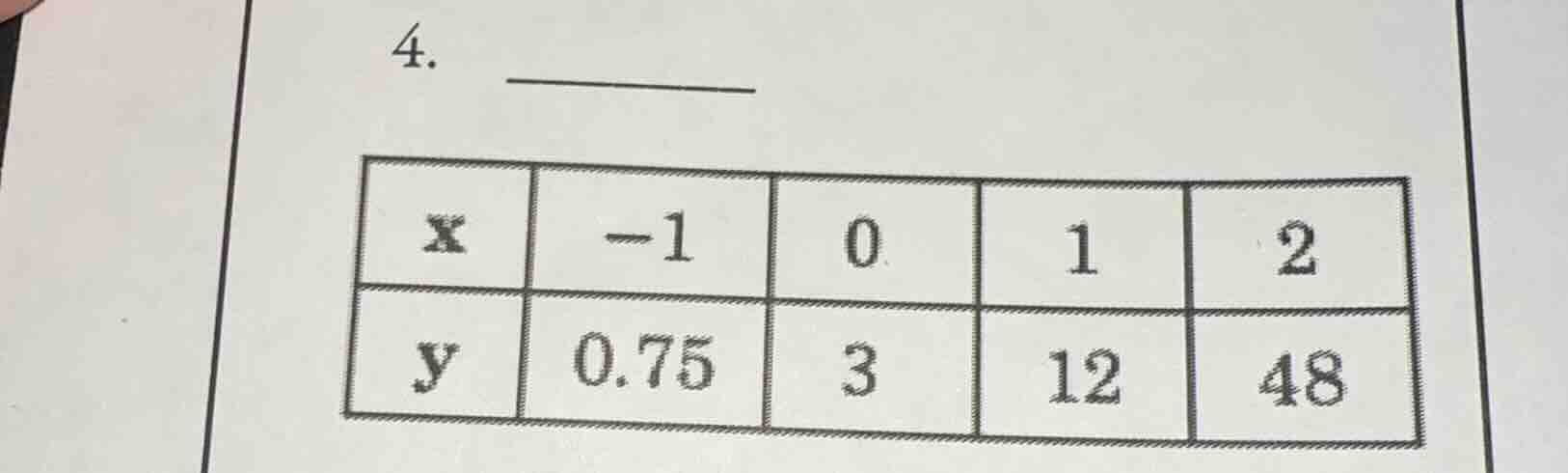
x | -1 | 0 | 1 | 2
y | 0.75 | 3 | 12 | 48
To determine the function that relates \( x \) and \( y \), we analyze the given table:
Step 1: Check for a pattern (exponential or linear)
Let's see the ratio between consecutive \( y \)-values:
- From \( x = -1 \) to \( x = 0 \): \( \frac{3}{0.75} = 4 \)
- From \( x = 0 \) to \( x = 1 \): \( \frac{12}{3} = 4 \)
- From \( x = 1 \) to \( x = 2 \): \( \frac{48}{12} = 4 \)
The common ratio is \( 4 \), so this is an exponential function.
Step 2: General form of an exponential function
The general form of an exponential function is \( y = ab^x \), where \( a \) is the initial value (when \( x = 0 \)) and \( b \) is the base (common ratio).
Step 3: Determine \( a \) and \( b \)
- When \( x = 0 \), \( y = 3 \). So, \( a = 3 \) (since \( y = ab^0 = a \cdot 1 = a \)).
- The common ratio \( b = 4 \) (from the ratios calculated above).
Thus, the function is \( y = 3 \cdot 4^x \).
Let's verify with \( x = -1 \):
\( y = 3 \cdot 4^{-1} = 3 \cdot \frac{1}{4} = 0.75 \), which matches the table.
With \( x = 1 \):
\( y = 3 \cdot 4^1 = 12 \), which matches.
With \( x = 2 \):
\( y = 3 \cdot 4^2 = 3 \cdot 16 = 48 \), which also matches.
So the function is \( y = 3 \cdot 4^x \).
If the question was to find the equation of the function, the answer is \( \boldsymbol{y = 3 \cdot 4^x} \).

Snap & solve any problem in the app
Get step-by-step solutions on Sovi AI
Photo-based solutions with guided steps
Explore more problems and detailed explanations
To determine the function that relates \( x \) and \( y \), we analyze the given table:
Step 1: Check for a pattern (exponential or linear)
Let's see the ratio between consecutive \( y \)-values:
- From \( x = -1 \) to \( x = 0 \): \( \frac{3}{0.75} = 4 \)
- From \( x = 0 \) to \( x = 1 \): \( \frac{12}{3} = 4 \)
- From \( x = 1 \) to \( x = 2 \): \( \frac{48}{12} = 4 \)
The common ratio is \( 4 \), so this is an exponential function.
Step 2: General form of an exponential function
The general form of an exponential function is \( y = ab^x \), where \( a \) is the initial value (when \( x = 0 \)) and \( b \) is the base (common ratio).
Step 3: Determine \( a \) and \( b \)
- When \( x = 0 \), \( y = 3 \). So, \( a = 3 \) (since \( y = ab^0 = a \cdot 1 = a \)).
- The common ratio \( b = 4 \) (from the ratios calculated above).
Thus, the function is \( y = 3 \cdot 4^x \).
Let's verify with \( x = -1 \):
\( y = 3 \cdot 4^{-1} = 3 \cdot \frac{1}{4} = 0.75 \), which matches the table.
With \( x = 1 \):
\( y = 3 \cdot 4^1 = 12 \), which matches.
With \( x = 2 \):
\( y = 3 \cdot 4^2 = 3 \cdot 16 = 48 \), which also matches.
So the function is \( y = 3 \cdot 4^x \).
If the question was to find the equation of the function, the answer is \( \boldsymbol{y = 3 \cdot 4^x} \).