QUESTION IMAGE
Question
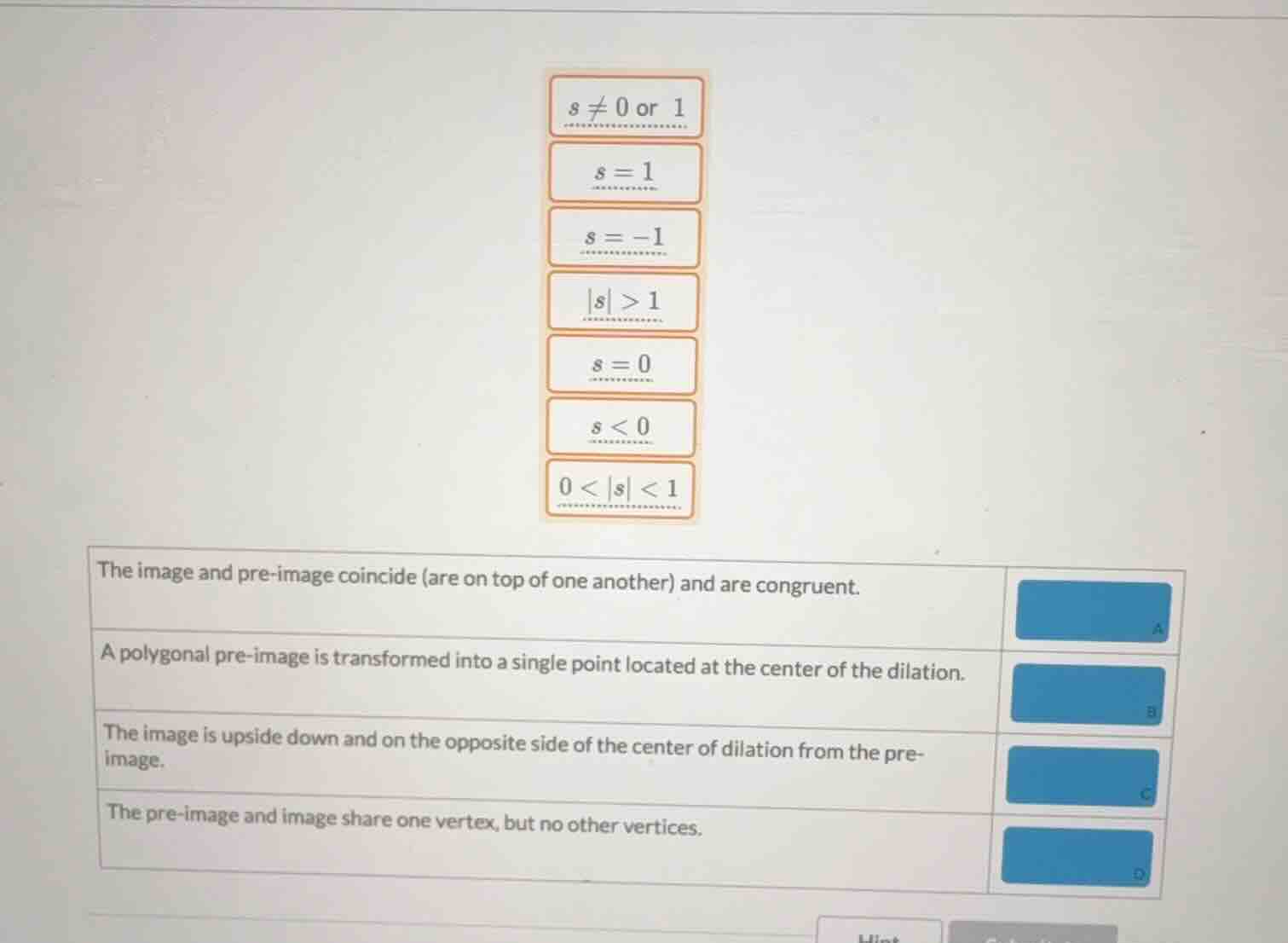
s ≠ 0 or 1; s = 1; s = -1; |s| > 1; s = 0; s < 0; 0 < |s| < 1. the image and pre - image coincide (are on top of one another) and are congruent. a polygonal pre - image is transformed into a single point located at the center of the dilation. the image is upside down and on the opposite side of the center of dilation from the pre - image. the pre - image and image share one vertex, but no other vertices.
To solve this, we analyze each statement based on the properties of dilation (scale factor \( s \)):
1. "The image and pre - image coincide (are on top of one another) and are congruent."
- When \( s = 1 \), the scale factor is 1. A dilation with a scale factor of 1 means that each point of the pre - image is mapped to itself (since \( (x,y)\to(1\times x,1\times y)=(x,y) \)). So the image and pre - image coincide and are congruent. So this matches \( s = 1 \).
2. "A polygonal pre - image is transformed into a single point located at the center of the dilation."
- When \( s = 0 \), the scale factor is 0. For any point \( (x,y) \) in the pre - image, after dilation \( (x,y)\to(0\times x,0\times y)=(0,0) \) (assuming the center of dilation is at the origin, in general, it will map to the center of dilation). So a polygonal pre - image will be transformed into a single point at the center of dilation. This matches \( s = 0 \).
3. "The image is upside down and on the opposite side of the center of dilation from the pre - image."
- When \( s=- 1 \), the scale factor is - 1. A dilation with \( s = - 1 \) reflects the pre - image over the center of dilation (since \( (x,y)\to(-1\times x,-1\times y)=(-x,-y) \)) and the image is congruent to the pre - image. The negative sign means the image is on the opposite side of the center of dilation from the pre - image, and "upside down" can be associated with this reflection - like transformation. So this matches \( s=-1 \).
4. "The pre - image and image share one vertex, but no other vertices."
- When \( 0<|s|<1 \) or \( |s| > 1 \) (but let's think about the case of a non - 1, non - 0, non - negative - 1 scale factor). If we have a dilation where the scale factor is not 1, 0, or - 1, and we consider a polygon, if the scale factor is such that the image is either enlarged (\( |s|>1 \)) or reduced (\( 0 < |s|<1 \)) and the center of dilation is at a vertex of the pre - image, then the image will share that vertex (since the vertex at the center of dilation will map to itself) and no other vertices (because the other vertices will be scaled and moved). Also, \( s
eq0 \) or \( 1 \) can be part of this. But more precisely, if we consider a dilation with the center at a vertex of the pre - image, for \( s
eq0,1,- 1 \), the image will share that vertex. However, among the given options, the description "share one vertex, but no other vertices" is consistent with a dilation where the center of dilation is at a vertex of the pre - image and \( s
eq0,1,-1 \). But if we have to choose from the given scale - factor descriptions, when \( s
eq0 \) or \( 1 \) (but actually, the key is the position of the center of dilation). Alternatively, if the center of dilation is not at a vertex, but for the sake of matching the options, the description "The pre - image and image share one vertex, but no other vertices" can be associated with a dilation where \( s
eq0 \) or \( 1 \) (but more accurately, when the center of dilation is at a vertex and \( s
eq0,1,-1 \)). But from the given options, the best match for a situation where the image is not coinciding, not a single point, not a reflection over the center (with \( s=-1 \)), is \( s
eq0 \) or \( 1 \) (but actually, the correct match for "share one vertex" is when the center of dilation is at a vertex and \( s
eq0,1,-1 \), but among the given scale - factor boxes, the description fits with \( s
eq0 \) or \( 1 \) (or the scale - factor conditions for non - trivial dilation with center at a vertex). However, if we re - evaluate:
Wait, let's co…

Snap & solve any problem in the app
Get step-by-step solutions on Sovi AI
Photo-based solutions with guided steps
Explore more problems and detailed explanations
To solve this, we analyze each statement based on the properties of dilation (scale factor \( s \)):
1. "The image and pre - image coincide (are on top of one another) and are congruent."
- When \( s = 1 \), the scale factor is 1. A dilation with a scale factor of 1 means that each point of the pre - image is mapped to itself (since \( (x,y)\to(1\times x,1\times y)=(x,y) \)). So the image and pre - image coincide and are congruent. So this matches \( s = 1 \).
2. "A polygonal pre - image is transformed into a single point located at the center of the dilation."
- When \( s = 0 \), the scale factor is 0. For any point \( (x,y) \) in the pre - image, after dilation \( (x,y)\to(0\times x,0\times y)=(0,0) \) (assuming the center of dilation is at the origin, in general, it will map to the center of dilation). So a polygonal pre - image will be transformed into a single point at the center of dilation. This matches \( s = 0 \).
3. "The image is upside down and on the opposite side of the center of dilation from the pre - image."
- When \( s=- 1 \), the scale factor is - 1. A dilation with \( s = - 1 \) reflects the pre - image over the center of dilation (since \( (x,y)\to(-1\times x,-1\times y)=(-x,-y) \)) and the image is congruent to the pre - image. The negative sign means the image is on the opposite side of the center of dilation from the pre - image, and "upside down" can be associated with this reflection - like transformation. So this matches \( s=-1 \).
4. "The pre - image and image share one vertex, but no other vertices."
- When \( 0<|s|<1 \) or \( |s| > 1 \) (but let's think about the case of a non - 1, non - 0, non - negative - 1 scale factor). If we have a dilation where the scale factor is not 1, 0, or - 1, and we consider a polygon, if the scale factor is such that the image is either enlarged (\( |s|>1 \)) or reduced (\( 0 < |s|<1 \)) and the center of dilation is at a vertex of the pre - image, then the image will share that vertex (since the vertex at the center of dilation will map to itself) and no other vertices (because the other vertices will be scaled and moved). Also, \( s
eq0 \) or \( 1 \) can be part of this. But more precisely, if we consider a dilation with the center at a vertex of the pre - image, for \( s
eq0,1,- 1 \), the image will share that vertex. However, among the given options, the description "share one vertex, but no other vertices" is consistent with a dilation where the center of dilation is at a vertex of the pre - image and \( s
eq0,1,-1 \). But if we have to choose from the given scale - factor descriptions, when \( s
eq0 \) or \( 1 \) (but actually, the key is the position of the center of dilation). Alternatively, if the center of dilation is not at a vertex, but for the sake of matching the options, the description "The pre - image and image share one vertex, but no other vertices" can be associated with a dilation where \( s
eq0 \) or \( 1 \) (but more accurately, when the center of dilation is at a vertex and \( s
eq0,1,-1 \)). But from the given options, the best match for a situation where the image is not coinciding, not a single point, not a reflection over the center (with \( s=-1 \)), is \( s
eq0 \) or \( 1 \) (but actually, the correct match for "share one vertex" is when the center of dilation is at a vertex and \( s
eq0,1,-1 \), but among the given scale - factor boxes, the description fits with \( s
eq0 \) or \( 1 \) (or the scale - factor conditions for non - trivial dilation with center at a vertex). However, if we re - evaluate:
Wait, let's correct the fourth one. If the center of dilation is at a vertex of the pre - image, and the scale factor \( s
eq0,1,-1 \), then the vertex at the center will map to itself (so share that vertex), and the other vertices will be scaled. So the pre - image and image share one vertex (the center vertex) and no other vertices. So the scale factor here is \( s
eq0 \) or \( 1 \) (since \( s = 1 \) would make them coincide, \( s = 0 \) would make it a point, \( s=-1 \) would reflect it). So the fourth statement matches \( s
eq0 \) or \( 1 \).
Final Matches:
- "The image and pre - image coincide (are on top of one another) and are congruent." → \( s = 1 \)
- "A polygonal pre - image is transformed into a single point located at the center of the dilation." → \( s = 0 \)
- "The image is upside down and on the opposite side of the center of dilation from the pre - image." → \( s=-1 \)
- "The pre - image and image share one vertex, but no other vertices." → \( s
eq0 \) or \( 1 \) (or the scale - factor conditions for non - 1, non - 0, non - negative - 1 dilation with center at a vertex)
If we are to fill the boxes:
- Box A (first row): \( s = 1 \)
- Box B (second row): \( s = 0 \)
- Box C (third row): \( s=-1 \)
- Box D (fourth row): \( s
eq0 \) or \( 1 \) (or the appropriate scale - factor box, like \( s
eq0 \) or \( 1 \))
But to present the answers as per the matching:
- For "The image and pre - image coincide (are on top of one another) and are congruent." the answer is \( s = 1 \)
- For "A polygonal pre - image is transformed into a single point located at the center of the dilation." the answer is \( s = 0 \)
- For "The image is upside down and on the opposite side of the center of dilation from the pre - image." the answer is \( s=-1 \)
- For "The pre - image and image share one vertex, but no other vertices." the answer is \( s
eq0 \) or \( 1 \)
If we consider the options in the boxes:
- First statement: \( s = 1 \)
- Second statement: \( s = 0 \)
- Third statement: \( s=-1 \)
- Fourth statement: \( s
eq0 \) or \( 1 \) (the box with \( s
eq0 \) or \( 1 \))
So, to summarize the answers for each row (from top to bottom in the table):
- \( s = 1 \)
- \( s = 0 \)
- \( s=-1 \)
- \( s
eq0 \) or \( 1 \) (or the box with \( s
eq0 \) or \( 1 \))
If we are to write the answers in the order of the table rows (A, B, C, D as per the blue boxes):
- A: \( s = 1 \)
- B: \( s = 0 \)
- C: \( s=-1 \)
- D: \( s
eq0 \) or \( 1 \)
(Note: The fourth one can also be associated with \( 0<|s|<1 \) or \( |s|>1 \) in some cases, but the key is the sharing of one vertex which happens when the center of dilation is at a vertex and the scale factor is not 0, 1, or - 1, so \( s
eq0 \) or \( 1 \) is a better match among the given boxes.)