QUESTION IMAGE
Question
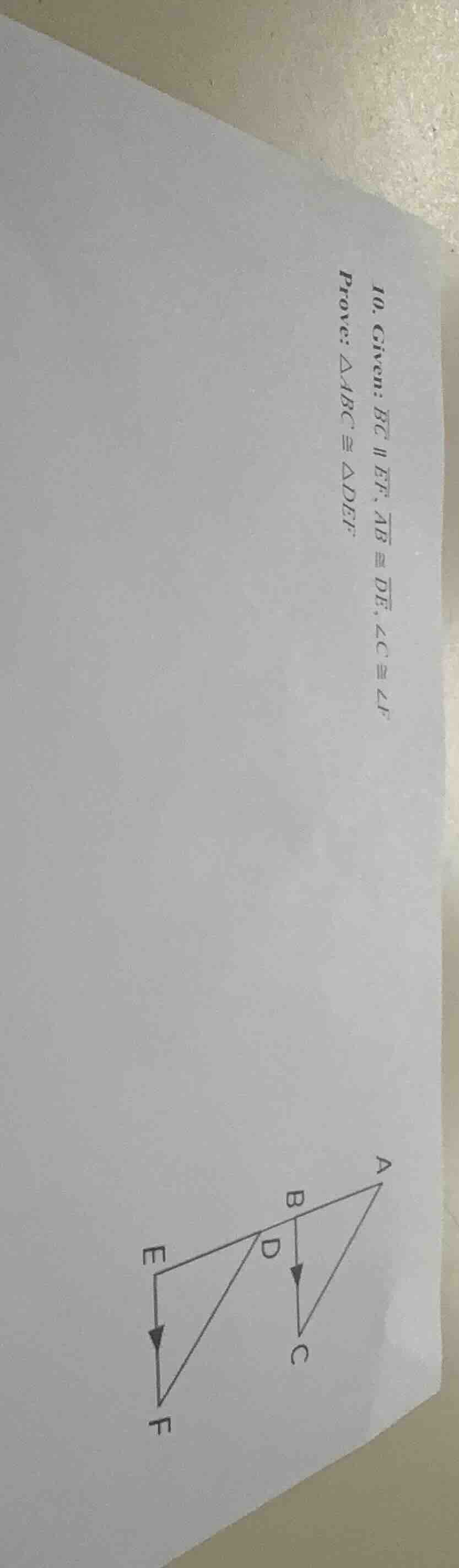
- given: $bc \parallel ef$, $\overline{ab} \cong \overline{de}$, $\angle c \cong \angle f$
prove: $\triangle abc \cong \triangle def$
Step1: Identify corresponding angles
Since $\overline{BC} \parallel \overline{EF}$, the corresponding angles formed by transversal $\overline{AC}$ are congruent: $\angle ABC \cong \angle DEF$.
Step2: List given congruent parts
We know:
- $\overline{AB} \cong \overline{DE}$ (Given)
- $\angle ABC \cong \angle DEF$ (From Step1)
- $\angle C \cong \angle F$ (Given)
Step3: Apply AAS congruence rule
By the Angle-Angle-Side (AAS) congruence postulate, if two angles and a non-included side of one triangle are congruent to the corresponding two angles and non-included side of another triangle, the triangles are congruent. Here, $\angle C \cong \angle F$, $\angle ABC \cong \angle DEF$, and $\overline{AB} \cong \overline{DE}$, so $\triangle ABC \cong \triangle DEF$.

Snap & solve any problem in the app
Get step-by-step solutions on Sovi AI
Photo-based solutions with guided steps
Explore more problems and detailed explanations
$\triangle ABC \cong \triangle DEF$ is proven by the AAS congruence postulate.