QUESTION IMAGE
Question
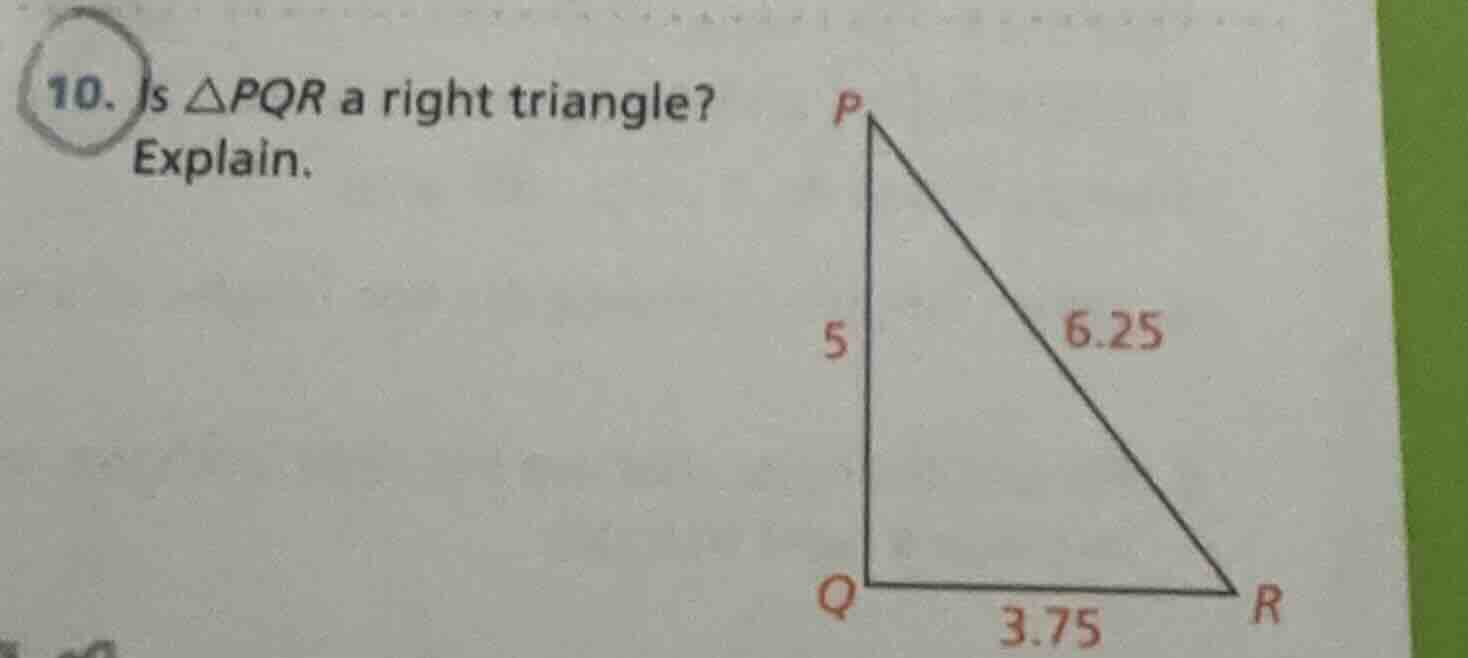
- is △pqr a right triangle? explain.
Step1: Recall Pythagorean theorem
For a triangle to be right - angled, the sum of the squares of the two shorter sides should equal the square of the longest side. Let the sides be \(a = 3.75\), \(b = 5\) and \(c = 6.25\) (where \(c\) is the longest side). The Pythagorean theorem states that \(a^{2}+b^{2}=c^{2}\) for a right - triangle.
Step2: Calculate \(a^{2}+b^{2}\)
First, calculate \(a^{2}\): \(a = 3.75\), so \(a^{2}=(3.75)^{2}=3.75\times3.75 = 14.0625\)
Then, calculate \(b^{2}\): \(b = 5\), so \(b^{2}=5^{2}=25\)
Now, find the sum \(a^{2}+b^{2}\): \(14.0625 + 25=39.0625\)
Step3: Calculate \(c^{2}\)
\(c = 6.25\), so \(c^{2}=(6.25)^{2}=6.25\times6.25 = 39.0625\)
Step4: Compare \(a^{2}+b^{2}\) and \(c^{2}\)
Since \(a^{2}+b^{2}=39.0625\) and \(c^{2}=39.0625\), we have \(a^{2}+b^{2}=c^{2}\)

Snap & solve any problem in the app
Get step-by-step solutions on Sovi AI
Photo-based solutions with guided steps
Explore more problems and detailed explanations
Yes, \(\triangle PQR\) is a right triangle because the sum of the squares of the two shorter sides (\(3.75^{2}+5^{2}\)) is equal to the square of the longest side (\(6.25^{2}\)) (by the Pythagorean theorem).