QUESTION IMAGE
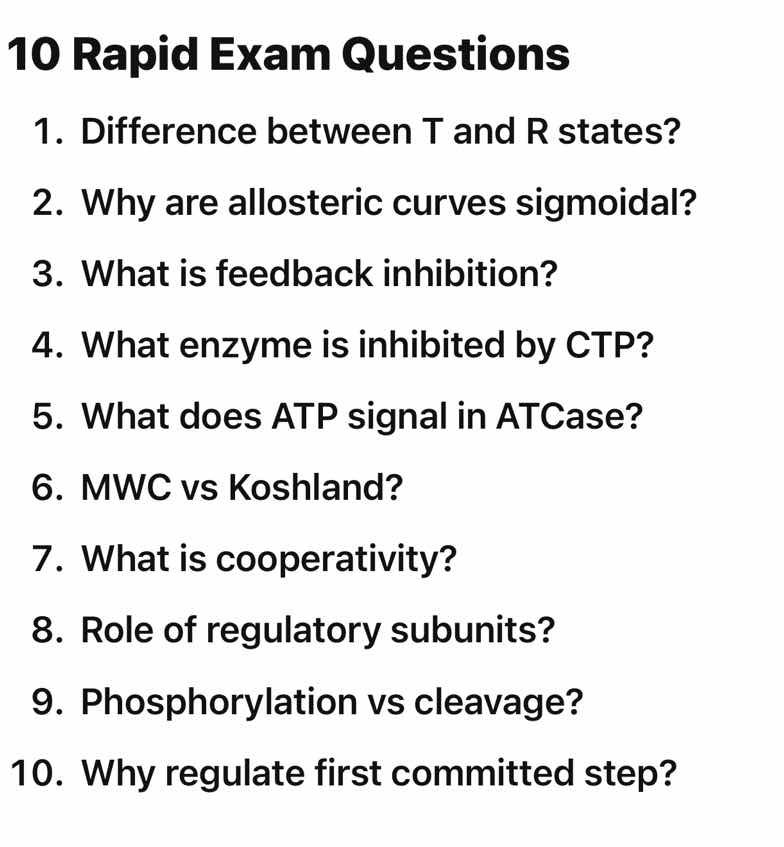
Question
10 rapid exam questions
- difference between t and r states?
- why are allosteric curves sigmoidal?
- what is feedback inhibition?
- what enzyme is inhibited by ctp?
- what does atp signal in atcase?
- mwc vs koshland?
- what is cooperativity?
- role of regulatory subunits?
- phosphorylation vs cleavage?
- why regulate first committed step?
Brief Explanations
- T (tense) state: low substrate affinity, inactive; R (relaxed) state: high substrate affinity, active, seen in allosteric enzymes.
- Sigmoidal curves arise from cooperative substrate binding—binding one substrate increases affinity for subsequent substrates, creating a steep response.
- Feedback inhibition: a metabolic pathway's end product inhibits an early enzyme in the pathway to prevent overproduction.
- CTP inhibits aspartate transcarbamoylase (ATCase), a key enzyme in pyrimidine synthesis.
- ATP signals high energy/abundant purines to ATCase, acting as an activator to promote pyrimidine synthesis (balance purine/pyrimidine levels).
- MWC (concerted model): all subunits switch between T/R states simultaneously; Koshland (sequential model): subunits change state one by one as substrate binds, inducing conformational changes.
- Cooperativity: substrate binding to one enzyme subunit alters affinity of other subunits for substrate, amplifying enzyme response to substrate concentration.
- Regulatory subunits bind allosteric effectors (activators/inhibitors) to modulate the catalytic activity of the enzyme's catalytic subunits.
- Phosphorylation: reversible addition of a phosphate group to regulate enzyme activity; cleavage: irreversible proteolytic cutting of an enzyme to activate it (e.g., zymogens).
- Regulating the first committed step prevents wasted energy/resources on synthesizing unneeded downstream products, controlling the entire pathway efficiently.

Snap & solve any problem in the app
Get step-by-step solutions on Sovi AI
Photo-based solutions with guided steps
Explore more problems and detailed explanations
- T state: low substrate affinity, inactive; R state: high substrate affinity, active.
- Due to cooperative substrate binding.
- End product of a pathway inhibits an early pathway enzyme.
- Aspartate transcarbamoylase (ATCase)
- High cellular energy/abundant purines, acts as an activator.
- MWC: all subunits switch T/R together; Koshland: sequential subunit conformational change.
- Subunit binding alters other subunits' substrate affinity.
- Bind effectors to modulate catalytic subunit activity.
- Phosphorylation: reversible; cleavage: irreversible activation via proteolysis.
- Prevents wasteful synthesis of unneeded pathway products.