QUESTION IMAGE
Question
10)
reflection on translation
(y - axis) (
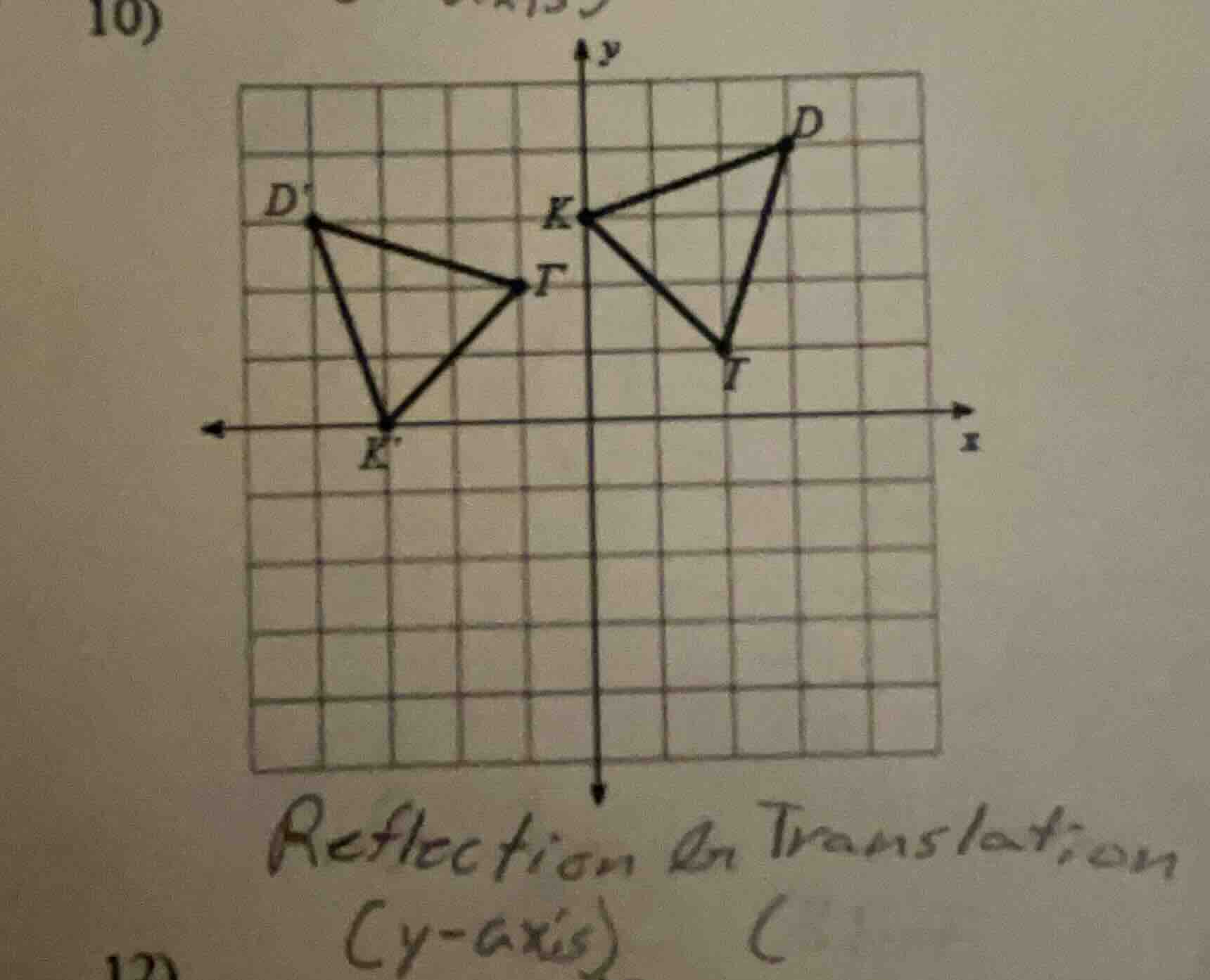
To determine the translation after reflecting over the \( y \)-axis, we analyze the coordinates of corresponding points (e.g., \( K \) and \( K' \), \( T \) and \( T' \), \( D \) and \( D' \)):
Step 1: Reflect over the \( y \)-axis
The reflection rule over the \( y \)-axis is \( (x, y) \to (-x, y) \). For a point \( (x, y) \) on the original figure, its reflection \( (x', y') \) has \( x' = -x \), \( y' = y \).
Step 2: Determine the translation
After reflection, observe the horizontal/vertical shift to map the reflected figure to \( D'E'T' \). For example, take point \( K \) (original) and \( K' \) (reflected then translated):
- Assume \( K \) has coordinates \( (0, 2) \) (from the grid). After reflection over \( y \)-axis, it remains \( (0, 2) \) (since \( x = 0 \)). To reach \( K' \), we shift left (negative \( x \)-direction) or down/up? Wait, re-examining the grid:
- Original \( K \) is at \( (0, 2) \), \( K' \) is at \( (-4, 2) \)? Wait, no—let’s count grid units. From \( K \) (near \( y \)-axis) to \( K' \): horizontal shift left by 4 units (since \( K \) is at \( x = 0 \), \( K' \) is at \( x = -4 \)), vertical shift 0. Similarly, \( T \) (original) at \( (2, 1) \), after reflection over \( y \)-axis: \( (-2, 1) \), then translated left by 2 more? Wait, no—maybe the original figure is \( KTD \), and the reflected-translated is \( K'E'T'D' \).
Wait, perhaps the correct approach is:
- Reflect \( KTD \) over \( y \)-axis: \( K(0,2) \to K(0,2) \) (no change), \( T(2,1) \to T(-2,1) \), \( D(3,3) \to D(-3,3) \).
- Then translate this reflected figure to \( K'E'T'D' \):
- \( K(0,2) \to K'(-4,2) \): shift left 4 units (\( \Delta x = -4 \), \( \Delta y = 0 \)).
- \( T(-2,1) \to T'(-1,1) \)? No, wait the grid: \( T' \) is at \( (-1,1) \)? Wait, maybe my coordinate estimation is off. Alternatively, count the horizontal distance between \( K \) and \( K' \): from \( x = 0 \) to \( x = -4 \), so translation vector is \( (-4, 0) \) (left 4 units, up/down 0).
Final Translation
After reflecting over the \( y \)-axis, the figure is translated 4 units to the left (horizontal shift \( \Delta x = -4 \), \( \Delta y = 0 \)).

Snap & solve any problem in the app
Get step-by-step solutions on Sovi AI
Photo-based solutions with guided steps
Explore more problems and detailed explanations
The translation after reflecting over the \( y \)-axis is \( \boldsymbol{4} \) units to the left (or vector \( (-4, 0) \)).