QUESTION IMAGE
Question
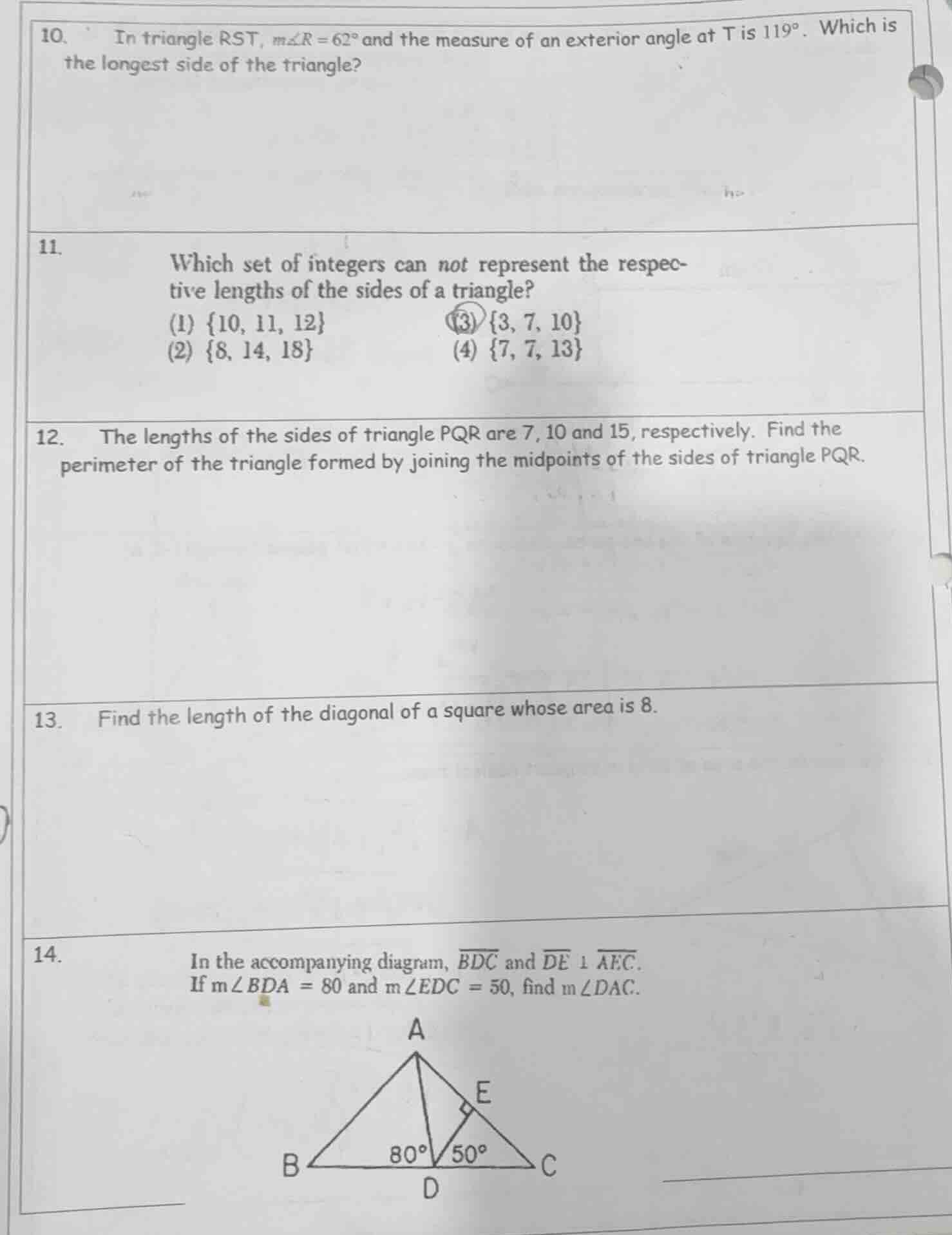
- in triangle rst, ( mangle r = 62^circ ) and the measure of an exterior angle at t is ( 119^circ ). which is the longest side of the triangle?
- which set of integers can not represent the respective lengths of the sides of a triangle?
(1) ( {10, 11, 12} )
(3) ( {3, 7, 10} )
(2) ( {8, 14, 18} )
(4) ( {7, 7, 13} )
- the lengths of the sides of triangle pqr are 7, 10 and 15, respectively. find the perimeter of the triangle formed by joining the midpoints of the sides of triangle pqr.
- find the length of the diagonal of a square whose area is 8.
- in the accompanying diagram, ( overline{bdc} ) and ( overline{de} perp overline{aec} ). if ( mangle bda = 80 ) and ( mangle edc = 50 ), find ( mangle dac ).
Step1: Find ∠RTS in △RST
The exterior angle at T is supplementary to ∠RTS, so:
$m\angle RTS = 180^\circ - 119^\circ = 61^\circ$
Step2: Calculate ∠S in △RST
Sum of angles in a triangle is $180^\circ$:
$m\angle S = 180^\circ - 62^\circ - 61^\circ = 57^\circ$
Step3: Identify longest side
The longest side is opposite the largest angle ($\angle R = 62^\circ$), so it is $\overline{ST}$.
---
Step1: Check triangle inequality for set (1)
Sum of two shortest sides: $10+11=21>12$, valid.
Step2: Check triangle inequality for set (2)
Sum of two shortest sides: $8+14=22>18$, valid.
Step3: Check triangle inequality for set (3)
Sum of two shortest sides: $3+7=10$, which is not greater than 10, invalid.
Step4: Check triangle inequality for set (4)
Sum of two shortest sides: $7+7=14>13$, valid.
---
Step1: Apply midsegment theorem
Each midsegment is $\frac{1}{2}$ the length of the corresponding side of △PQR:
$\frac{7}{2}=3.5$, $\frac{10}{2}=5$, $\frac{15}{2}=7.5$
Step2: Calculate perimeter of new triangle
Add the midsegment lengths:
$3.5 + 5 + 7.5 = 16$
---
Step1: Find side length of the square
Area $A = s^2 = 8$, so side length $s = \sqrt{8} = 2\sqrt{2}$
Step2: Calculate diagonal length
Use Pythagorean theorem for square diagonal $d$:
$d = s\sqrt{2} = 2\sqrt{2} \times \sqrt{2} = 4$
---
Step1: Find ∠ADE
$\angle BDA + \angle ADE + \angle EDC = 180^\circ$, so:
$m\angle ADE = 180^\circ - 80^\circ - 50^\circ = 50^\circ$
Step2: Find ∠DAE in right △ADE
In right triangle $ADE$, $\angle AED = 90^\circ$, so:
$m\angle DAC = 180^\circ - 90^\circ - 50^\circ = 40^\circ$

Snap & solve any problem in the app
Get step-by-step solutions on Sovi AI
Photo-based solutions with guided steps
Explore more problems and detailed explanations
- $\overline{ST}$
- (3) {3, 7, 10}
- 16
- 4
- $40^\circ$