QUESTION IMAGE
Question
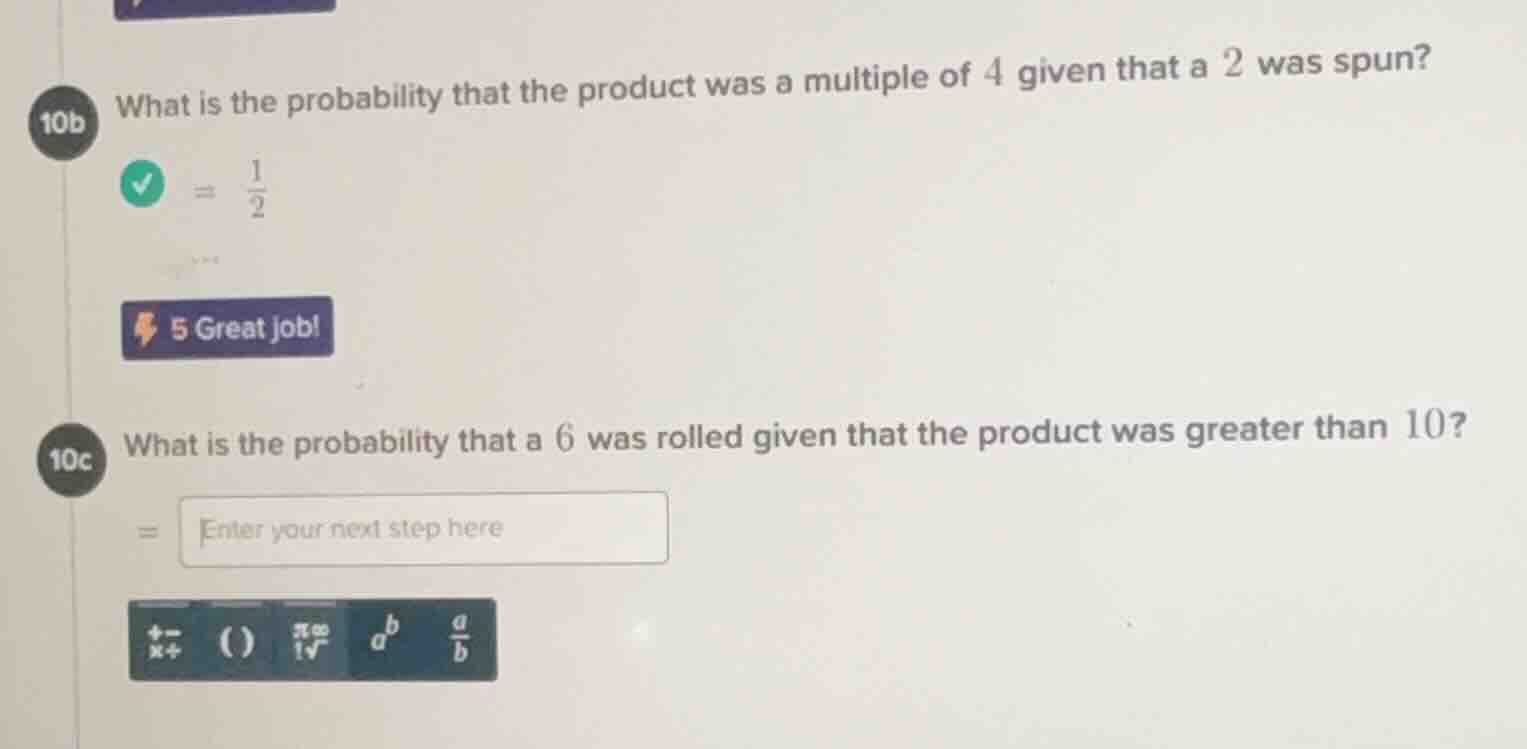
10b what is the probability that the product was a multiple of 4 given that a 2 was spun? = \\(\frac{1}{2}\\) 5 great job! 10c what is the probability that a 6 was rolled given that the product was greater than 10? = enter your next step here
Step1: Identify the context (assuming a spinner and a die, let's say the spinner has numbers and the die is 6 - sided. First, find all products >10. Let's assume spinner numbers (say 1 - 4) and die (1 - 6). Products:
- Spinner 1: Die 1 - 6 → products 1 - 6 (none >10)
- Spinner 2: Die 1 - 6 → 2 - 12 (products >10: 12 (2×6))
- Spinner 3: Die 1 - 6 → 3 - 18 (products >10: 12 (3×4), 15 (3×5), 18 (3×6))
- Spinner 4: Die 1 - 6 → 4 - 24 (products >10: 12 (4×3), 16 (4×4), 20 (4×5), 24 (4×6))
Wait, maybe a common spinner (e.g., spinner with 2, 3, 4; die 1 - 6). Let's re - define: Let spinner have values \( S=\{2,3,4\} \), die \( D = \{1,2,3,4,5,6\} \). Product \( P=S\times D \).
Find \( P>10 \):
- \( S = 2 \): \( 2\times6 = 12>10 \) → 1 outcome
- \( S = 3 \): \( 3\times4 = 12 \), \( 3\times5 = 15 \), \( 3\times6 = 18 \) → 3 outcomes
- \( S = 4 \): \( 4\times3 = 12 \), \( 4\times4 = 16 \), \( 4\times5 = 20 \), \( 4\times6 = 24 \) → 4 outcomes
Total outcomes with \( P>10 \): \( 1 + 3+4=8 \)
Now, outcomes where \( D = 6 \) and \( P>10 \):
- \( S = 2 \): \( 2\times6 = 12 \)
- \( S = 3 \): \( 3\times6 = 18 \)
- \( S = 4 \): \( 4\times6 = 24 \)
So 3 outcomes.
Step2: Apply conditional probability formula \( P(D = 6|P>10)=\frac{\text{Number of outcomes with }D = 6\text{ and }P>10}{\text{Number of outcomes with }P>10} \)
Number of favorable (D = 6, P>10) = 3 (as above: (2,6),(3,6),(4,6))
Number of total (P>10) = 8 (from earlier: (2,6),(3,4),(3,5),(3,6),(4,3),(4,4),(4,5),(4,6))
So \( P=\frac{3}{8} \)? Wait, maybe my initial spinner assumption is wrong. Let's use a standard problem: Suppose spinner has 2, 3, 4 and die 1 - 6. Wait, another common setup: spinner with 2, 3, 4; die 1 - 6. Wait, maybe the spinner is 2, 3, 4 (3 options) and die 6 options.
Wait, let's take a different approach. Let's list all possible products where product >10:
If spinner is 2:
- 2×6 = 12 (only one >10)
If spinner is 3:
- 3×4 = 12, 3×5 = 15, 3×6 = 18 (three >10)
If spinner is 4:
- 4×3 = 12, 4×4 = 16, 4×5 = 20, 4×6 = 24 (four >10)
Total number of outcomes with product >10: 1 + 3+4 = 8
Number of outcomes where 6 was rolled and product >10:
- Spinner 2, die 6: 2×6 = 12
- Spinner 3, die 6: 3×6 = 18
- Spinner 4, die 6: 4×6 = 24
So 3 outcomes.
Thus, probability \(=\frac{3}{8}\)
Wait, maybe the spinner is different. Let's assume spinner has numbers 1 - 4 and die 1 - 6. Then:
Spinner 1: products 1 - 6 (none >10)
Spinner 2: products 2 - 12 (product >10: 12 (2×6))
Spinner 3: products 3 - 18 (products >10: 12 (3×4), 15 (3×5), 18 (3×6))
Spinner 4: products 4 - 24 (products >10: 12 (4×3), 16 (4×4), 20 (4×5), 24 (4×6))
Total outcomes with product >10: 1 (2×6)+3 (3×4,3×5,3×6)+4 (4×3,4×4,4×5,4×6)=8
Outcomes with die 6 and product >10: 2×6, 3×6, 4×6 → 3 outcomes. So probability \(=\frac{3}{8}\)

Snap & solve any problem in the app
Get step-by-step solutions on Sovi AI
Photo-based solutions with guided steps
Explore more problems and detailed explanations
\(\frac{3}{8}\)