QUESTION IMAGE
Question
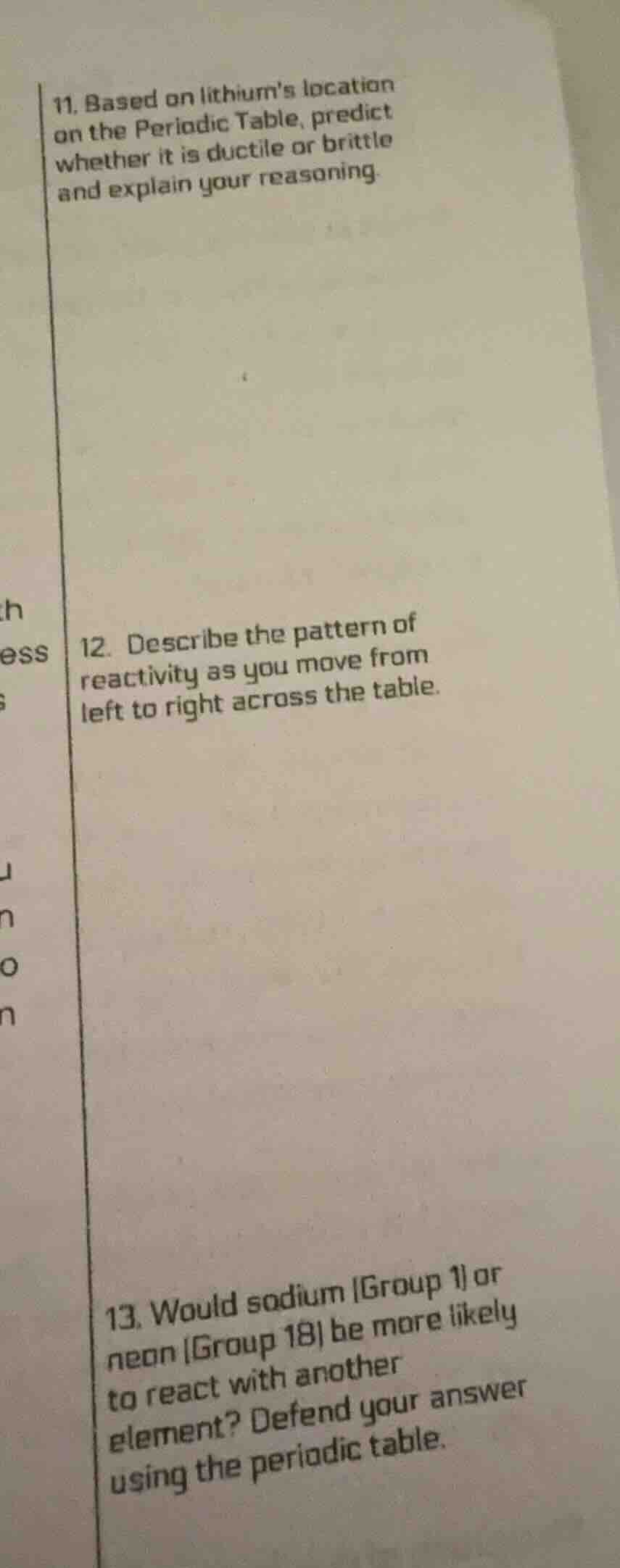
- based on lithiums location on the periodic table, predict whether it is ductile or brittle and explain your reasoning.
- describe the pattern of reactivity as you move from left to right across the table.
- would sodium (group 1) or neon (group 18) be more likely to react with another element? defend your answer using the periodic table.
For Question 11:
Lithium is in Group 1 (alkali metals) of the Periodic Table, which are all metals. Ductility is a key physical property of metals, allowing them to be drawn into wires, while brittleness is a property of nonmetals/metalloids.
For Question 12:
Across a period, metals on the left lose electrons easily, so reactivity decreases left-to-right for metals. Nonmetals on the right gain electrons easily, so reactivity increases left-to-right for nonmetals. Noble gases on the far right are unreactive.
For Question 13:
Sodium is in Group 1, which has 1 valence electron that it readily loses to form a stable octet, making it highly reactive. Neon is in Group 18 (noble gases), which has a full valence electron shell, so it has no tendency to gain/lose electrons and is unreactive.

Snap & solve any problem in the app
Get step-by-step solutions on Sovi AI
Photo-based solutions with guided steps
Explore more problems and detailed explanations
- Lithium is ductile. It is a Group 1 metal, and ductility is a characteristic physical property of metals.
- Moving left to right across a period: Reactivity decreases for metals (as they hold valence electrons more tightly), reactivity increases for nonmetals (as they gain electrons more easily), and reactivity drops to near zero for the noble gases on the far right.
- Sodium (Group 1) is more likely to react with another element. Sodium has only 1 valence electron, which it readily loses to achieve a stable electron configuration, while neon (Group 18) has a full valence electron shell and is chemically inert.