QUESTION IMAGE
Question
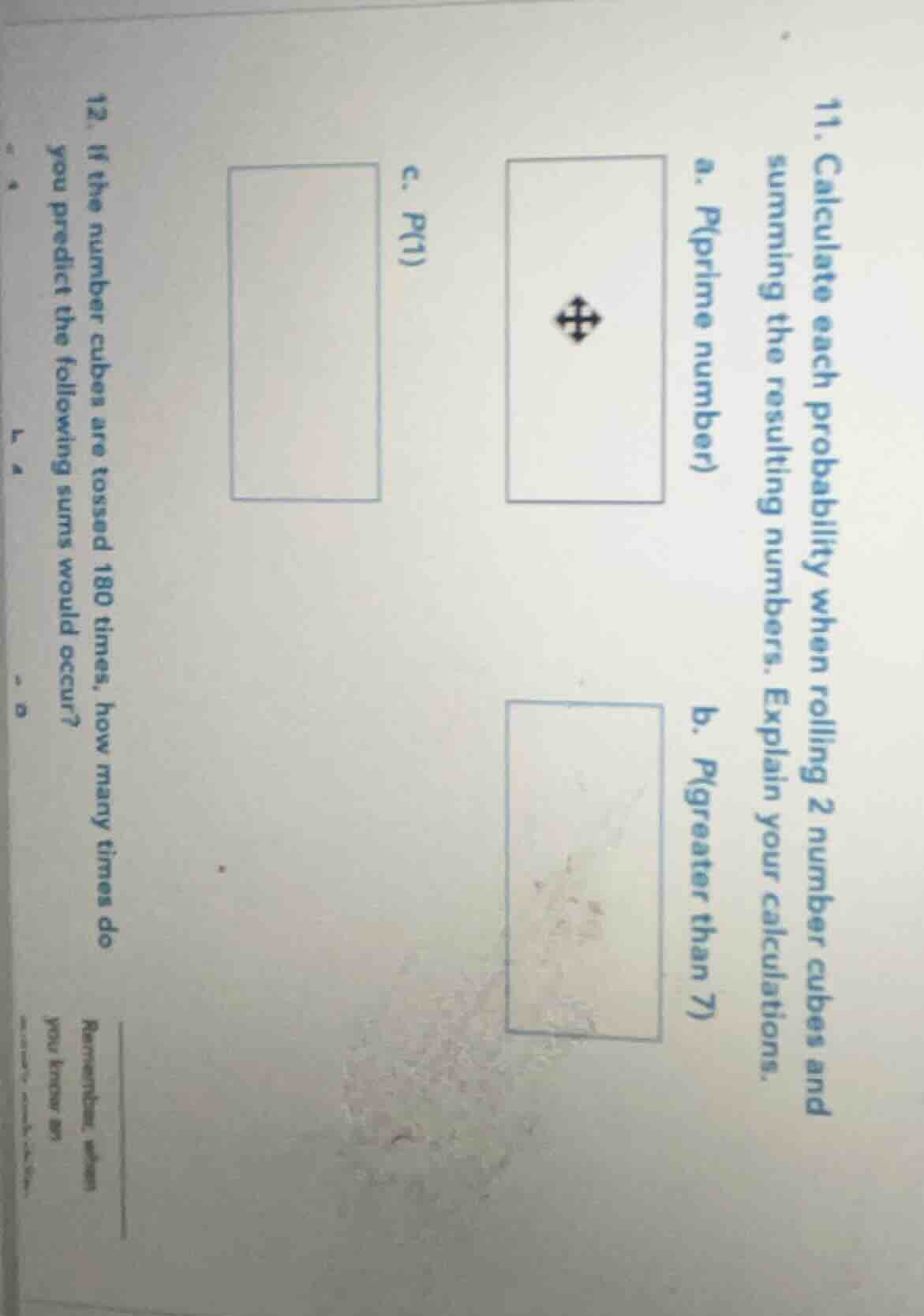
- calculate each probability when rolling 2 number cubes and summing the resulting numbers. explain your calculations.
a. p(prime number)
b. p(greater than 7)
c. p(1)
- if the number cubes are tossed 180 times, how many times do you predict the following sums would occur?
When rolling two number cubes, there are a total of $6 \times 6 = 36$ possible outcomes.
Step1: Identify prime sum outcomes
Prime sums are 2,3,5,7,11.
Count valid pairs:
- Sum=2: (1,1) → 1 outcome
- Sum=3: (1,2),(2,1) → 2 outcomes
- Sum=5: (1,4),(2,3),(3,2),(4,1) → 4 outcomes
- Sum=7: (1,6),(2,5),(3,4),(4,3),(5,2),(6,1) → 6 outcomes
- Sum=11: (5,6),(6,5) → 2 outcomes
Total prime outcomes: $1+2+4+6+2=15$
Probability: $\frac{15}{36} = \frac{5}{12}$
Step2: Identify sums >7 outcomes
Sums >7 are 8,9,10,11,12.
Count valid pairs:
- Sum=8: (2,6),(3,5),(4,4),(5,3),(6,2) → 5 outcomes
- Sum=9: (3,6),(4,5),(5,4),(6,3) → 4 outcomes
- Sum=10: (4,6),(5,5),(6,4) → 3 outcomes
- Sum=11: (5,6),(6,5) → 2 outcomes
- Sum=12: (6,6) → 1 outcome
Total outcomes >7: $5+4+3+2+1=15$
Probability: $\frac{15}{36} = \frac{5}{12}$
Step3: Identify sum=1 outcomes
The minimum sum of two cubes is 2, so there are 0 outcomes where the sum is 1.
Probability: $\frac{0}{36} = 0$
Step4: Predict occurrences for 180 tosses
For each sum category, multiply probability by 180:
- Prime number: $180 \times \frac{5}{12} = 75$
- Greater than 7: $180 \times \frac{5}{12} = 75$
- Sum=1: $180 \times 0 = 0$

Snap & solve any problem in the app
Get step-by-step solutions on Sovi AI
Photo-based solutions with guided steps
Explore more problems and detailed explanations
11.
a. $P(\text{prime number}) = \frac{5}{12}$
b. $P(\text{greater than 7}) = \frac{5}{12}$
c. $P(1) = 0$
12.
- Prime number sum: 75 times
- Sum greater than 7: 75 times
- Sum of 1: 0 times