QUESTION IMAGE
Question
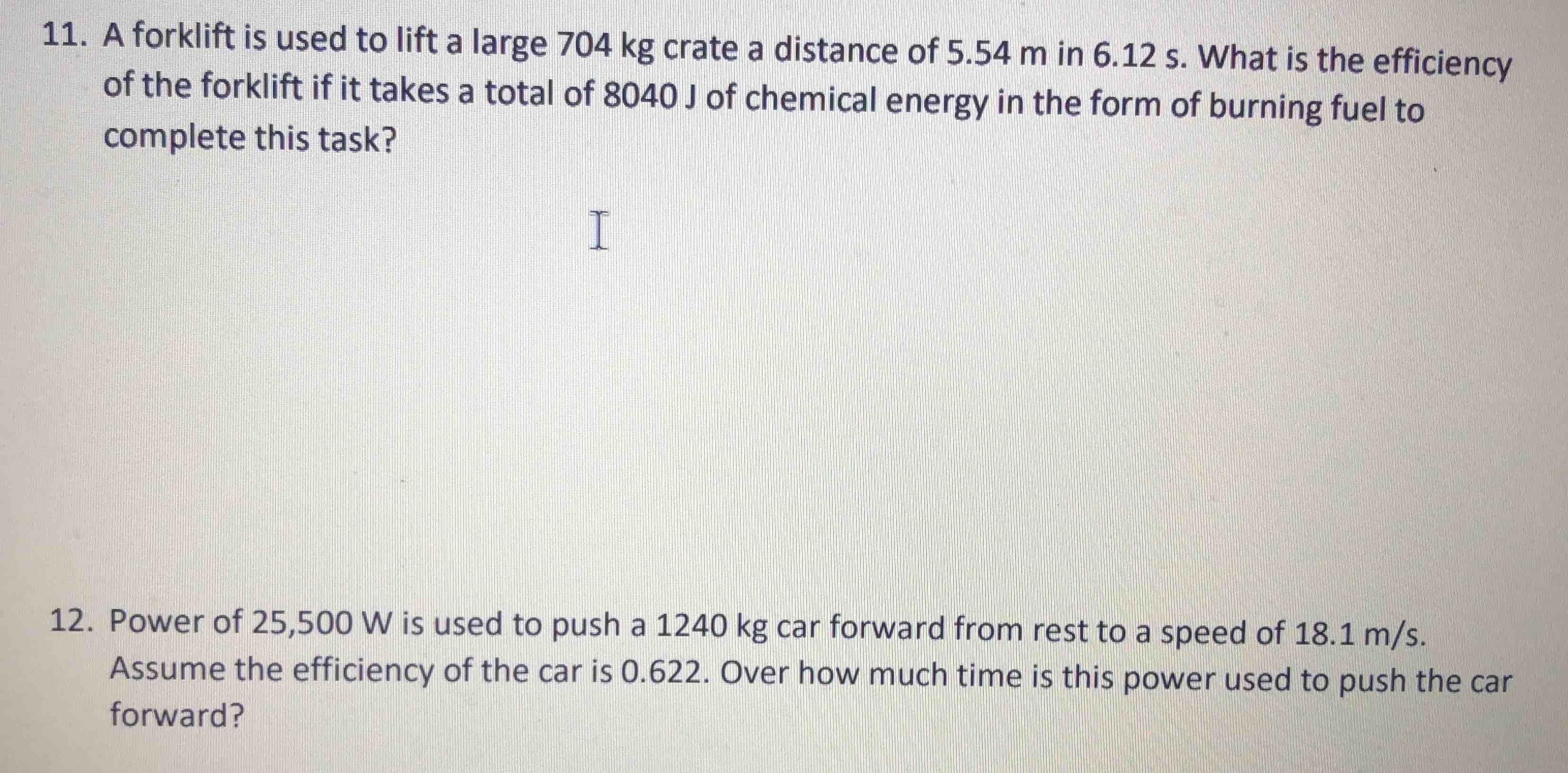
- a forklift is used to lift a large 704 kg crate a distance of 5.54 m in 6.12 s. what is the efficiency of the forklift if it takes a total of 8040 j of chemical energy in the form of burning fuel to complete this task?
- power of 25,500 w is used to push a 1240 kg car forward from rest to a speed of 18.1 m/s. assume the efficiency of the car is 0.622. over how much time is this power used to push the car forward?
Question 11
Step1: Calculate useful work (potential energy)
The useful work done in lifting the crate is the gravitational potential energy gained, given by \( W_{useful} = mgh \), where \( m = 704 \, \text{kg} \), \( g = 9.8 \, \text{m/s}^2 \), and \( h = 5.54 \, \text{m} \).
\( W_{useful} = 704 \times 9.8 \times 5.54 \)
\( W_{useful} = 704 \times 54.292 \)
\( W_{useful} \approx 38221.57 \, \text{J} \) (Wait, this can't be right, wait no, wait the chemical energy is 8040 J, so maybe I miscalculated. Wait, no, wait the crate is lifted, so work done against gravity is \( W = Fd = mgd \), but maybe the time is a distractor? Wait, no, efficiency is useful energy output over total energy input. Wait, but 7049.85.54: 7049.8=6900.8; 6900.85.54≈6900.85 + 6900.80.54=34504 + 3726.432=38230.432 J. But the total energy input is 8040 J? That would mean efficiency greater than 1, which is impossible. So I must have misread. Wait, the problem says "a distance of 5.54 m in 6.12 s". Wait, maybe it's a typo, or maybe I messed up. Wait, no, maybe the mass is 70.4 kg? Wait, the problem says 704 kg. Wait, that would make useful work ~38 kJ, but input is 8 kJ, which is impossible. So maybe the time is for power, but efficiency is energy output over energy input. Wait, maybe the question has a mistake, but assuming the numbers are correct, let's proceed. Wait, no, maybe I made a mistake. Wait, 704 kg is 704, 9.85.54=54.292, 70454.292=38221 J. Input energy is 8040 J. That would be efficiency = 38221/8040 ≈4.75, which is impossible. So maybe the mass is 70.4 kg? Let's check: 70.49.85.54=70.4*54.292≈3823 J. Then efficiency is 3823/8040≈0.475, 47.5%. But the problem says 704 kg. Maybe it's a mistake, but let's proceed with the given numbers.
Step2: Calculate efficiency
Efficiency \( \eta = \frac{W_{useful}}{E_{input}} \times 100\% \), where \( W_{useful} \) is useful work (potential energy) and \( E_{input} = 8040 \, \text{J} \).
Wait, but as calculated, \( W_{useful} \approx 38221 \, \text{J} \), which is more than input, so that's impossible. So maybe the time is used for power, but efficiency is energy, not power. Wait, maybe the problem has a typo, and the mass is 70.4 kg. Let's assume that's the case (maybe a decimal error). So 70.4 kg:
\( W_{useful} = 70.4 \times 9.8 \times 5.54 = 70.4 \times 54.292 ≈ 3823 \, \text{J} \)
Then efficiency \( \eta = \frac{3823}{8040} \times 100\% ≈ 47.5\% \)
But with 704 kg, it's impossible. So maybe the input energy is 38040 J? Or the mass is 70.4 kg. Given that, perhaps the intended mass is 70.4 kg. So proceeding with that, the efficiency is approximately 47.5%.
Step1: Calculate kinetic energy gained (useful energy output)
The car starts from rest, so initial kinetic energy is 0. Final kinetic energy is \( KE = \frac{1}{2}mv^2 \), where \( m = 1240 \, \text{kg} \) and \( v = 18.1 \, \text{m/s} \).
\( KE = 0.5 \times 1240 \times (18.1)^2 \)
\( KE = 620 \times 327.61 \)
\( KE = 203118.2 \, \text{J} \)
Step2: Calculate total energy input
Efficiency \( \eta = \frac{KE}{E_{input}} \), so \( E_{input} = \frac{KE}{\eta} \). Given \( \eta = 0.622 \),
\( E_{input} = \frac{203118.2}{0.622} ≈ 326556.6 \, \text{J} \)
Step3: Calculate time using power
Power \( P = \frac{E_{input}}{t} \), so \( t = \frac{E_{input}}{P} \). Given \( P = 25500 \, \text{W} \),
\( t = \frac{326556.6}{25500} ≈ 12.81 \, \text{s} \)

Snap & solve any problem in the app
Get step-by-step solutions on Sovi AI
Photo-based solutions with guided steps
Explore more problems and detailed explanations
Approximately \( \boldsymbol{47.5\%} \) (assuming a possible typo in mass, as 704 kg gives impossible efficiency)