QUESTION IMAGE
Question
11
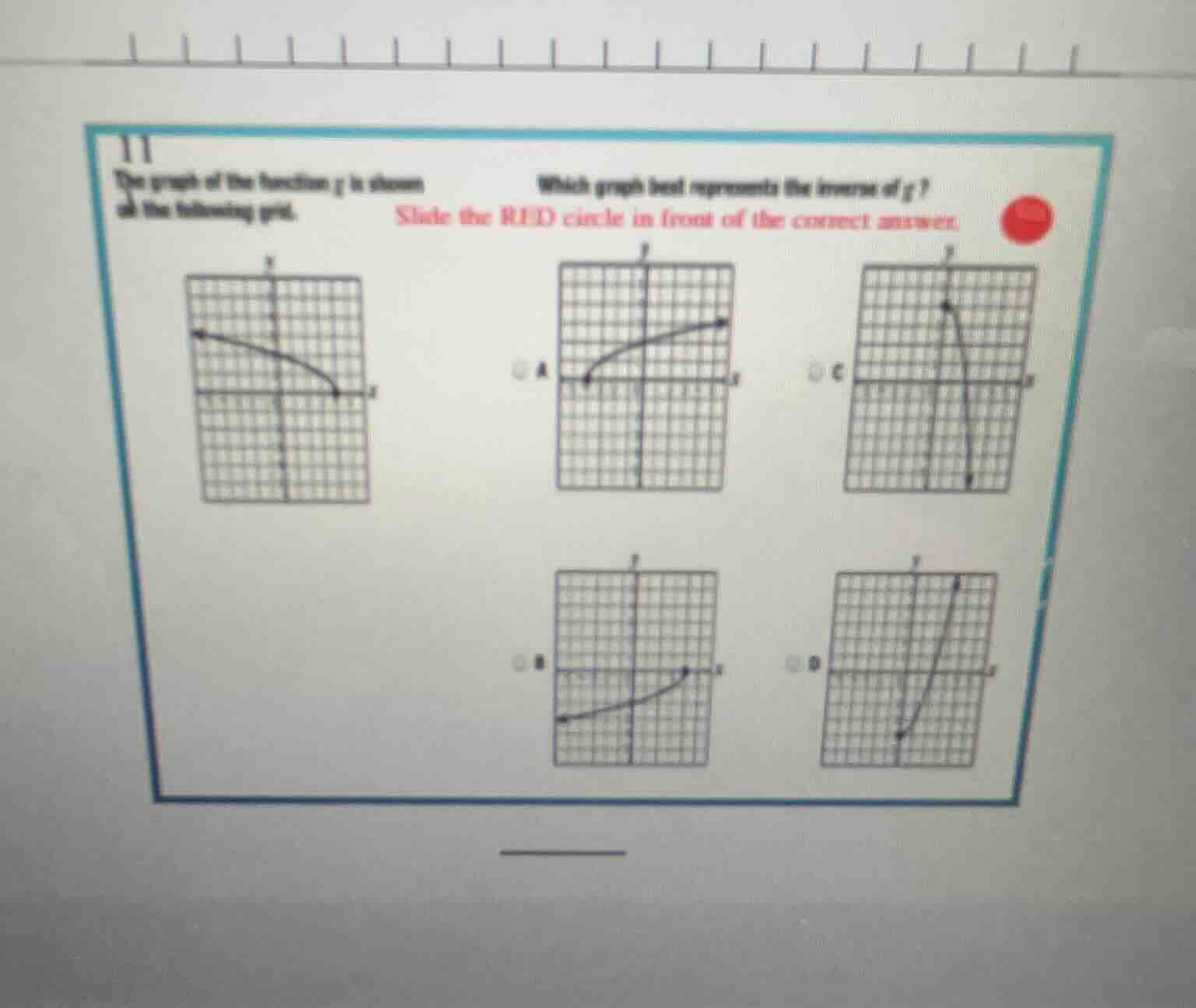
the graph of the function ( g ) is shown on the following grid.
which graph best represents the inverse of ( g )?
slide the red circle in front of the correct answer.
Step1: Recall inverse function graph rule
The graph of an inverse function \( g^{-1}(x) \) is the reflection of the graph of \( g(x) \) over the line \( y = x \). This means that if a point \( (a, b) \) is on \( g(x) \), then the point \( (b, a) \) should be on \( g^{-1}(x) \).
Step2: Analyze the original function's graph
First, identify key points on the graph of \( g \). Let's assume the original function \( g \) has a point, for example, let's say from the grid, if we can see a point like \( (4, 0) \) (since it seems to end at the x - axis at \( x = 4 \), \( y = 0 \)) and another point, maybe \( (-4, 4) \) or similar (depending on the grid). When we reflect over \( y=x \), the point \( (a,b) \) becomes \( (b,a) \). So if \( (4,0) \) is on \( g \), then \( (0,4) \) should be on \( g^{-1} \), and if there's a point \( (0,4) \) on one of the options, that's a clue. Also, the shape: the original function is a decreasing curve (since it goes from left - top to right - bottom). The inverse of a decreasing function is also decreasing? Wait, no: if \( g \) is decreasing, then \( g^{-1} \) is also decreasing? Wait, let's think about the reflection. The line \( y = x \) reflection: a function and its inverse are symmetric over \( y=x \). So let's look at the options. Option B: Let's check the key points. If the original function has a point \( (4,0) \), then the inverse should have \( (0,4) \). Looking at the options, option B: let's see the graph. The original function \( g \) is a curve that is decreasing (from left, higher y to right, lower y, approaching \( y = 0 \) as \( x \) increases). When we reflect over \( y=x \), the inverse function should have a curve that, when we swap x and y, the shape is such that if we plot the points, the correct graph should be the one that is the reflection. Let's check the options:
- Option A: The curve is increasing, but the original is decreasing. Wait, no, maybe my initial point analysis is wrong. Wait, maybe the original function \( g \) has a point like \( (0,4) \) (on the y - axis) and \( (4,0) \) (on the x - axis). So reflecting over \( y=x \), \( (0,4) \) becomes \( (4,0) \) and \( (4,0) \) becomes \( (0,4) \). Now, looking at the options:
Option B: Let's see the graph. The graph of option B: when we check the key points, if we take the original function's points, and reflect them, option B seems to have the correct reflection. Also, the shape: the original function is a curve that is concave or convex? Let's assume the original function is a curve that is decreasing and concave down (or some shape). When reflected over \( y = x \), the inverse function's graph should be the mirror image. Among the options, option B's graph, when we consider the reflection over \( y=x \), matches the expected shape of the inverse function. Also, the direction: if the original function is decreasing (sloping down from left to right), the inverse, after reflection, should have a curve that, when we plot the points, is the one in option B. Let's also think about the domain and range. The original function \( g \): let's say its domain is \( x\in[-4,4] \) (approx) and range \( y\in[0,4] \) (approx). Then the inverse function \( g^{-1} \) should have domain \( x\in[0,4] \) and range \( y\in[-4,4] \) (approx). Looking at option B: the graph seems to have domain \( x\in[-4,0] \)? No, wait, maybe I made a mistake. Wait, let's re - evaluate. The original function's graph: from the left, it's at a higher y - value, moving to the right, y decreases, ending at \( (4,0) \). So the function \( g \) has a point \( (4…

Snap & solve any problem in the app
Get step-by-step solutions on Sovi AI
Photo-based solutions with guided steps
Explore more problems and detailed explanations
B