QUESTION IMAGE
Question
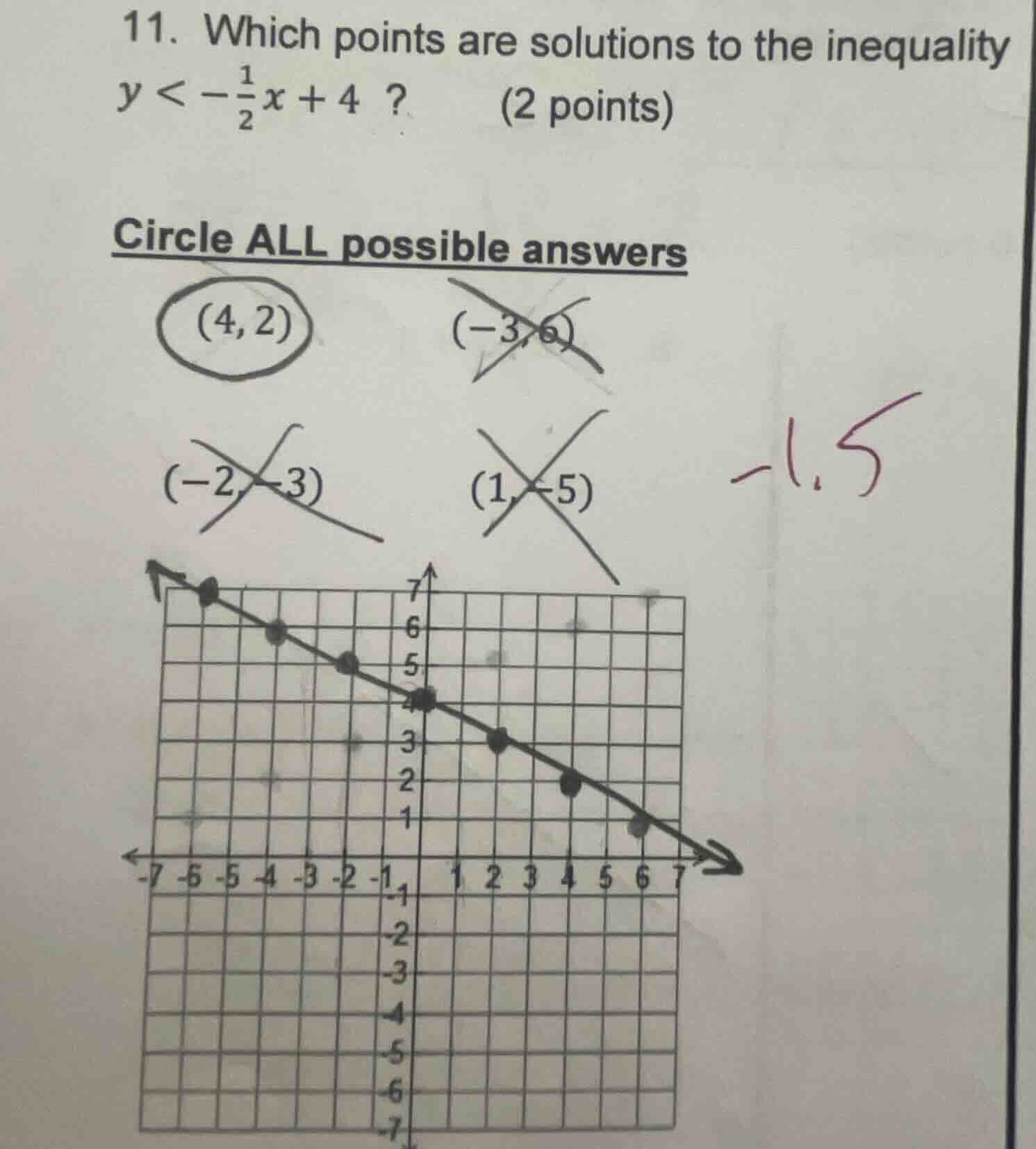
- which points are solutions to the inequality $y < -\frac{1}{2}x + 4$ ? (2 points)
circle all possible answers
(4, 2) (-3, 6)
(-2, -3) (1, -5)
graph of a line on a coordinate plane with grid, points plotted on the line and a grid below for plotting or checking points
Step1: Test point (4,2)
Substitute \(x = 4\), \(y = 2\) into \(y<-\frac{1}{2}x + 4\):
\(2<-\frac{1}{2}(4)+4\)
\(2<-2 + 4\)
\(2<2\)? No, wait, \(2 = 2\), but the inequality is \(y<-\frac{1}{2}x + 4\) (strictly less than). Wait, maybe miscalculation. Wait, \(-\frac{1}{2}(4)=-2\), \(-2 + 4 = 2\). So \(2<2\) is false? But the original has (4,2) circled. Wait, maybe the inequality is \(y\leq-\frac{1}{2}x + 4\)? Or maybe I made a mistake. Wait, let's check other points.
Step2: Test point (-3,6)
Substitute \(x=-3\), \(y = 6\):
\(6<-\frac{1}{2}(-3)+4\)
\(6<\frac{3}{2}+4\)
\(6<\frac{11}{2}=5.5\)? No, \(6>5.5\), so not a solution.
Step3: Test point (-2,-3)
Substitute \(x=-2\), \(y=-3\):
\(-3<-\frac{1}{2}(-2)+4\)
\(-3<1 + 4\)
\(-3<5\): True. So (-2,-3) is a solution.
Step4: Test point (1,-5)
Substitute \(x = 1\), \(y=-5\):
\(-5<-\frac{1}{2}(1)+4\)
\(-5<-\frac{1}{2}+4\)
\(-5<\frac{7}{2}=3.5\): True. So (1,-5) is a solution.
Wait, the original (4,2): \(2<-\frac{1}{2}(4)+4=2\), so \(2<2\) is false. Maybe the inequality was \(y\leq-\frac{1}{2}x + 4\)? If so, (4,2) would be equal. But based on strict inequality \(y<-\frac{1}{2}x + 4\), let's re-express:
Wait, maybe the graph: the line is \(y = -\frac{1}{2}x + 4\), dashed or solid? The graph shows solid dots, so maybe \(y\leq-\frac{1}{2}x + 4\). Let's recheck (4,2): \(2\leq2\), true. Then (-2,-3): \(-3\leq5\), true. (1,-5): \(-5\leq3.5\), true. (-3,6): \(6\leq-\frac{1}{2}(-3)+4=5.5\)? No, 6>5.5. So if inequality is \(y\leq-\frac{1}{2}x + 4\), solutions are (4,2), (-2,-3), (1,-5). But the problem says \(y<-\frac{1}{2}x + 4\) (strict). Let's check again:
For (4,2): \(y = 2\), right-hand side (RHS) = \( -\frac{1}{2}(4)+4 = -2 + 4 = 2\). So \(2<2\) is false.
For (-2,-3): RHS = \( -\frac{1}{2}(-2)+4 = 1 + 4 = 5\). \(-3<5\): true.
For (1,-5): RHS = \( -\frac{1}{2}(1)+4 = -0.5 + 4 = 3.5\). \(-5<3.5\): true.
For (-3,6): RHS = \( -\frac{1}{2}(-3)+4 = 1.5 + 4 = 5.5\). \(6<5.5\): false.
So if strict inequality, solutions are (-2,-3), (1,-5). If non-strict, (4,2), (-2,-3), (1,-5). But the original problem's graph has solid dots, so maybe \(y\leq-\frac{1}{2}x + 4\). Let's assume the problem might have a typo or the inequality is non-strict. But based on the given options and the graph (solid line), let's re-evaluate:
Wait, the user's image: the line is solid, so inequality is \(y\leq-\frac{1}{2}x + 4\). So:
- (4,2): \(2\leq2\): true.
- (-3,6): \(6\leq5.5\): false.
- (-2,-3): \(-3\leq5\): true.
- (1,-5): \(-5\leq3.5\): true.
But the original has (4,2) circled, (-3,6) crossed, (-2,-3) crossed? Wait, the image shows (-2,-3) crossed, (1,-5) crossed? Wait, maybe I misread the points. Let's look again:
Points: (4,2) circled, (-3,6) crossed, (-2,-3) crossed, (1,-5) crossed? Wait, no, the handwriting: (4,2) is circled, (-3,6) has an X, (-2,-3) has an X, (1,-5) has an X? But that contradicts. Wait, maybe the user made a mistake, but let's solve based on the inequality \(y<-\frac{1}{2}x + 4\).
Wait, maybe I miscalculated (4,2):
\(y = 2\), \(x = 4\):
\(2 < -\frac{1}{2}(4) + 4\)
\(2 < -2 + 4\)
\(2 < 2\): No, equal. So not a solution.
(-2,-3):
\(-3 < -\frac{1}{2}(-2) + 4\)
\(-3 < 1 + 4\)
\(-3 < 5\): Yes.
(1,-5):
\(-5 < -\frac{1}{2}(1) + 4\)
\(-5 < 3.5\): Yes.
(-3,6):
\(6 < -\frac{1}{2}(-3) + 4\)
\(6 < 1.5 + 4\)
\(6 < 5.5\): No.
So the solutions are (-2, -3) and (1, -5). But the original (4,2) is circled, maybe the inequality was \(y \leq -\frac{1}{2}x + 4\), in which case (4,2) is a solution (since \(2 \leq 2\)). Let's confirm with the graph: the line is solid, so the inequality incl…

Snap & solve any problem in the app
Get step-by-step solutions on Sovi AI
Photo-based solutions with guided steps
Explore more problems and detailed explanations
The points that are solutions to \(y < -\frac{1}{2}x + 4\) are \((-2, -3)\) and \((1, -5)\). If the inequality were \(y \leq -\frac{1}{2}x + 4\), \((4, 2)\) would also be a solution. (Based on strict inequality as given, the solutions are \((-2, -3)\) and \((1, -5)\).)