QUESTION IMAGE
Question
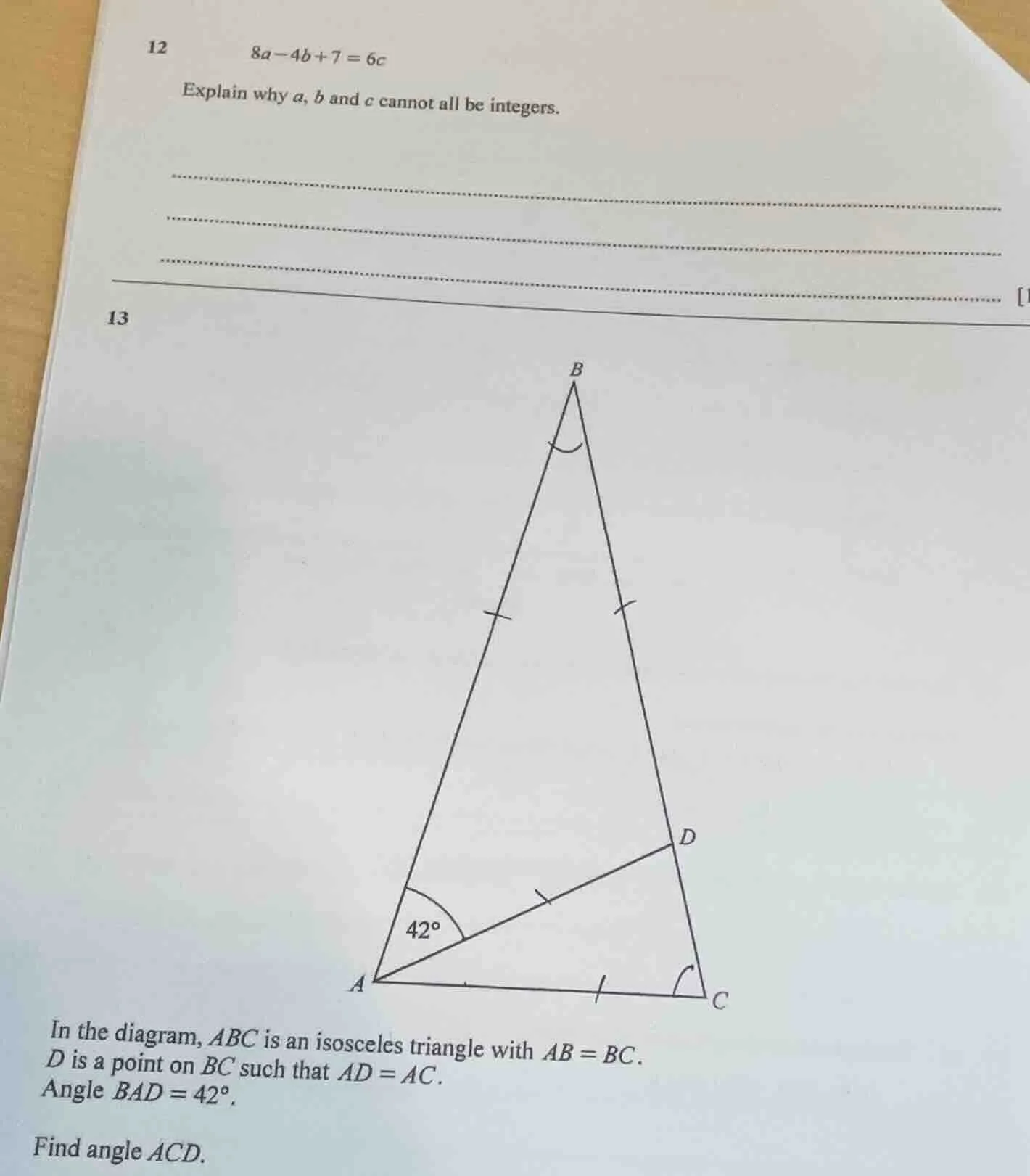
12 8a - 4b + 7 = 6c explain why a, b and c cannot all be integers. 13 in the diagram, abc is an isosceles triangle with ab = bc. d is a point on bc such that ad = ac. angle bad = 42°. find angle acd.
Question 12
Step1: Analyze the parity of terms
Consider the left - hand side (LHS) of the equation \(8a - 4b+7 = 6c\). The terms \(8a\) and \(- 4b\) are both even numbers because \(8a = 2\times(4a)\) and \(-4b=2\times(- 2b)\), and the sum of two even numbers is even. Then, when we add 7 (an odd number) to an even number, we get an odd number. So, \(8a - 4b + 7\) is odd.
Step2: Analyze the parity of the right - hand side (RHS)
The right - hand side of the equation is \(6c=2\times(3c)\), which is an even number because it is a multiple of 2.
Step3: Compare LHS and RHS parities
An odd number cannot be equal to an even number. So, there are no integer solutions for \(a\), \(b\), and \(c\) that satisfy the equation \(8a - 4b + 7=6c\) simultaneously.
Step1: Let \(\angle ACD=x\)
Since \(AD = AC\), triangle \(ADC\) is isosceles with \(\angle ADC=\angle ACD = x\). Then, by the angle - sum property of a triangle (\(\angle DAC+\angle ACD+\angle ADC = 180^{\circ}\)), \(\angle DAC=180^{\circ}-2x\).
Step2: Analyze triangle \(ABC\)
Since \(AB = BC\), triangle \(ABC\) is isosceles with \(\angle BAC=\angle BCA\). We know that \(\angle BAC=\angle BAD+\angle DAC = 42^{\circ}+(180 - 2x)^{\circ}\), and \(\angle BCA=x\). So, \(42+(180 - 2x)=x\).
Step3: Solve the equation for \(x\)
Simplify the equation \(42 + 180-2x=x\). Combine like terms: \(222=3x\). Then, divide both sides by 3: \(x = 74\).

Snap & solve any problem in the app
Get step-by-step solutions on Sovi AI
Photo-based solutions with guided steps
Explore more problems and detailed explanations
Since \(8a-4b\) is even (as \(8a\) and \(4b\) are even, and even - even = even), \(8a - 4b+7\) is odd (even + odd = odd). But \(6c\) is even (as \(6c = 2\times3c\)). An odd number cannot equal an even number, so \(a\), \(b\), and \(c\) cannot all be integers.