QUESTION IMAGE
Question
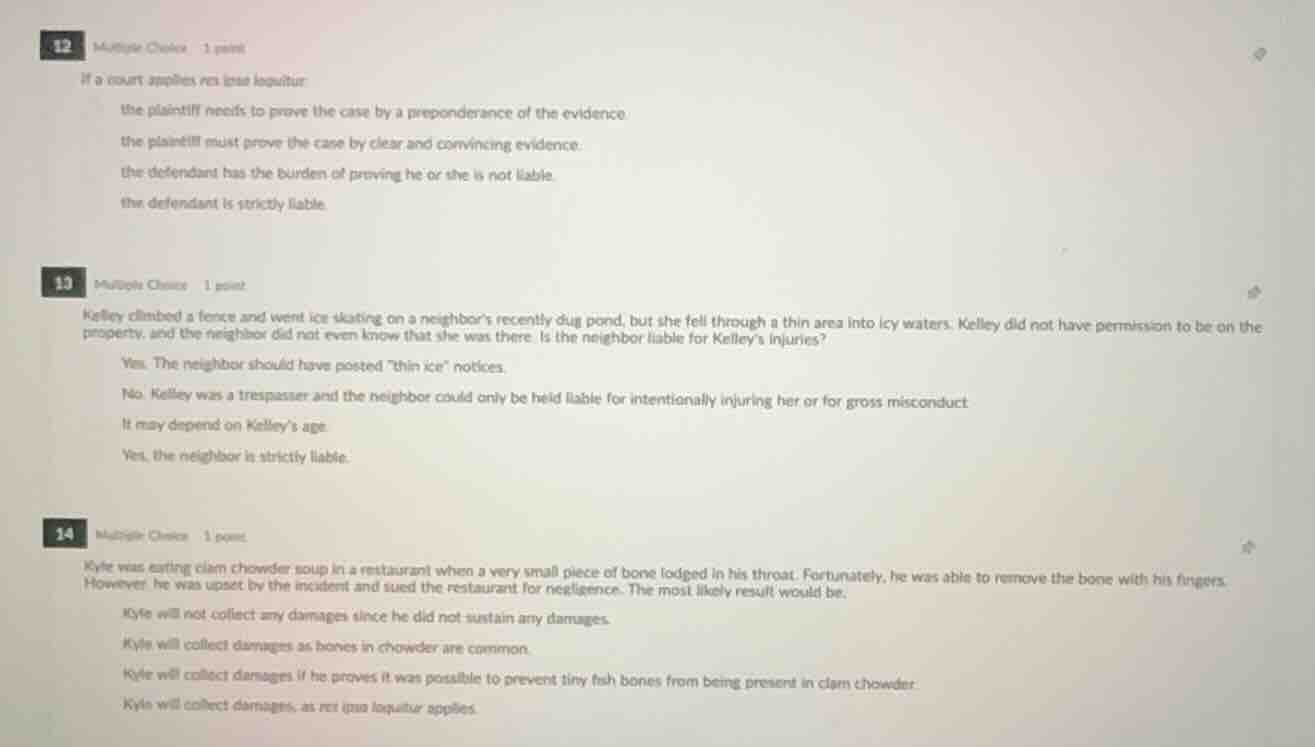
12 multiple choice 1 point if a court applies res ipsa loquitur the plaintiff needs to prove the case by a preponderance of the evidence. the plaintiff must prove the case by clear and convincing evidence. the defendant has the burden of proving he or she is not liable. the defendant is strictly liable. 13 multiple choice 1 point kelley climbed a fence and went ice skating on a neighbor’s recently dug pond, but she fell through a thin area into icy waters. kelley did not have permission to be on the property, and the neighbor did not even know that she was there. is the neighbor liable for kelley’s injuries? yes. the neighbor should have posted “thin ice” notices. no. kelley was a trespasser and the neighbor could only be held liable for intentionally injuring her or for gross misconduct. it may depend on kelley’s age. yes, the neighbor is strictly liable. 14 multiple choice 1 point kyle was eating clam chowder soup in a restaurant when a very small piece of bone lodged in his throat. fortunately, he was able to remove the bone with his fingers. however, he was upset by the incident and sued the restaurant for negligence. the most likely result would be: kyle will not collect any damages since he did not sustain any damages. kyle will collect damages as bones in chowder are common. kyle will collect damages if he proves it was possible to prevent tiny fish bones from being present in clam chowder. kyle will collect damages, as res ipsa loquitur applies.
For Question 12:
Res ipsa loquitur shifts the burden of proof to the defendant, who must show they are not liable, as the event implies negligence.
For Question 13:
Trespassers are owed limited duty; landowners are only liable for intentional harm or gross misconduct to trespassers unknown to them.
For Question 14:
To win a negligence claim for food-related incidents, the plaintiff must prove the restaurant could have prevented the hazard (tiny bone) and failed to do so.

Snap & solve any problem in the app
Get step-by-step solutions on Sovi AI
Photo-based solutions with guided steps
Explore more problems and detailed explanations
- the defendant has the burden of proving he or she is not liable.
- No. Kelley was a trespasser and the neighbor could only be held liable for intentionally injuring her or for gross misconduct
- Kyle will collect damages if he proves it was possible to prevent tiny fish bones from being present in clam chowder.