QUESTION IMAGE
Question
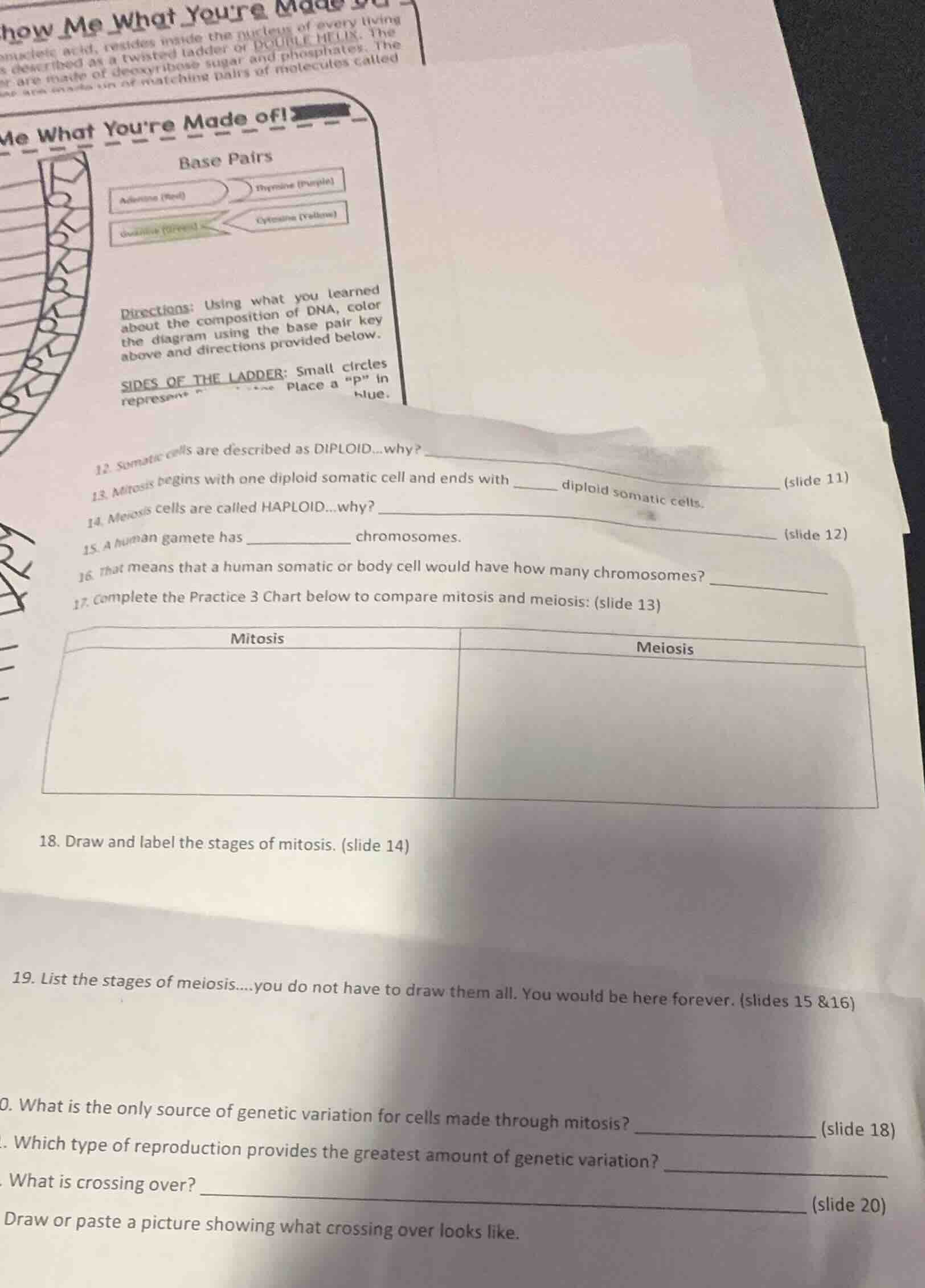
- somatic cells are described as diploid...why?
- mitosis begins with one diploid somatic cell and ends with ______ diploid somatic cells. (slide 11)
- meiosis cells are called haploid...why? (slide 12)
- a human gamete has ____________ chromosomes.
- that means that a human somatic or body cell would have how many chromosomes? ____________
- complete the practice 3 chart below to compare mitosis and meiosis: (slide 13)
mitosis meiosis
- draw and label the stages of mitosis. (slide 14)
- list the stages of meiosis....you do not have to draw them all. you would be here forever. (slides 15 &16)
- what is the only source of genetic variation for cells made through mitosis? ____________ (slide 18)
. which type of reproduction provides the greatest amount of genetic variation? ____________
. what is crossing over? ____________ (slide 20)
draw or paste a picture showing what crossing over looks like.
Question 12:
Somatic cells (body cells) have two sets of chromosomes, one from each parent. Diploid means having two complete sets of chromosomes (2n). So they are diploid because they contain two homologous copies of each chromosome (one from mother, one from father).
Mitosis is the process of cell division that results in two identical daughter cells, each with the same number of chromosomes as the parent cell. If the parent is diploid (somatic), the two daughter cells are also diploid.
Meiosis produces gametes (sex cells). Haploid cells have only one set of chromosomes (n), meaning they have half the number of chromosomes of a diploid cell. Meiosis cells (gametes) are haploid because they contain only one set of chromosomes (half the diploid number), as they are formed to combine with another gamete during fertilization to restore the diploid number.

Snap & solve any problem in the app
Get step-by-step solutions on Sovi AI
Photo-based solutions with guided steps
Explore more problems and detailed explanations
Somatic cells are diploid because they contain two sets of chromosomes (one set from each parent), so they have a full complement of chromosomes (2n), with homologous chromosomes present.