QUESTION IMAGE
Question
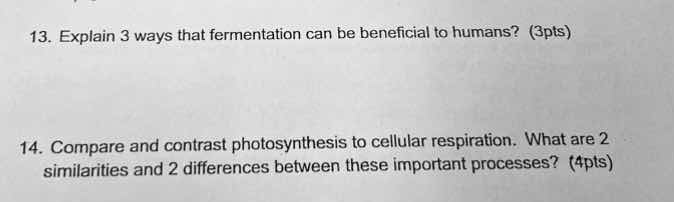
- explain 3 ways that fermentation can be beneficial to humans? (3pts)
- compare and contrast photosynthesis to cellular respiration. what are 2 similarities and 2 differences between these important processes? (4pts)
Response
Question 13 (Fermentation Benefits)
Brief Explanations
- Food Production: Fermentation is used to make foods like yogurt (lactic acid fermentation of milk), sauerkraut (fermented cabbage), and kimchi. These foods have enhanced flavor, texture, and longer shelf - life. Also, fermentation can increase the bioavailability of nutrients in food, for example, some fermented foods have higher levels of certain vitamins.
- Production of Beverages: Alcoholic beverages such as beer and wine are produced through fermentation (yeast ferments sugars to produce alcohol). Also, non - alcoholic beverages like kombucha are fermented, which can have probiotic benefits.
- Probiotic Benefits: Fermented foods often contain probiotics (beneficial bacteria). These probiotics can help maintain a healthy gut microbiome, which is important for digestion, immune function, and even mental health (there is a gut - brain axis connection). For example, yogurt with live cultures can help improve gut health.
Brief Explanations
Similarities:
- Use of Energy - Carrying Molecules: Both processes involve the use of ATP (adenosine triphosphate). In photosynthesis, ATP is produced during the light - dependent reactions and used in the Calvin cycle. In cellular respiration, ATP is produced (and used) throughout the process (glycolysis, Krebs cycle, electron transport chain) to power cellular activities.
- Involvement of Electron Transport Chains: Photosynthesis has an electron transport chain in the thylakoid membrane (during light - dependent reactions) to generate ATP and NADPH. Cellular respiration has an electron transport chain in the inner mitochondrial membrane (during oxidative phosphorylation) to generate a large amount of ATP.
Differences:
- Energy Flow Direction:
- Photosynthesis: Converts light energy into chemical energy (stores energy). The overall reaction is $6CO_2 + 6H_2O \xrightarrow[Chlorophyll]{Light} C_6H_{12}O_6+6O_2$. It takes in carbon dioxide and water to produce glucose and oxygen.
- Cellular Respiration: Converts chemical energy (in glucose) into ATP (releases energy). The overall reaction is $C_6H_{12}O_6 + 6O_2
ightarrow6CO_2 + 6H_2O+ATP$. It takes in glucose and oxygen to produce carbon dioxide, water, and ATP.
- Location in the Cell:
- Photosynthesis: Occurs in the chloroplasts of plant cells (and some bacteria). The light - dependent reactions occur in the thylakoid membranes, and the Calvin cycle (light - independent) occurs in the stroma.
- Cellular Respiration: Occurs in the cytoplasm (glycolysis) and mitochondria (Krebs cycle and electron transport chain) of eukaryotic cells. In prokaryotes, it occurs in the cytoplasm and cell membrane.

Snap & solve any problem in the app
Get step-by-step solutions on Sovi AI
Photo-based solutions with guided steps
Explore more problems and detailed explanations
- Food production (e.g., yogurt, sauerkraut, beer production with enhanced flavor, nutrient availability, and shelf - life).
- Beverage production (e.g., alcoholic like beer/wine, non - alcoholic like kombucha).
- Probiotic benefits (promotes gut health, aids digestion, boosts immunity).