QUESTION IMAGE
Question
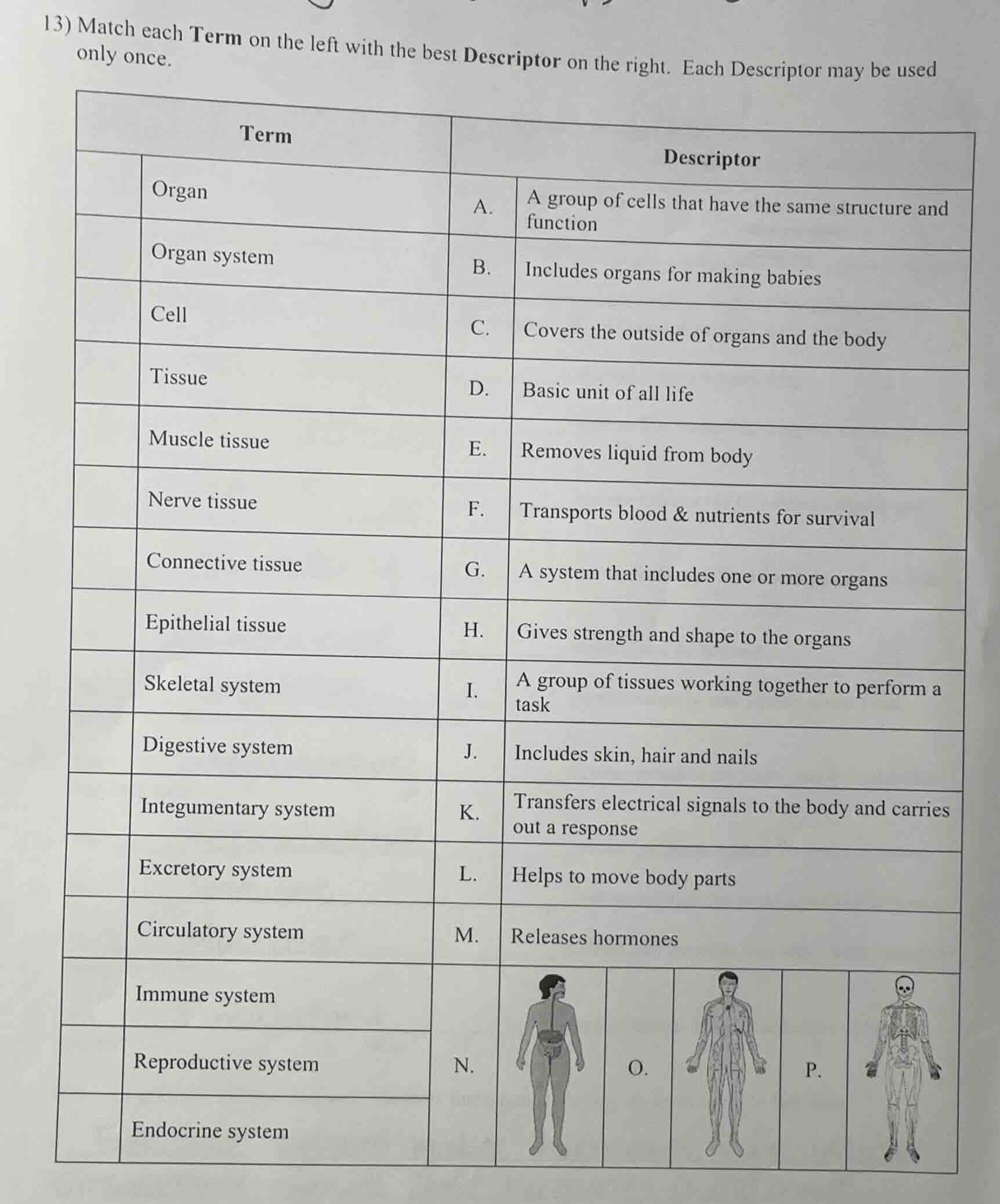
- match each term on the left with the best descriptor on the right. each descriptor may be used only once.
| term | descriptor | ---- | ---- | organ | a. a group of cells that have the same structure and function | organ system | b. includes organs for making babies | cell | c. covers the outside of organs and the body | tissue | d. basic unit of all life | muscle tissue | e. removes liquid from body | nerve tissue | f. transports blood & nutrients for survival | connective tissue | g. a system that includes one or more organs | epithelial tissue | h. gives strength and shape to the organs | skeletal system | i. a group of tissues working together to perform a task | digestive system | j. includes skin, hair and nails | integumentary system | k. transfers electrical signals to the body and carries out a response | excretory system | l. helps to move body parts | circulatory system | m. releases hormones | immune system | n. | reproductive system | o. | endocrine system | p. |
Brief Explanations
Each term is matched to its standard biological definition or associated structure:
- An organ is a group of specialized tissues working together for a task.
- An organ system consists of multiple organs with a shared function.
- The cell is the fundamental unit of all living things.
- Tissue is a collection of identical, specialized cells.
- Muscle tissue enables body movement.
- Nerve tissue transmits electrical signals for bodily responses.
- Connective tissue provides structural support to organs.
- Epithelial tissue forms protective coverings for the body and organs.
- The skeletal system corresponds to the body's bone structure (image P).
- The digestive system corresponds to the organs that process food (image N).
- The integumentary system includes skin, hair, and nails.
- The excretory system removes liquid waste from the body.
- The circulatory system transports blood and nutrients.
- The immune system corresponds to the body's defense network (image O).
- The reproductive system is involved in producing offspring.
- The endocrine system releases hormones to regulate bodily functions.

Snap & solve any problem in the app
Get step-by-step solutions on Sovi AI
Photo-based solutions with guided steps
Explore more problems and detailed explanations
- Organ: I. A group of tissues working together to perform a task
- Organ system: G. A system that includes one or more organs
- Cell: D. Basic unit of all life
- Tissue: A. A group of cells that have the same structure and function
- Muscle tissue: L. Helps to move body parts
- Nerve tissue: K. Transfers electrical signals to the body and carries out a response
- Connective tissue: H. Gives strength and shape to the organs
- Epithelial tissue: C. Covers the outside of organs and the body
- Skeletal system: P. [Image of the skeletal system]
- Digestive system: N. [Image of the digestive system]
- Integumentary system: J. Includes skin, hair and nails
- Excretory system: E. Removes liquid from body
- Circulatory system: F. Transports blood & nutrients for survival
- Immune system: O. [Image of the immune/lymphatic system]
- Reproductive system: B. Includes organs for making babies
- Endocrine system: M. Releases hormones