QUESTION IMAGE
Question
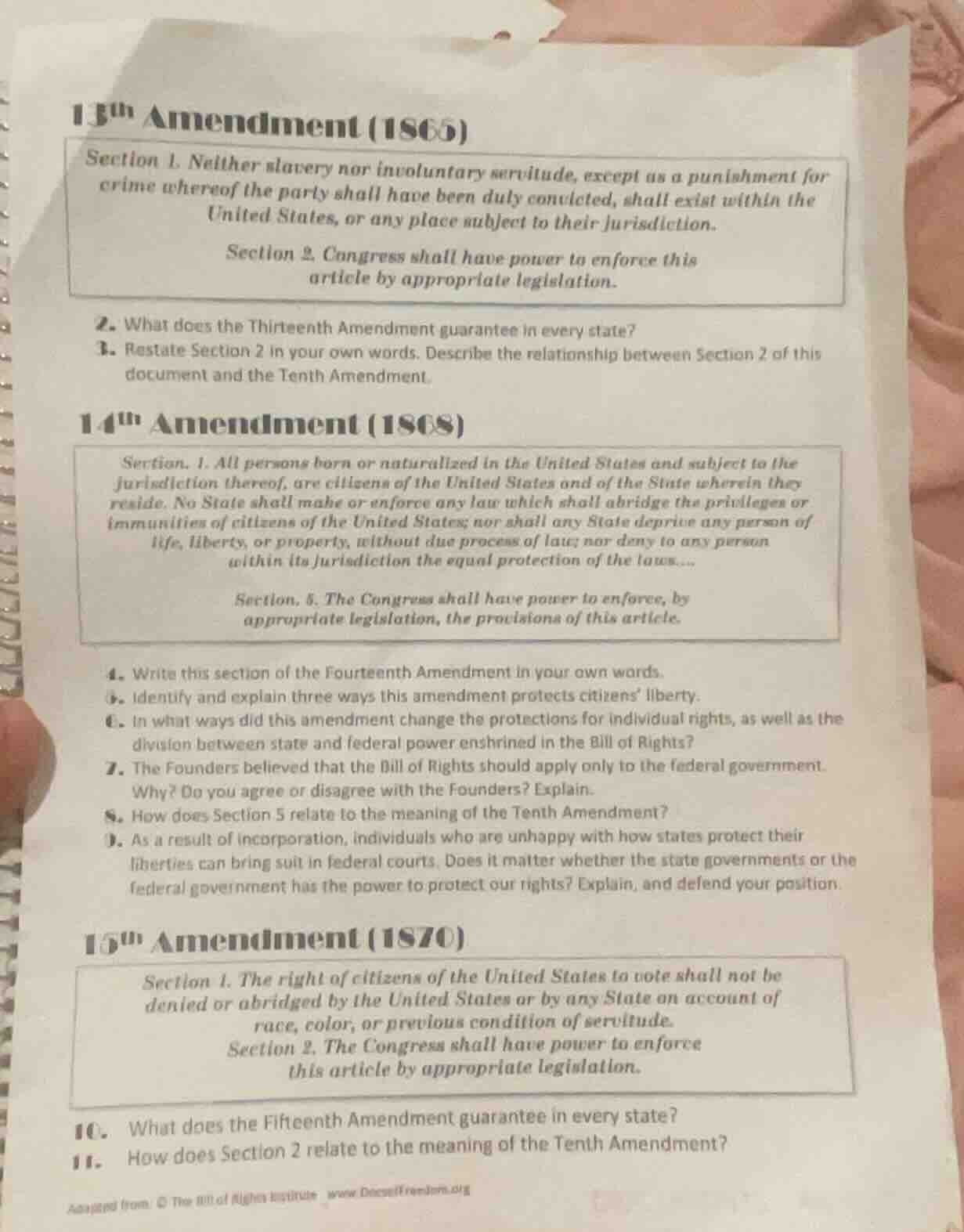
13th amendment (1865)
section 1. neither slavery nor involuntary servitude, except as a punishment for crime whereof the party shall have been duly convicted, shall exist within the united states, or any place subject to their jurisdiction.
section 2. congress shall have power to enforce this article by appropriate legislation.
- what does the thirteenth amendment guarantee in every state?
- restate section 2 in your own words. describe the relationship between section 2 of this document and the tenth amendment.
14th amendment (1868)
section. 1. all persons born or naturalized in the united states and subject to the jurisdiction thereof, are citizens of the united states and of the state wherein they reside. no state shall make or enforce any law which shall abridge the privileges or immunities of citizens of the united states; nor shall any state deprive any person of life, liberty, or property, without due process of law; nor deny to any person within its jurisdiction the equal protection of the laws....
section. 5. the congress shall have power to enforce, by appropriate legislation, the provisions of this article.
- write this section of the fourteenth amendment in your own words.
- identify and explain three ways this amendment protects citizens’ liberty.
- in what ways did this amendment change the protections for individual rights, as well as the division between state and federal power enshrined in the bill of rights?
- the founders believed that the bill of rights should apply only to the federal government. why? do you agree or disagree with the founders? explain.
- how does section 5 relate to the meaning of the tenth amendment?
- as a result of incorporation, individuals who are unhappy with how states protect their liberties can bring suit in federal courts. does it matter whether the state governments or the federal government has the power to protect our rights? explain, and defend your position.
15th amendment (1870)
section 1. the right of citizens of the united states to vote shall not be denied or abridged by the united states or by any state on account of race, color, or previous condition of servitude.
section 2. the congress shall have power to enforce this article by appropriate legislation.
- what does the fifteenth amendment guarantee in every state?
- how does section 2 relate to the meaning of the tenth amendment?
Question 2: What does the Thirteenth Amendment guarantee in every state?
The 13th Amendment's Section 1 states that slavery or involuntary servitude (except as punishment for a crime after due conviction) can't exist in the US or its jurisdictions. So in every state, it guarantees the abolition of slavery and involuntary servitude (with the crime - related exception).
- Restate Section 2: Section 2 of the 13th Amendment means that Congress has the authority to make laws to put this amendment (the 13th) into effect.
- Relationship with Tenth Amendment: The Tenth Amendment reserves powers not delegated to the federal government (or prohibited to the states) to the states or the people. Section 2 of the 13th Amendment gives Congress a specific power (to enforce the 13th Amendment via legislation), which is a delegated power to the federal government, while the Tenth Amendment deals with reserved powers. So Section 2 is an example of a federal power (delegated to Congress) while the Tenth Amendment is about powers reserved to states/people.
Section 1 of the 14th Amendment: All people born or naturalized in the US and under its jurisdiction are US citizens and citizens of the state they live in. No state can make or enforce a law that takes away the privileges or immunities of US citizens; no state can take away a person's life, liberty, or property without a fair legal process; and no state can deny a person equal protection of the laws within its jurisdiction.

Snap & solve any problem in the app
Get step-by-step solutions on Sovi AI
Photo-based solutions with guided steps
Explore more problems and detailed explanations
The Thirteenth Amendment guarantees that neither slavery nor involuntary servitude (except as a punishment for a crime of which the party has been duly convicted) shall exist within every state (and any place subject to the United States' jurisdiction).