QUESTION IMAGE
Question
- water is often called the \universal solvent\ because many substances can be dissolved in water. what property of water allows it to be such a versatile solvent?
\ta. purity
\tb. polarity and cohesion
\tc. high heat capacity
\td. expansion upon freezing
- large bodies of water, such as lakes and oceans, do not quickly fluctuate in temperature. what is the reason for this phenomenon?
\ta. water is an acid.
\tb. water is a versatile solvent.
\tc. water has a high heat capacity.
\td. water acts as a buffer.
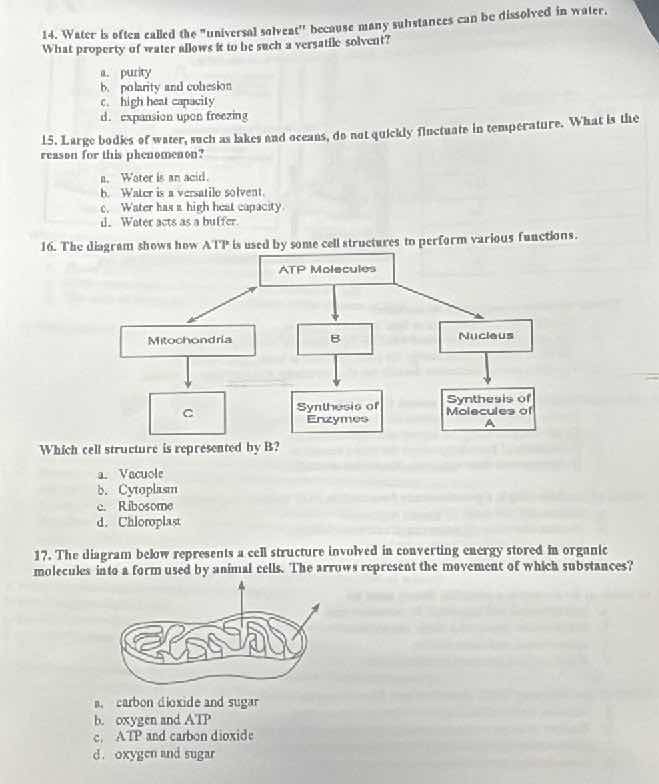
- the diagram shows how atp is used by some cell structures to perform various functions.
diagram: atp molecules at the top, with arrows to mitochondria, b, and nucleus. mitochondria has an arrow to c. b has an arrow to synthesis of enzymes. nucleus has an arrow to synthesis of molecules of a.
which cell structure is represented by b?
\ta. vacuole
\tb. cytoplasm
\tc. ribosome
\td. chloroplast
- the diagram below represents a cell structure involved in converting energy stored in organic molecules into a form used by animal cells. the arrows represent the movement of which substances?
diagram of a mitochondrion with two upward arrows
\ta. carbon dioxide and sugar
\tb. oxygen and atp
\tc. atp and carbon dioxide
\td. oxygen and sugar
Question 14
To determine the property of water that makes it a versatile solvent, we analyze each option:
- Option a: Purity doesn't directly relate to water's solvency.
- Option b: Water is a polar molecule, and its polarity (along with cohesion, but mainly polarity) allows it to form hydrogen bonds and interact with various polar and ionic substances, dissolving them.
- Option c: High heat capacity relates to temperature regulation, not solvency.
- Option d: Expansion upon freezing is about water's state change, not solvency.
So the correct property is polarity (and cohesion, but polarity is the key for solvency here).
For large water bodies' temperature stability:
- Option a: Water is not an acid.
- Option b: Being a solvent doesn't affect temperature fluctuation rate.
- Option c: High heat capacity means water absorbs/releases large heat for small temp change, so it resists quick temp fluctuations.
- Option d: Water as a buffer is about pH, not temperature.
Thus, high heat capacity is the reason.
Enzymes are proteins, synthesized by ribosomes. Let's analyze options:
- Option a: Vacuole stores substances, not synthesize enzymes.
- Option b: Cytoplasm is a medium, not the site of enzyme synthesis.
- Option c: Ribosomes are the site of protein (enzyme) synthesis. ATP is used here, so B should be Ribosome.
- Option d: Chloroplast is for photosynthesis, not enzyme synthesis in general cells (and enzymes here are likely not related to photosynthesis).
So B is Ribosome.

Snap & solve any problem in the app
Get step-by-step solutions on Sovi AI
Photo-based solutions with guided steps
Explore more problems and detailed explanations
b. polarity and cohesion