QUESTION IMAGE
Question
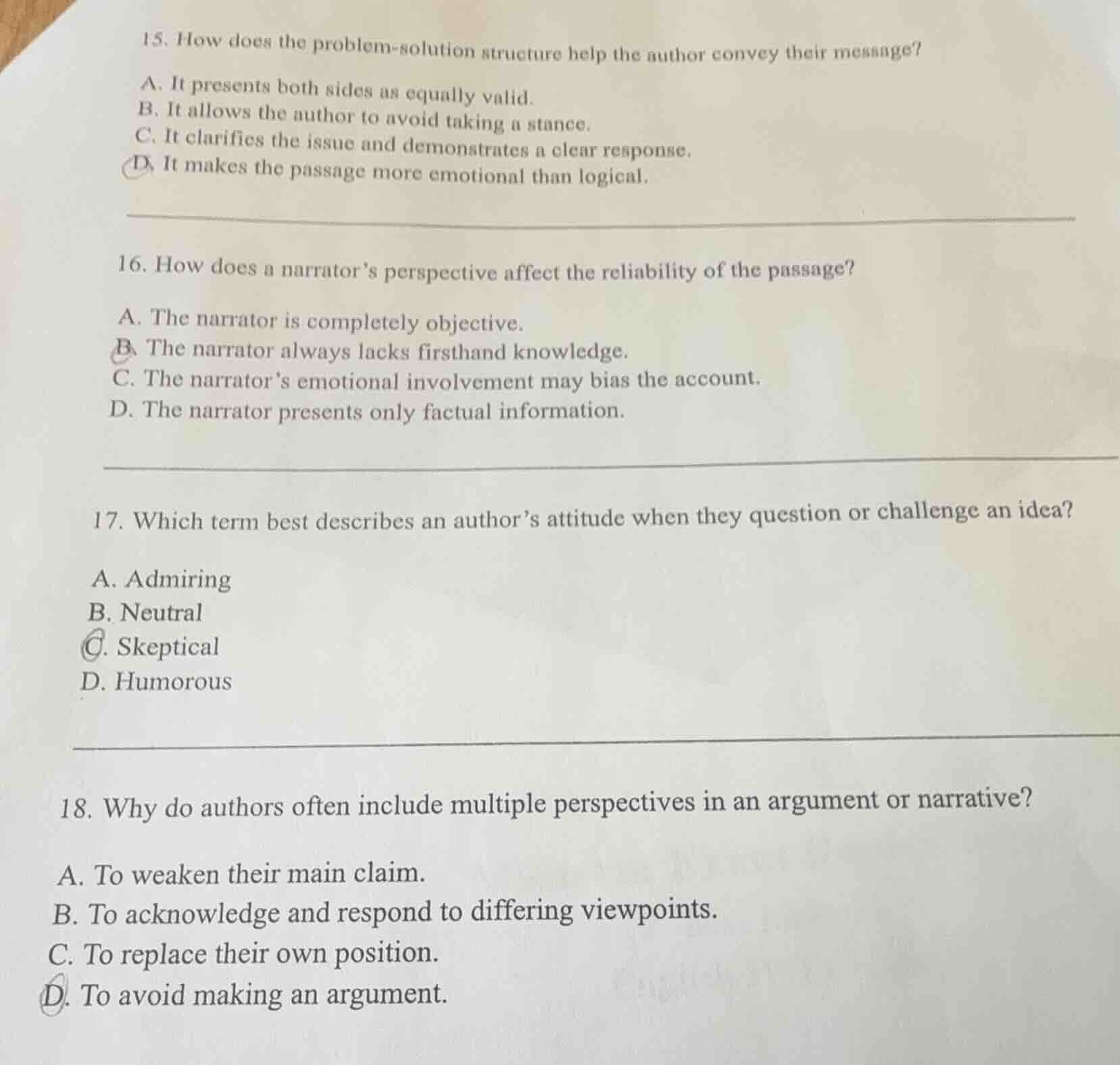
- how does the problem - solution structure help the author convey their message?
a. it presents both sides as equally valid.
b. it allows the author to avoid taking a stance.
c. it clarifies the issue and demonstrates a clear response.
d. it makes the passage more emotional than logical.
- how does a narrator’s perspective affect the reliability of the passage?
a. the narrator is completely objective.
b. the narrator always lacks firsthand knowledge.
c. the narrator’s emotional involvement may bias the account.
d. the narrator presents only factual information.
- which term best describes an author’s attitude when they question or challenge an idea?
a. admiring
b. neutral
c. skeptical
d. humorous
- why do authors often include multiple perspectives in an argument or narrative?
a. to weaken their main claim.
b. to acknowledge and respond to differing viewpoints.
c. to replace their own position.
d. to avoid making an argument.
- Problem-solution structure first defines a clear problem, then provides a targeted solution, which clarifies the issue and shows a direct response. Options A, B, and D are incorrect because this structure takes a clear stance, does not frame both sides as equal, and is logical rather than emotional.
- A narrator's personal perspective and emotional investment can lead to biased, non-objective retelling of events. Options A, B, and D are wrong because narrators are not always objective, can have firsthand knowledge, and do not only present factual information.
- A skeptical attitude involves questioning or challenging existing ideas. The other options do not match: admiring means approving, neutral means unaligned, and humorous means comedic.
- Including multiple perspectives shows the author has considered differing viewpoints, which strengthens their argument by addressing counterpoints. Options A, C, and D are incorrect because this practice does not weaken the claim, replace the author's position, or avoid making an argument.

Snap & solve any problem in the app
Get step-by-step solutions on Sovi AI
Photo-based solutions with guided steps
Explore more problems and detailed explanations
- C. It clarifies the issue and demonstrates a clear response.
- C. The narrator's emotional involvement may bias the account.
- C. Skeptical
- B. To acknowledge and respond to differing viewpoints.