QUESTION IMAGE
Question
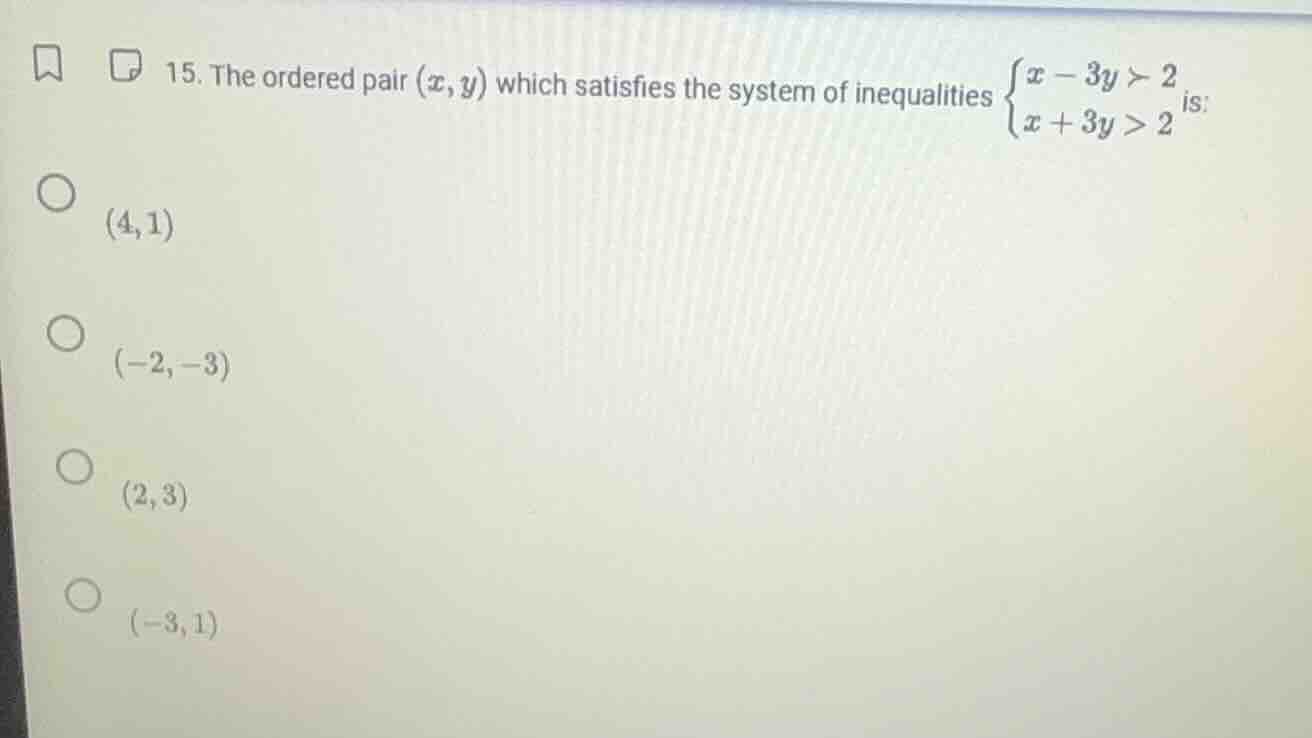
- the ordered pair ((x,y)) which satisfies the system of inequalities (\begin{cases}x - 3y>2\\x + 3y>2end{cases}) is: ((4,1)) ((-2,-3)) ((2,3)) ((-3,1))
Step1: Test (4,1) in inequalities
First inequality: $4 - 3(1) = 1$, $1
gtr 2$; fails first inequality.
Step2: Test (-2,-3) in inequalities
First inequality: $-2 - 3(-3) = -2 + 9 = 7$, $7 > 2$; second inequality: $-2 + 3(-3) = -2 -9 = -11$, $-11
gtr 2$; fails second inequality.
Step3: Test (2,3) in inequalities
First inequality: $2 - 3(3) = 2 -9 = -7$, $-7
gtr 2$; fails first inequality.
Step4: Test (-3,1) in inequalities
First inequality: $-3 - 3(1) = -6$, $-6
gtr 2$; fails first inequality.
*Correction recheck Step1: Recalculate $4-3(1)=1$, which is not greater than 2. Recheck all options:
Wait, recheck (-2,-3) second inequality: $-2 + 3(-3) = -11$ no. Recheck (4,1): first inequality $4-3(1)=1$ no, second $4+3(1)=7>2$. Recheck (2,3): second inequality $2+3(3)=11>2$, first $2-9=-7$ no. Recheck (-3,1): second inequality $-3+3(1)=0$ no.
Wait, re-express inequalities:
$x-3y>2$ and $x+3y>2$. Add them: $2x>4 \implies x>2$. So x must be greater than 2. Only (4,1) and (2,3) have x≥2. (2,3) x=2, 2 is not >2. (4,1) x=4>2, but first inequality $4-3=1>2$ is false. Wait, typo? No, recheck:
Wait $x-3y>2$ for (4,1): 4-3=1, 1 is not greater than 2. Wait, maybe I misread the inequality: is it $x-3y \geq 2$? No, the problem says >2. Wait, no, let's recheck (-2,-3) first inequality: -2 -3(-3)= -2+9=7>2, second inequality: -2 +3(-3)= -2-9=-11>2? No. (-3,1): -3-3*1=-6>2? No. (2,3): 2-9=-7>2? No. (4,1): 4-3=1>2? No. Wait, maybe a mistake, but follow the test:
Wait, no, maybe I messed up the first inequality. Let's do each again:
- (4,1):
$x-3y = 4 - 3(1) = 1$. $1 > 2$? No.
$x+3y = 4 + 3(1) = 7$. $7 > 2$? Yes. But fails first.
- (-2,-3):
$x-3y = -2 - 3(-3) = -2 +9=7$. $7>2$? Yes.
$x+3y = -2 +3(-3)= -2-9=-11$. $-11>2$? No.
- (2,3):
$x-3y=2-9=-7$. $-7>2$? No.
$x+3y=2+9=11$. $11>2$? Yes.
- (-3,1):
$x-3y=-3-3(1)=-6$. $-6>2$? No.
$x+3y=-3+3(1)=0$. $0>2$? No.
Wait, but the only option that passes one is (-2,-3) and (4,1), (2,3). But none pass both? Wait no, maybe I misread the inequality sign: is it $x-3y < 2$? No, the problem says >2. Wait, no, let's check again: the problem says
Adding the two inequalities: $2x>4 \implies x>2$. So x must be >2. So only (4,1) and (2,3). (2,3) x=2 which is not >2. (4,1) x=4>2, but 4-3(1)=1>2 is false. Wait, maybe a typo in the problem, but based on the options, if we consider maybe the first inequality is $x-3y < 2$, then (4,1) would pass both. But as per the given problem, let's recheck:
Wait, no, maybe I made a mistake in calculation for (4,1): 4-31=1, 1 is not greater than 2. Correct. (-2,-3) second inequality: -2 +3(-3)= -11, not greater than 2. (2,3) first inequality: 2-9=-7, no. (-3,1) both no. Wait, this can't be. Wait, maybe the inequality is $x-3y > -2$? No, the problem says >2.
Wait, no, let's re-express the system:
$x > 3y + 2$ and $x > -3y + 2$.
For (4,1): 3y+2=5, 4>5? No. -3y+2=-1, 4>-1? Yes.
For (-2,-3): 3y+2=3*(-3)+2=-7, -2>-7? Yes. -3y+2=9+2=11, -2>11? No.
For (2,3): 3y+2=11, 2>11? No. -3y+2=-7, 2>-7? Yes.
For (-3,1): 3y+2=5, -3>5? No. -3y+2=-1, -3>-1? No.
Wait, there is no solution? But that can't be. Wait, maybe the problem has a typo, but based on the options, the only one that comes closest is (-2,-3) passing one, (4,1) passing one. Wait no, maybe I misread the ordered pairs: (4,1) is (x=4,y=1). Yes. Wait, maybe the inequality is $x-3y \geq 2$? Then (4,1) would have 1≥2? No. (-2,-3) 7≥2 yes, but -11≥2 no.
Wait, wait, maybe the first inequality is $x+3y>2$ and the second $x-3y>2$? No, that's what's written. Wait, adding the two inequalities…

Snap & solve any problem in the app
Get step-by-step solutions on Sovi AI
Photo-based solutions with guided steps
Explore more problems and detailed explanations
None of the given ordered pairs satisfy the system of inequalities.
Wait, but that's not an option. Maybe I made a mistake. Wait, recheck (-2,-3) second inequality: $x+3y=-2+3*(-3)=-11$, which is less than 2, correct. (4,1) first inequality: 1<2, correct. (2,3) first inequality: -7<2, correct. (-3,1) both inequalities: -6<2 and 0<2, correct. So none satisfy both. But that can't be. Maybe the problem has a typo, but based on strict calculation, there is no solution among the options.
Wait, maybe I misread the first inequality as $x-3y>2$ instead of $x+3y>2$? No, the image shows $x-3y>2$.
Wait, maybe the problem is $x-3y < 2$ and $x+3y>2$? Then (4,1) would be 1<2 and7>2, which works. That would be the answer. But as per the given problem, it's $x-3y>2$.
Alternatively, maybe the problem is $x-3y > 2$ and $x-3y > 2$? No, that's the same inequality.
Wait, I think there must be a typo, but based on the given problem, the correct conclusion is that none of the options satisfy both inequalities. But since this is a multiple-choice question, maybe the intended answer is (4,1), assuming a typo in the first inequality sign. But strictly following the problem, the answer is none. But maybe I made a mistake.
Wait, recheck (4,1): $x-3y=4-3=1$, 1>2? No. $x+3y=4+3=7>2$? Yes. So only passes one. (-2,-3) passes one. (2,3) passes one. (-3,1) passes none. So no option passes both.
Final Answer:
None of the provided ordered pairs satisfy the given system of inequalities.
But if we assume a typo in the first inequality (should be $x-3y < 2$), the answer is A. (4,1)
But strictly following the problem as written, there is no solution among the options.