QUESTION IMAGE
Question
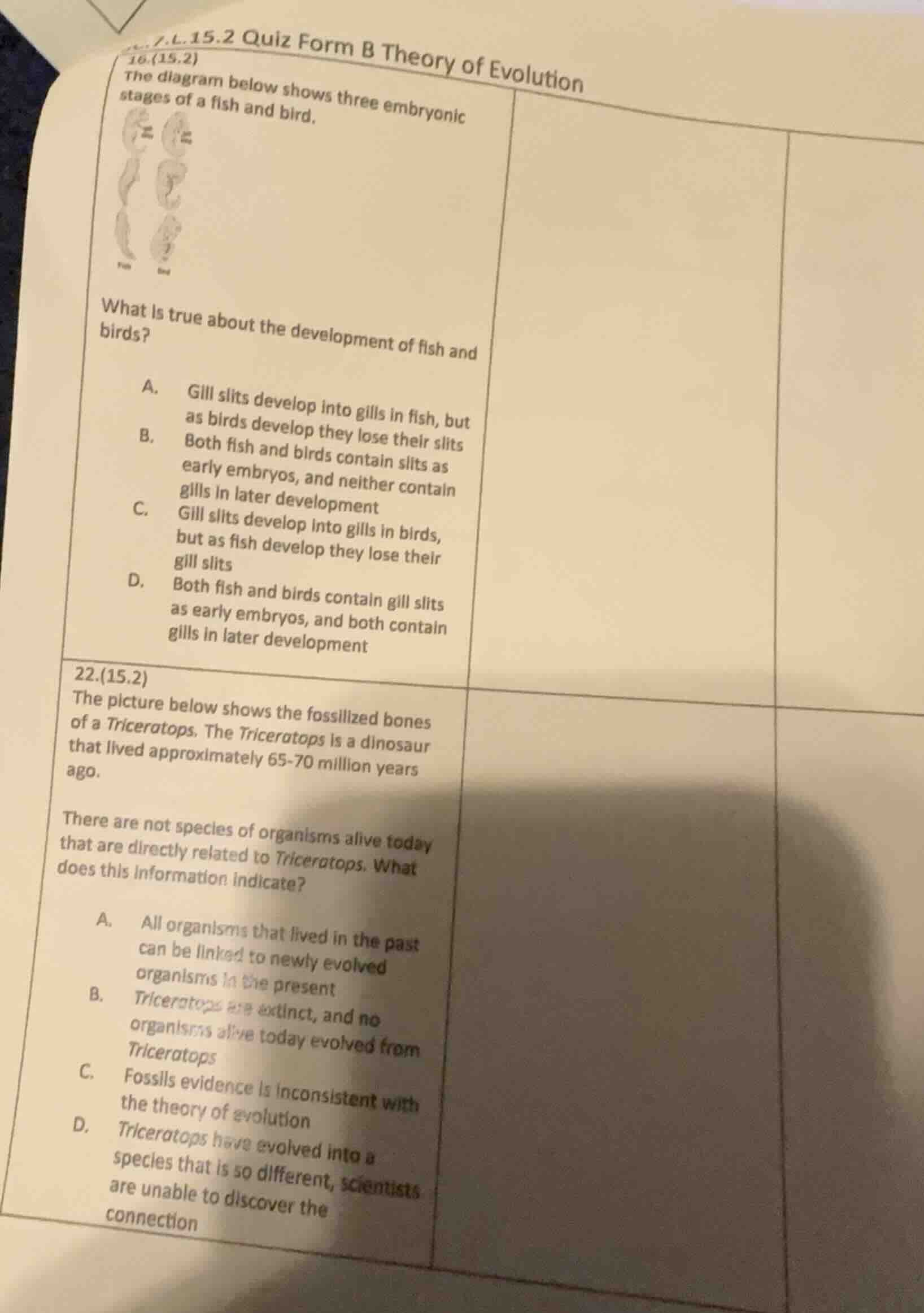
l.15.2 quiz form b theory of evolution16.(15.2)the diagram below shows three embryonic stages of a fish and bird.what is true about the development of fish and birds?a. gill slits develop into gills in fish, but as birds develop they lose their slitsb. both fish and birds contain slits as early embryos, and neither contain gills in later developmentc. gill slits develop into gills in birds, but as fish develop they lose their gill slitsd. both fish and birds contain gill slits as early embryos, and both contain gills in later development22.(15.2)the picture below shows the fossilized bones of a triceratops. the triceratops is a dinosaur that lived approximately 65-70 million years ago.there are not species of organisms alive today that are directly related to triceratops. what does this information indicate?a. all organisms that lived in the past can be linked to newly evolved organisms in the presentb. triceratops are extinct, and no organisms alive today evolved from triceratopsc. fossils evidence is inconsistent with the theory of evolutiond. triceratops have evolved into a species that is so different, scientists are unable to discover the connection
- For fish, embryonic gill slits develop into functional gills for aquatic respiration. Birds (terrestrial vertebrates) have gill slits in early embryonic development as a shared ancestral trait, but these slits do not develop into gills and are lost as the embryo matures into a bird.
- The absence of living direct relatives of Triceratops indicates the species went extinct, with no modern organisms descending directly from it. Evolution does not require all past species to have living direct descendants, and fossil evidence aligns with evolutionary theory of extinction and lineage divergence.

Snap & solve any problem in the app
Get step-by-step solutions on Sovi AI
Photo-based solutions with guided steps
Explore more problems and detailed explanations
- A. Gill slits develop into gills in fish, but as birds develop they lose their slits
- B. Triceratops are extinct, and no organisms alive today evolved from Triceratops