QUESTION IMAGE
Question
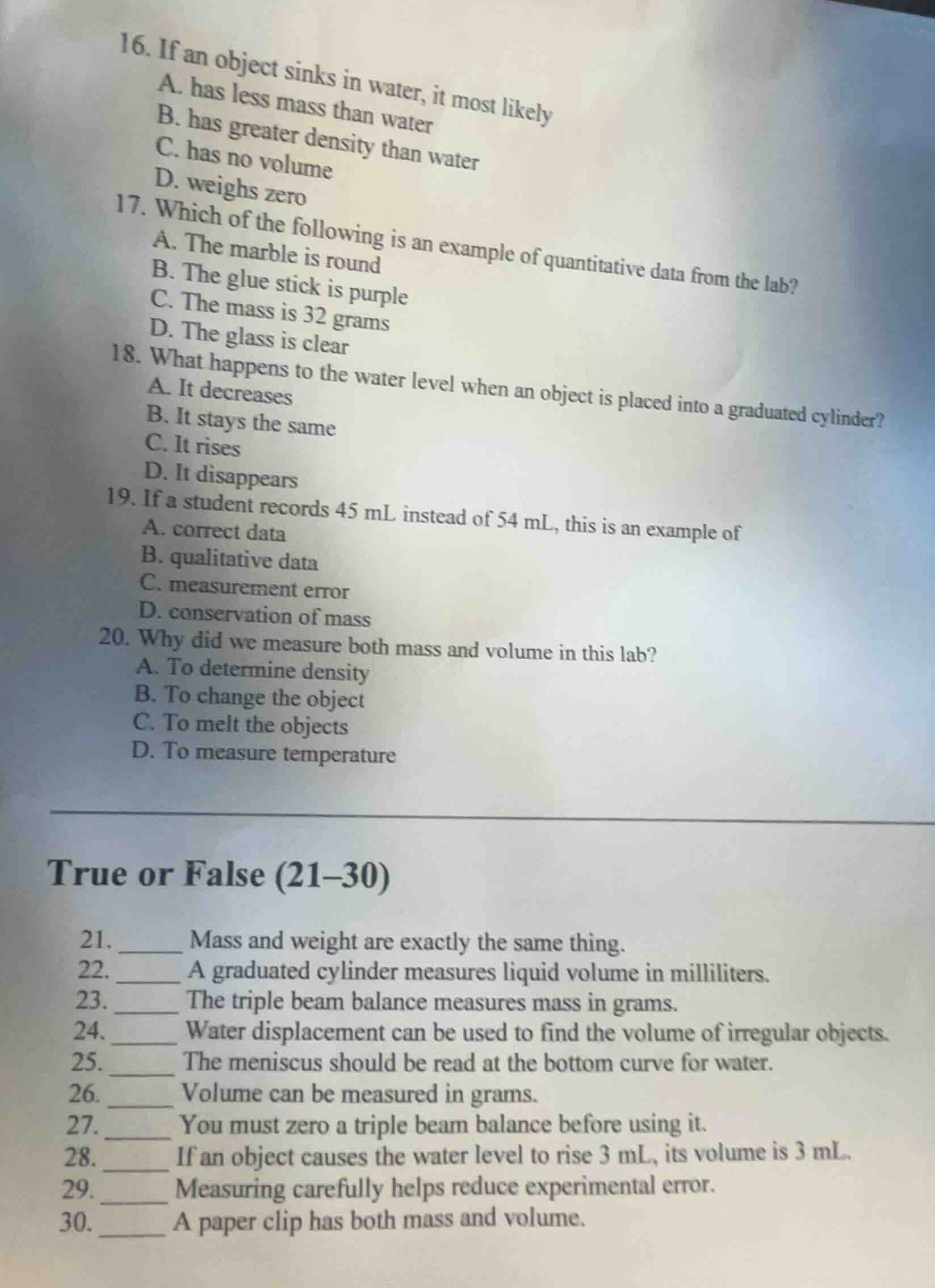
- if an object sinks in water, it most likely
a. has less mass than water
b. has greater density than water
c. has no volume
d. weighs zero
- which of the following is an example of quantitative data from the lab?
a. the marble is round
b. the glue stick is purple
c. the mass is 32 grams
d. the glass is clear
- what happens to the water level when an object is placed into a graduated cylinder?
a. it decreases
b. it stays the same
c. it rises
d. it disappears
- if a student records 45 ml instead of 54 ml, this is an example of
a. correct data
b. qualitative data
c. measurement error
d. conservation of mass
- why did we measure both mass and volume in this lab?
a. to determine density
b. to change the object
c. to melt the objects
d. to measure temperature
true or false (21-30)
- ______ mass and weight are exactly the same thing.
- ______ a graduated cylinder measures liquid volume in milliliters.
- ______ the triple beam balance measures mass in grams.
- ______ water displacement can be used to find the volume of irregular objects.
- ______ the meniscus should be read at the bottom curve for water.
- ______ volume can be measured in grams.
- ______ you must zero a triple beam balance before using it.
- ______ if an object causes the water level to rise 3 ml, its volume is 3 ml.
- ______ measuring carefully helps reduce experimental error.
- ______ a paper clip has both mass and volume.
Brief Explanations
- An object sinks when its density is higher than the fluid it's in (water here).
- Quantitative data uses numerical measurements; other options are qualitative (descriptive).
- An object displaces water equal to its volume, raising the level.
- Recording an incorrect measured value is a measurement error.
- Density is calculated as $\frac{\text{mass}}{\text{volume}}$, so both are needed.
- Mass is amount of matter; weight is gravitational force on mass.
- Graduated cylinders are calibrated for mL volume measurements.
- Triple beam balances are standard for measuring mass in grams.
- Water displacement is a standard method for irregular object volume.
- For water, the meniscus curves downward, so we read the bottom.
- Grams are a unit of mass, not volume (volume uses mL, L, etc.).
- Zeroing a balance ensures accurate mass measurements.
- The volume of displaced water equals the object's volume.
- Careful measurement minimizes mistakes in experimental data.
- All matter has mass and volume; a paper clip is matter.

Snap & solve any problem in the app
Get step-by-step solutions on Sovi AI
Photo-based solutions with guided steps
Explore more problems and detailed explanations
- B. has greater density than water
- C. The mass is 32 grams
- C. It rises
- C. measurement error
- A. To determine density
- False
- True
- True
- True
- True
- False
- True
- True
- True
- True