QUESTION IMAGE
Question
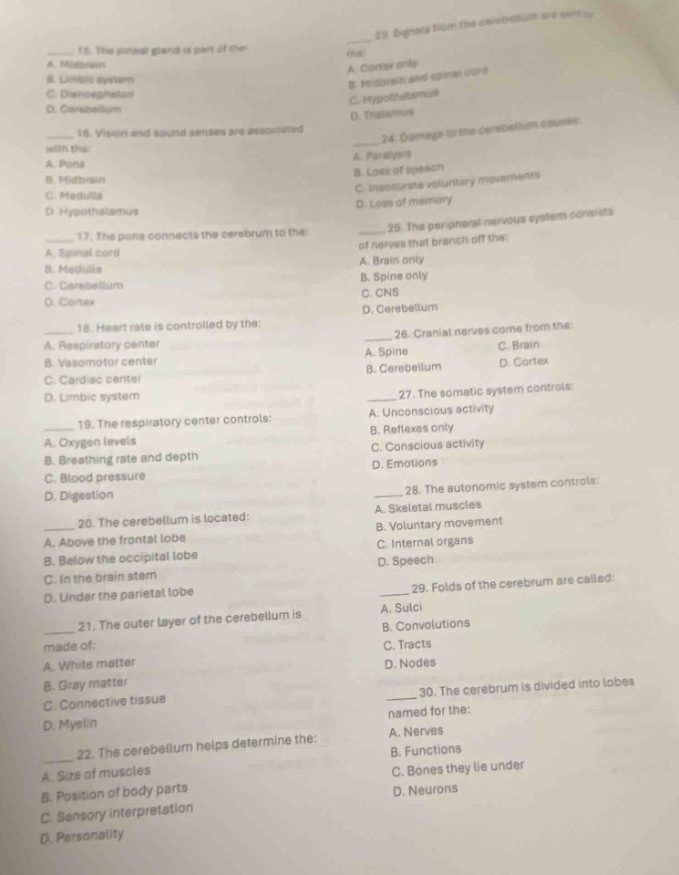
- the pineal gland is part of the:a. midbrainb. limbic systemc. diencephalond. cerebellum17. vision and sound senses are associated with the:a. ponsb. midbrainc. medullad. hypothalamus18. the pons connects the cerebrum to the:a. spinal cordb. medullac. cerebellumd. cortex19. heart rate is controlled by the:a. respiratory centerb. vasomotor centerc. cardiac centerd. limbic system20. the respiratory center controls:a. oxygen levelsb. breathing rate and depthc. blood pressured. digestion21. the cerebellum is located:a. above the frontal lobeb. below the occipital lobec. in the brain stemd. under the parietal lobe22. the outer layer of the cerebellum is made of:a. white matterb. gray matterc. connective tissued. myelin23. the cerebellum helps determine the:a. size of musclesb. position of body partsc. sensory interpretationd. personality24. signals from the cerebellum are sent to the:a. cortex onlyb. midbrain and spinal cordc. hypothalamusd. thalamus25. damage to the cerebellum causes:a. paralysisb. loss of speechc. inaccurate voluntary movementsd. loss of memory26. the peripheral nervous system consists of nerves that branch off the:a. brain onlyb. spine onlyc. cnsd. cerebellum27. cranial nerves come from the:a. spineb. cerebellumc. braind. cortex28. the somatic system controls:a. unconscious activityb. reflexes onlyc. conscious activityd. emotions29. the autonomic system controls:a. skeletal musclesb. voluntary movementc. internal organsd. speech30. folds of the cerebrum are called:a. sulcib. convolutionsc. tractsd. nodes31. the cerebrum is divided into lobes named for the:a. nervesb. functionsc. bones they lie underd. neurons
Brief Explanations
- The pineal gland is part of the diencephalon, a brain region housing endocrine and sensory structures.
- Vision and auditory pathways pass through the pons, linking these senses to the brain.
- The cardiac center in the medulla oblongata regulates heart rate.
- The respiratory center in the brainstem controls breathing rate and depth.
- The cerebellum is positioned inferior to the occipital lobe at the base of the brain.
- The cerebellum's outer layer (cerebellar cortex) is composed of gray matter.
- The cerebellum coordinates motor function by tracking body part positions.
- Cerebellar signals are sent to the midbrain and spinal cord to refine movement.
- Cerebellar damage disrupts fine motor control, causing uncoordinated voluntary movements.
- The peripheral nervous system includes nerves branching off the central nervous system (CNS).
- Cranial nerves emerge directly from the brain, controlling head/neck functions.
- The somatic nervous system mediates conscious voluntary motor and sensory activity.
- The autonomic nervous system regulates involuntary functions of internal organs.
- The cerebrum's folded ridges are called convolutions (gyri), increasing surface area.
- Cerebral lobes are named for the skull bones that overlie them (e.g., frontal bone → frontal lobe).

Snap & solve any problem in the app
Get step-by-step solutions on Sovi AI
Photo-based solutions with guided steps
Explore more problems and detailed explanations
- C. Diencephalon
- A. Pons
- C. Cardiac center
- B. Breathing rate and depth
- B. Below the occipital lobe
- B. Gray matter
- B. Position of body parts
- B. Midbrain and spinal cord
- C. Inaccurate voluntary movements
- C. CNS
- C. Brain
- C. Conscious activity
- C. Internal organs
- B. Convolutions
- C. Bones they lie under