QUESTION IMAGE
Question
17
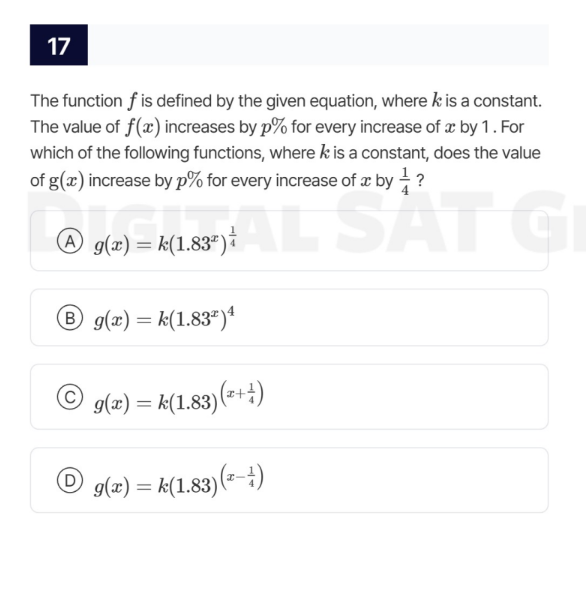
the function ( f ) is defined by the given equation, where ( k ) is a constant. the value of ( f(x) ) increases by ( p% ) for every increase of ( x ) by 1. for which of the following functions, where ( k ) is a constant, does the value of ( g(x) ) increase by ( p% ) for every increase of ( x ) by ( \frac{1}{4} )?
(a) ( g(x) = k(1.83^{x})^{\frac{1}{4}} )
(b) ( g(x) = k(1.83^{x})^{4} )
(c) ( g(x) = k(1.83)^{left(x + \frac{1}{4}
ight)} )
(d) ( g(x) = k(1.83)^{left(x - \frac{1}{4}
ight)} )
Step1: Identify f(x) form
Since f(x) increases by p% when x increases by 1, \( f(x) = k(1 + \frac{p}{100})^x = k(1.83)^x \) (so \( 1 + \frac{p}{100} = 1.83 \)).
Step2: Define g(x) requirement
g(x) needs to increase by p% when x increases by \( \frac{1}{4} \). Let \( x' = x + \frac{1}{4} \), then \( g(x') = 1.83 \cdot g(x) \).
Step3: Test option B
\( g(x) = k(1.83^x)^4 = k(1.83)^{4x} \).
\( g(x + \frac{1}{4}) = k(1.83)^{4(x + \frac{1}{4})} = k(1.83)^{4x + 1} = 1.83 \cdot k(1.83)^{4x} = 1.83g(x) \), which meets the requirement.
Step4: Verify other options
- A: \( g(x + \frac{1}{4}) = k(1.83^{x + \frac{1}{4}})^{\frac{1}{4}} = k(1.83)^{\frac{x}{4} + \frac{1}{16}}
eq 1.83g(x) \)
- C: \( g(x + \frac{1}{4}) = k(1.83)^{(x + \frac{1}{4}) + \frac{1}{4}} = k(1.83)^{x + \frac{1}{2}}
eq 1.83g(x) \)
- D: \( g(x + \frac{1}{4}) = k(1.83)^{(x + \frac{1}{4}) - \frac{1}{4}} = k(1.83)^x
eq 1.83g(x) \)
Only option B satisfies the condition.

Snap & solve any problem in the app
Get step-by-step solutions on Sovi AI
Photo-based solutions with guided steps
Explore more problems and detailed explanations
B. \( g(x) = k(1.83^x)^4 \)