QUESTION IMAGE
Question
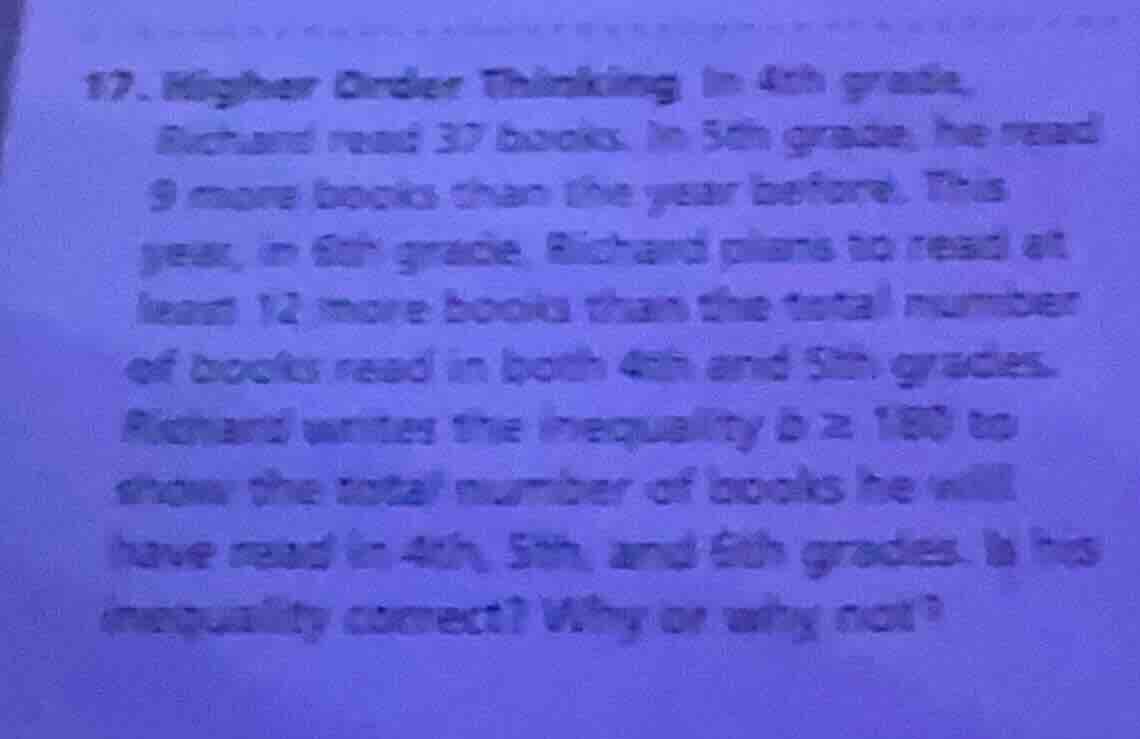
- higher order thinking in 4th grade, richard read 37 books. in 5th grade, he read 9 more books than the year before. this year, in 6th grade, richard plans to read at least 12 more books than the total number of books read in both 4th and 5th grades. richard writes the inequality ( b geq 130 ) to show the total number of books he will have read in 4th, 5th, and 6th grades. is his inequality correct? why or why not?
Step1: Find books read in 5th grade
Richard read 37 books in 4th grade. In 5th grade, he read 9 more books than 4th grade. So, number of books in 5th grade = \( 37 + 9 = 46 \)
Step2: Find total books read in 4th and 5th grade
Total books in 4th and 5th grade = \( 37 + 46 = 83 \)
Step3: Find minimum books read in 6th grade
In 6th grade, he plans to read at least 12 more books than total of 4th and 5th grade. So, minimum books in 6th grade = \( 83 + 12 = 95 \)
Step4: Find total books read in 4th, 5th, and 6th grade
Total books \( b = 37 + 46 + 95 = 178 \) (minimum total). Wait, but Richard wrote \( b \geq 180 \). Let's re - calculate total properly. Total books read in 4th and 5th is \( 37+(37 + 9)=37 + 46 = 83 \). Let the number of books in 6th grade be \( x \), where \( x\geq83 + 12=95 \). Then total books \( b=37 + 46+x=83 + x \). Since \( x\geq95 \), then \( b = 83+x\geq83 + 95=178 \). So the correct inequality should be \( b\geq178 \), not \( b\geq180 \). So his inequality is not correct.

Snap & solve any problem in the app
Get step-by-step solutions on Sovi AI
Photo-based solutions with guided steps
Explore more problems and detailed explanations
Richard's inequality \( b\geq180 \) is not correct. The correct minimum total number of books he will have read is \( 37+(37 + 9)+(37 + 9+12)=37 + 46+95 = 178 \), so the inequality should be \( b\geq178 \), not \( b\geq180 \).