QUESTION IMAGE
Question
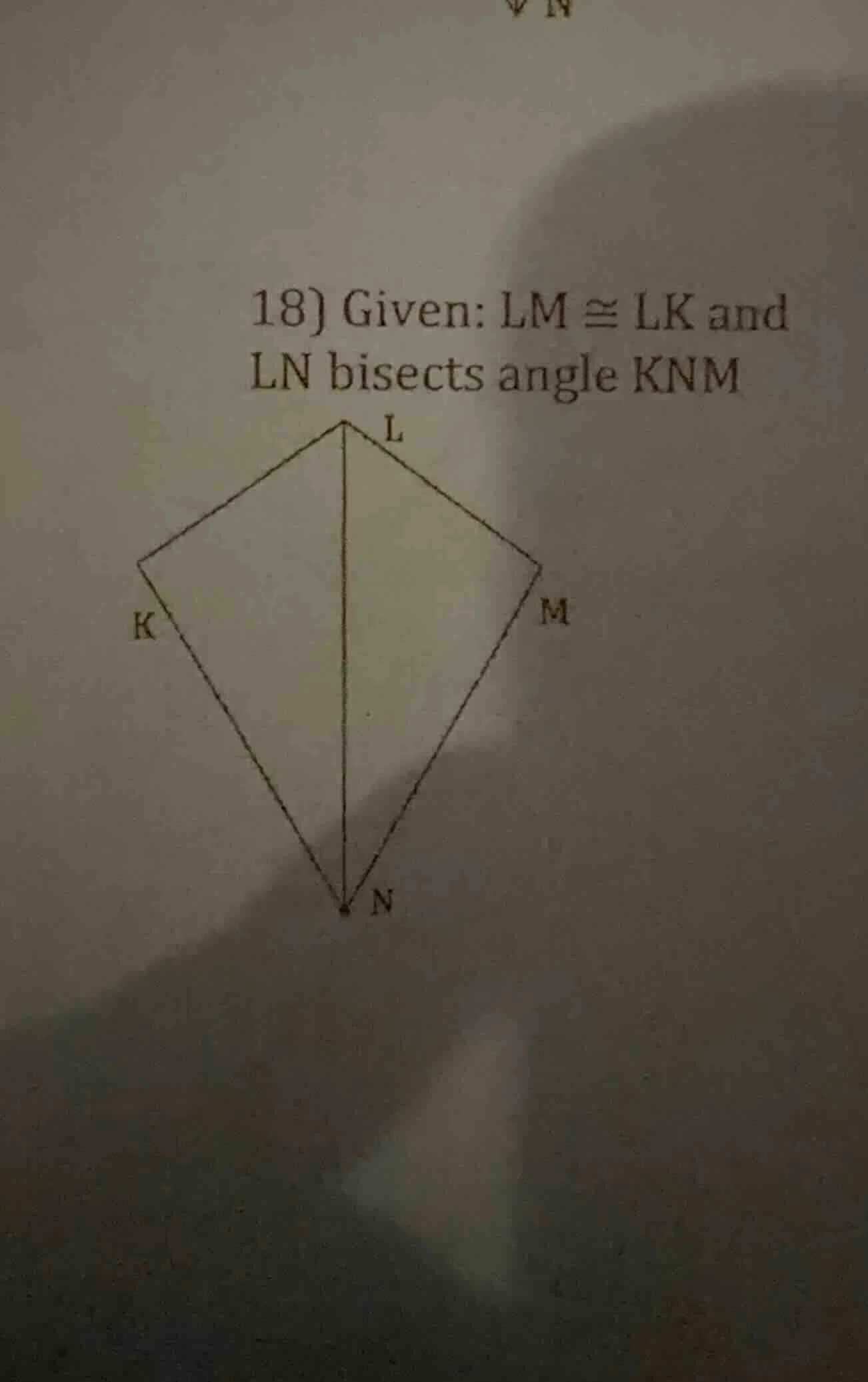
- given: lm ≅ lk and ln bisects angle knm
Since the problem involves triangle congruence and angle bisectors, we can prove that \(\triangle LKN \cong \triangle LMN\) (or other related congruences) using the given information. Let's assume the goal is to prove \(\triangle LKN \cong \triangle LMN\):
Step 1: Identify given information
- \(LM \cong LK\) (given).
- \(LN\) bisects \(\angle KNM\), so \(\angle KNL \cong \angle MNL\) (definition of angle bisector).
- \(LN\) is a common side to both \(\triangle LKN\) and \(\triangle LMN\), so \(LN \cong LN\) (reflexive property of congruence).
Step 2: Apply congruence criterion
Using the SAS (Side - Angle - Side) congruence criterion:
- Side: \(LK \cong LM\) (given).
- Angle: \(\angle KNL \cong \angle MNL\) (from angle bisector).
- Side: \(LN \cong LN\) (common side).
Thus, by SAS, \(\triangle LKN \cong \triangle LMN\).
If the question was to prove triangle congruence (a common geometry task with this diagram), the above steps show the congruence of \(\triangle LKN\) and \(\triangle LMN\) using SAS.
If the problem had a specific question (e.g., prove a side/angle congruence, find a length/angle), the steps would adjust, but with the given info, this is a typical proof.
(Note: Since the original problem’s specific question wasn’t fully stated, this is a common solution path for such a diagram/givens.)
If we assume the task is to prove \(\triangle LKN \cong \triangle LMN\), the answer is that \(\triangle LKN \cong \triangle LMN\) by SAS.

Snap & solve any problem in the app
Get step-by-step solutions on Sovi AI
Photo-based solutions with guided steps
Explore more problems and detailed explanations
Since the problem involves triangle congruence and angle bisectors, we can prove that \(\triangle LKN \cong \triangle LMN\) (or other related congruences) using the given information. Let's assume the goal is to prove \(\triangle LKN \cong \triangle LMN\):
Step 1: Identify given information
- \(LM \cong LK\) (given).
- \(LN\) bisects \(\angle KNM\), so \(\angle KNL \cong \angle MNL\) (definition of angle bisector).
- \(LN\) is a common side to both \(\triangle LKN\) and \(\triangle LMN\), so \(LN \cong LN\) (reflexive property of congruence).
Step 2: Apply congruence criterion
Using the SAS (Side - Angle - Side) congruence criterion:
- Side: \(LK \cong LM\) (given).
- Angle: \(\angle KNL \cong \angle MNL\) (from angle bisector).
- Side: \(LN \cong LN\) (common side).
Thus, by SAS, \(\triangle LKN \cong \triangle LMN\).
If the question was to prove triangle congruence (a common geometry task with this diagram), the above steps show the congruence of \(\triangle LKN\) and \(\triangle LMN\) using SAS.
If the problem had a specific question (e.g., prove a side/angle congruence, find a length/angle), the steps would adjust, but with the given info, this is a typical proof.
(Note: Since the original problem’s specific question wasn’t fully stated, this is a common solution path for such a diagram/givens.)
If we assume the task is to prove \(\triangle LKN \cong \triangle LMN\), the answer is that \(\triangle LKN \cong \triangle LMN\) by SAS.