QUESTION IMAGE
Question
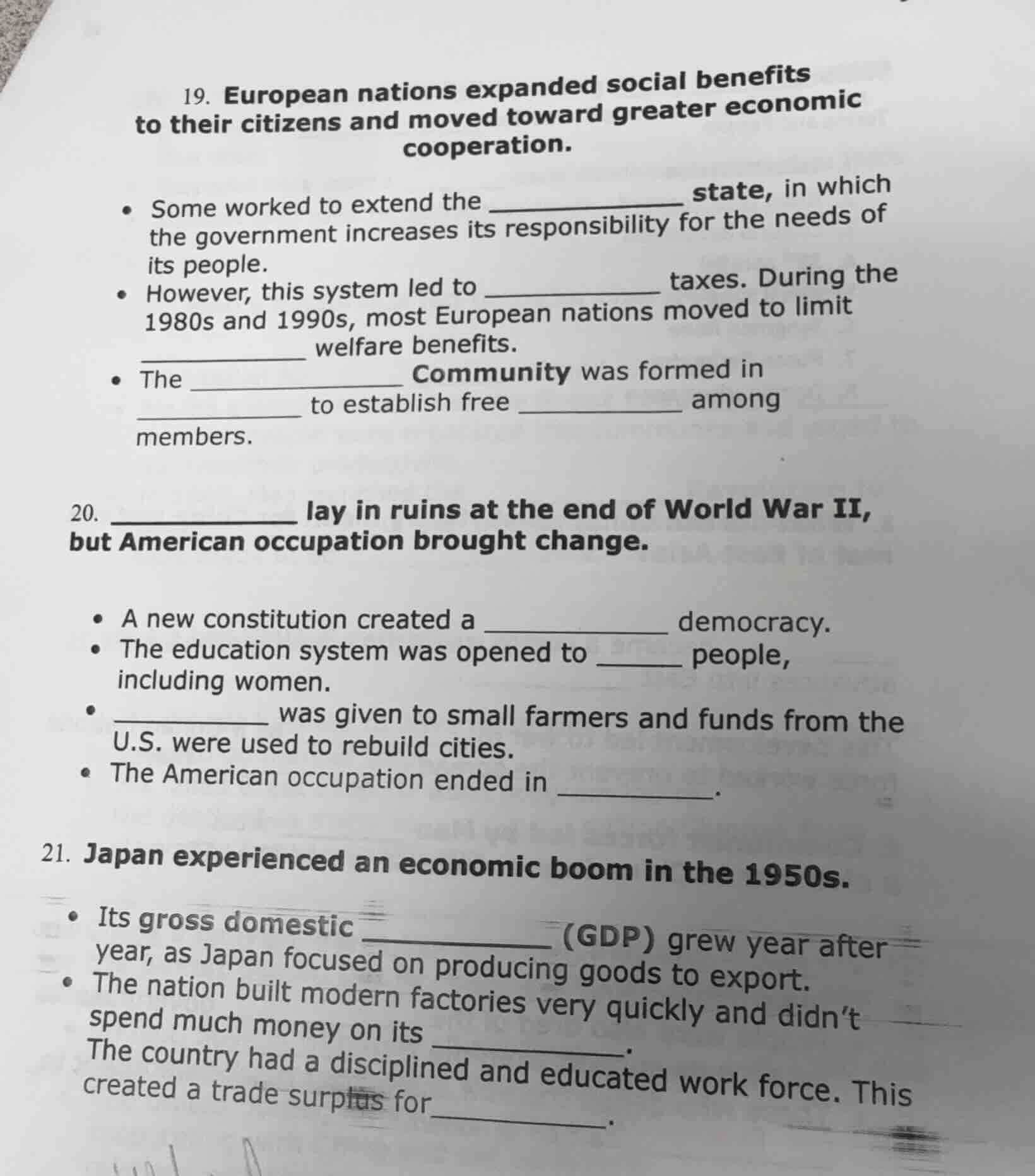
- european nations expanded social benefits to their citizens and moved toward greater economic cooperation.
- some worked to extend the ______________ state, in which the government increases its responsibility for the needs of its people.
- however, this system led to ____________ taxes. during the 1980s and 1990s, most european nations moved to limit ____________ welfare benefits.
- the ____________ community was formed in __________ to establish free ____________ among members.
- ______________ lay in ruins at the end of world war ii, but american occupation brought change.
- a new constitution created a ______________ democracy.
- the education system was opened to ______ people, including women.
- ______________ was given to small farmers and funds from the u.s. were used to rebuild cities.
- the american occupation ended in ______________.
- japan experienced an economic boom in the 1950s.
- its gross domestic ______________ (gdp) grew year after year, as japan focused on producing goods to export.
- the nation built modern factories very quickly and didnt spend much money on its ______________.
the country had a disciplined and educated work force. this created a trade surplus for______________.
Brief Explanations
These are fill-in-the-blank questions focused on post-WWII European and Japanese history, covering social policy, economic integration, post-war reconstruction, and economic growth.
- For question 19: The term for a government taking greater responsibility for citizen needs is "welfare"; expansive welfare systems require high taxes, so European nations later reduced benefits. The European Community (predecessor of the EU) was formed in 1957 to establish free trade among members.
- For question 20: Japan lay in ruins after WWII; the U.S. occupation established a parliamentary democracy, opened education to all people, provided land reform for small farmers, and ended in 1952.
- For question 21: GDP stands for gross domestic product; Japan focused on exports, avoided high military spending, and its strong workforce created a trade surplus for the country.

Snap & solve any problem in the app
Get step-by-step solutions on Sovi AI
Photo-based solutions with guided steps
Explore more problems and detailed explanations
19.
- welfare
- high
- costly
- European; 1957; trade
20.
- Japan
- parliamentary
- all
- Land reform
- 1952
21.
- product
- military
- Japan