QUESTION IMAGE
Question
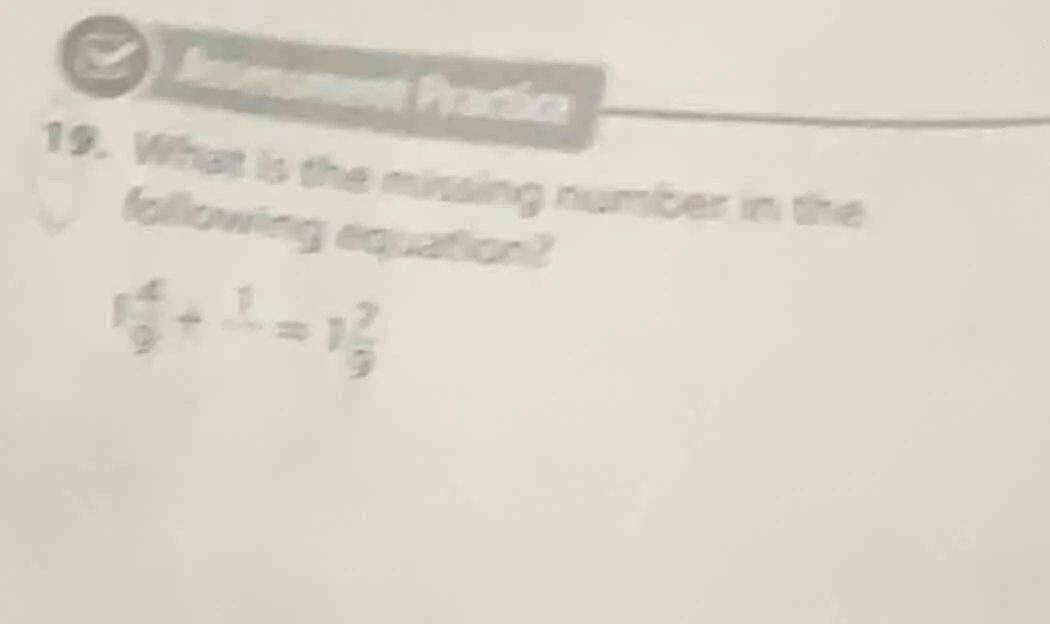
- what is the missing number in the following equation?
$1\frac{4}{9}+\frac{1}{\\_}=1\frac{7}{9}$
Step1: Let the missing number be \( x \), so the equation is \( 1\frac{4}{9}+\frac{1}{x}=1\frac{7}{9} \) (Wait, no, the original equation is \( 1\frac{4}{9}+\frac{1}{?}=1\frac{7}{9} \), actually, let's correct: Let the missing fraction be \( \frac{1}{n} \)? No, wait, maybe the missing number is the numerator, and the denominator is same? Wait, original equation: \( 1\frac{4}{9}+\frac{?}{9}=1\frac{7}{9} \)? Wait, maybe the user's equation is \( 1\frac{4}{9}+\frac{1}{?}=1\frac{7}{9} \) but actually, probably the missing is a fraction with denominator 9. Wait, let's re-express: Let the missing number be \( \frac{a}{9} \), but the problem shows \( \frac{1}{-} \), maybe it's \( \frac{?}{9} \), but the user's image has \( 1\frac{4}{9}+\frac{1}{-}=1\frac{7}{9} \), maybe a typo, but actually, let's solve: Subtract \( 1\frac{4}{9} \) from both sides.
Step2: Subtract \( 1\frac{4}{9} \) from \( 1\frac{7}{9} \). First, convert mixed numbers to improper fractions: \( 1\frac{7}{9}=\frac{16}{9} \), \( 1\frac{4}{9}=\frac{13}{9} \). Then \( \frac{16}{9}-\frac{13}{9}=\frac{3}{9}=\frac{1}{3} \)? Wait, no, wait, the equation is \( 1\frac{4}{9}+\frac{?}{9}=1\frac{7}{9} \) (assuming the missing is \( \frac{?}{9} \)). Then \( 1\frac{7}{9}-1\frac{4}{9}=\frac{7 - 4}{9}=\frac{3}{9}=\frac{1}{3} \), but the problem has \( \frac{1}{-} \), maybe the missing is \( \frac{3}{9}=\frac{1}{3} \), but the denominator? Wait, no, let's do mixed numbers subtraction: \( 1\frac{7}{9}-1\frac{4}{9}=(1 - 1)+(\frac{7}{9}-\frac{4}{9})=\frac{3}{9}=\frac{1}{3} \). But the problem shows \( \frac{1}{-} \), maybe the missing is 3, because \( \frac{3}{9}=\frac{1}{3} \), but the denominator is 3? Wait, no, let's check again. Wait, the original equation: \( 1\frac{4}{9}+\frac{1}{?}=1\frac{7}{9} \). Let's solve for the missing fraction: Let \( y \) be the missing fraction, so \( y = 1\frac{7}{9}-1\frac{4}{9} \). \( 1\frac{7}{9}-1\frac{4}{9}=\frac{7 - 4}{9}=\frac{3}{9}=\frac{1}{3} \). But the problem has \( \frac{1}{-} \), maybe it's \( \frac{3}{9} \), but the numerator is 3, denominator 9, but the problem shows \( \frac{1}{-} \), maybe a typo, but actually, the correct missing number (numerator, denominator 9) is 3, but if it's \( \frac{1}{x} \), then \( \frac{1}{x}=\frac{3}{9}=\frac{1}{3} \), so \( x = 3 \).
Wait, let's do it step by step correctly:
Let the missing number be \( x \), so the equation is \( 1\frac{4}{9}+\frac{1}{x}=1\frac{7}{9} \) (assuming \( \frac{1}{x} \) is the missing term, but actually, probably the denominator is 9, so \( \frac{?}{9} \), but the problem has \( \frac{1}{-} \), maybe it's \( \frac{?}{9} \), and the numerator is missing. Let's solve:
\( 1\frac{7}{9}-1\frac{4}{9} = \frac{7 - 4}{9} = \frac{3}{9} = \frac{1}{3} \). But the problem has \( \frac{1}{-} \), so if the missing is \( \frac{3}{9} \), but the numerator is 3, denominator 9. Wait, maybe the problem is \( 1\frac{4}{9}+\frac{?}{9}=1\frac{7}{9} \), so the missing numerator is 3, so the fraction is \( \frac{3}{9} \), but the problem shows \( \frac{1}{-} \), maybe a typo, and the correct missing number (numerator) is 3, but wait, no, let's re-express:
Wait, the equation is \( 1\frac{4}{9} + \frac{1}{n} = 1\frac{7}{9} \). Then \( \frac{1}{n} = 1\frac{7}{9} - 1\frac{4}{9} = \frac{3}{9} = \frac{1}{3} \), so \( n = 3 \). So the missing number is 3, so the fraction is \( \frac{1}{3} \), so the denominator is 3.

Snap & solve any problem in the app
Get step-by-step solutions on Sovi AI
Photo-based solutions with guided steps
Explore more problems and detailed explanations
The missing number (denominator) is 3, so the fraction is \( \frac{1}{3} \), so the missing number is 3.