QUESTION IMAGE
Question
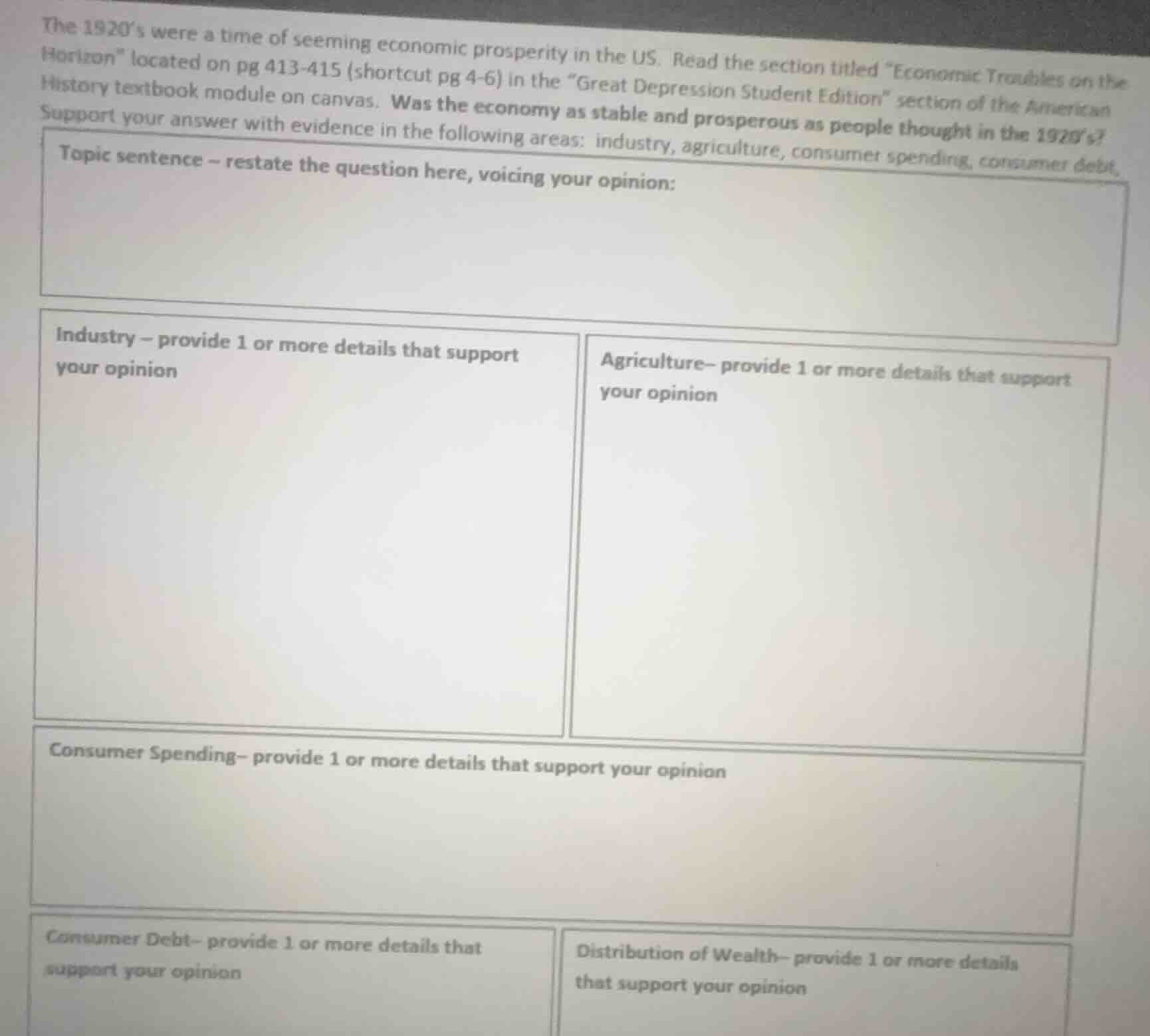
the 1920s were a time of seeming economic prosperity in the us. read the section titled \economic troubles on the horizon\ located on pg 413 - 415 (shortcut pg 4 - 6) in the \great depression student edition\ section of the american history textbook module on canvas. was the economy as stable and prosperous as people thought in the 1920s? support your answer with evidence in the following areas: industry, agriculture, consumer spending, consumer debt, topic sentence - restate the question here, voicing your opinion: industry - provide 1 or more details that support your opinion agriculture - provide 1 or more details that support your opinion consumer spending - provide 1 or more details that support your opinion consumer debt - provide 1 or more details that support your opinion distribution of wealth - provide 1 or more details that support your opinion
The 1920s U.S. economy was not as stable and prosperous as perceived, with hidden weaknesses across key sectors:
- Topic Sentence: The 1920s U.S. economy appeared prosperous on the surface, but underlying flaws in industry, agriculture, consumer behavior, and wealth distribution made it unstable and not as robust as people believed.
- Industry: While manufacturing (like automobiles) boomed, many traditional industries (such as coal and textiles) declined due to competition from new energy sources and foreign goods, creating uneven growth and job insecurity.
- Agriculture: Farmers faced plummeting crop prices (due to overproduction and reduced post-WWI global demand) and high debt from new machinery, leading to widespread farm foreclosures and rural poverty despite urban prosperity.
- Consumer Spending: Spending was driven by the rise of credit, not actual sustained wealth growth. When wages stagnated for most workers, many could not maintain spending levels, creating a fragile demand bubble.
- Consumer Debt: The widespread use of installment plans for big-ticket items (cars, appliances) left millions of households with high levels of debt, making them vulnerable to even small financial shocks like job loss.
- Distribution of Wealth: The top 1% of Americans controlled over 40% of the nation's wealth, while 60% of households lived below the poverty line. This inequality meant most people had limited purchasing power to sustain economic growth long-term.

Snap & solve any problem in the app
Get step-by-step solutions on Sovi AI
Photo-based solutions with guided steps
Explore more problems and detailed explanations
- Topic sentence: The 1920s U.S. economy appeared prosperous on the surface, but underlying flaws in industry, agriculture, consumer behavior, and wealth distribution made it unstable and not as robust as people believed.
- Industry: Traditional industries (coal, textiles) declined; growth was concentrated in a few booming sectors (automobiles, radio), creating uneven job security.
- Agriculture: Crop prices collapsed (wheat fell from $2.50 to $0.30 per bushel by 1929) due to overproduction and lost foreign markets, pushing farmers into debt and foreclosure.
- Consumer Spending: Spending relied on credit, not rising wages; most workers saw stagnant incomes, so demand was unsustainable.
- Consumer Debt: 60% of cars and 80% of radios were bought on installment plans, leaving households overleveraged and at risk of default.
- Distribution of Wealth: The top 1% held 40% of U.S. wealth; 60% of households lived in poverty, limiting broad-based consumer demand.