QUESTION IMAGE
Question
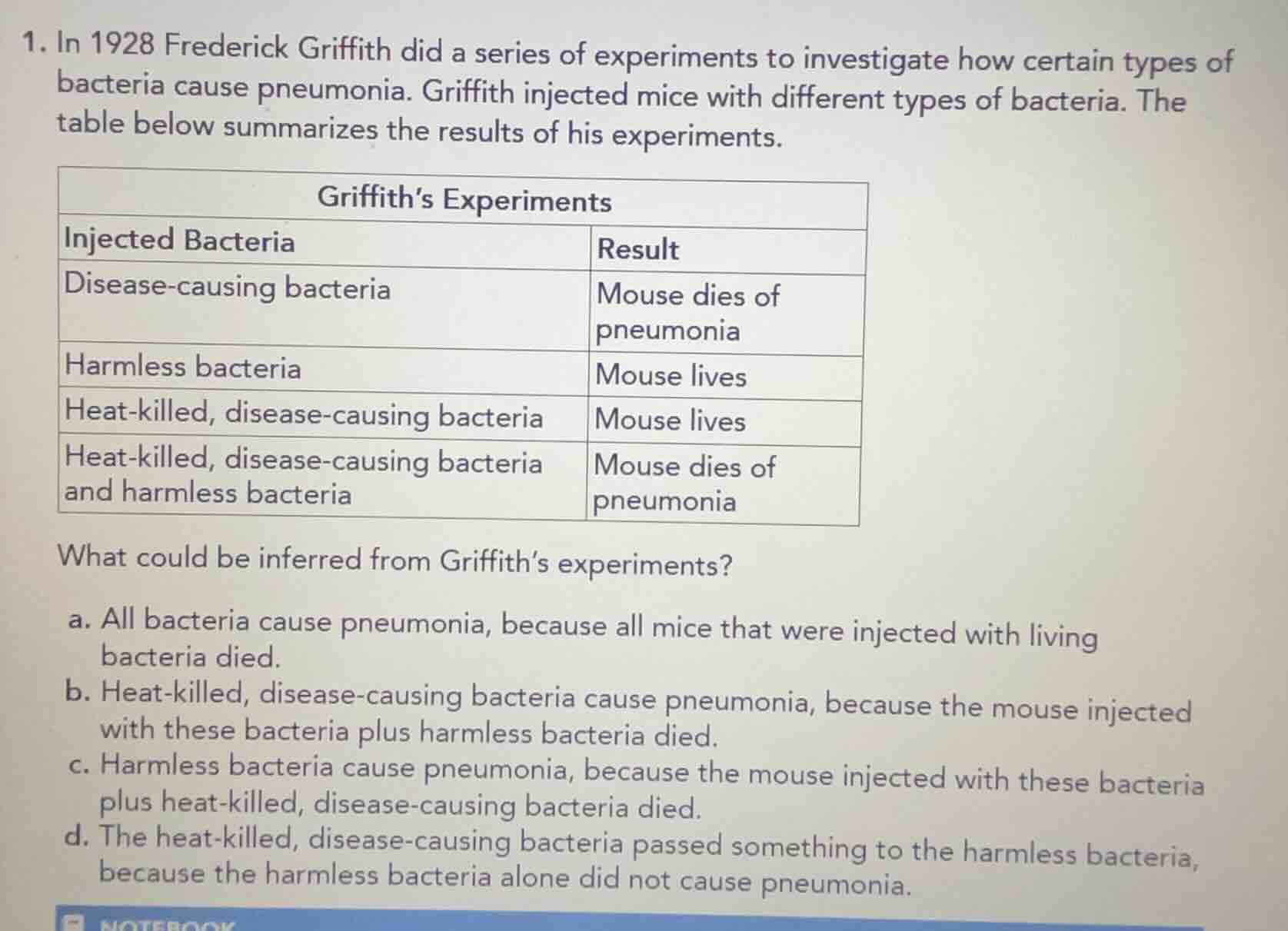
- in 1928 frederick griffith did a series of experiments to investigate how certain types of bacteria cause pneumonia. griffith injected mice with different types of bacteria. the table below summarizes the results of his experiments.
griffith’s experiments
injected bacteria | result
disease - causing bacteria | mouse dies of pneumonia
harmless bacteria | mouse lives
heat - killed, disease - causing bacteria | mouse lives
heat - killed, disease - causing bacteria and harmless bacteria | mouse dies of pneumonia
what could be inferred from griffith’s experiments?
a. all bacteria cause pneumonia, because all mice that were injected with living bacteria died.
b. heat - killed, disease - causing bacteria cause pneumonia, because the mouse injected with these bacteria plus harmless bacteria died.
c. harmless bacteria cause pneumonia, because the mouse injected with these bacteria plus heat - killed, disease - causing bacteria died.
d. the heat - killed, disease - causing bacteria passed something to the harmless bacteria, because the harmless bacteria alone did not cause pneumonia.
- Option a is incorrect: Mice injected with living harmless bacteria survived, so not all bacteria cause pneumonia.
- Option b is incorrect: Mice injected with only heat-killed disease-causing bacteria lived, so these bacteria alone do not cause pneumonia.
- Option c is incorrect: Harmless bacteria alone did not kill mice, so they do not cause pneumonia on their own.
- Option d is correct: When combined with heat-killed disease-causing bacteria, harmless bacteria became able to kill mice, meaning the heat-killed bacteria transferred a factor that transformed the harmless bacteria into disease-causing ones.

Snap & solve any problem in the app
Get step-by-step solutions on Sovi AI
Photo-based solutions with guided steps
Explore more problems and detailed explanations
d. The heat-killed, disease-causing bacteria passed something to the harmless bacteria, because the harmless bacteria alone did not cause pneumonia.