QUESTION IMAGE
Question
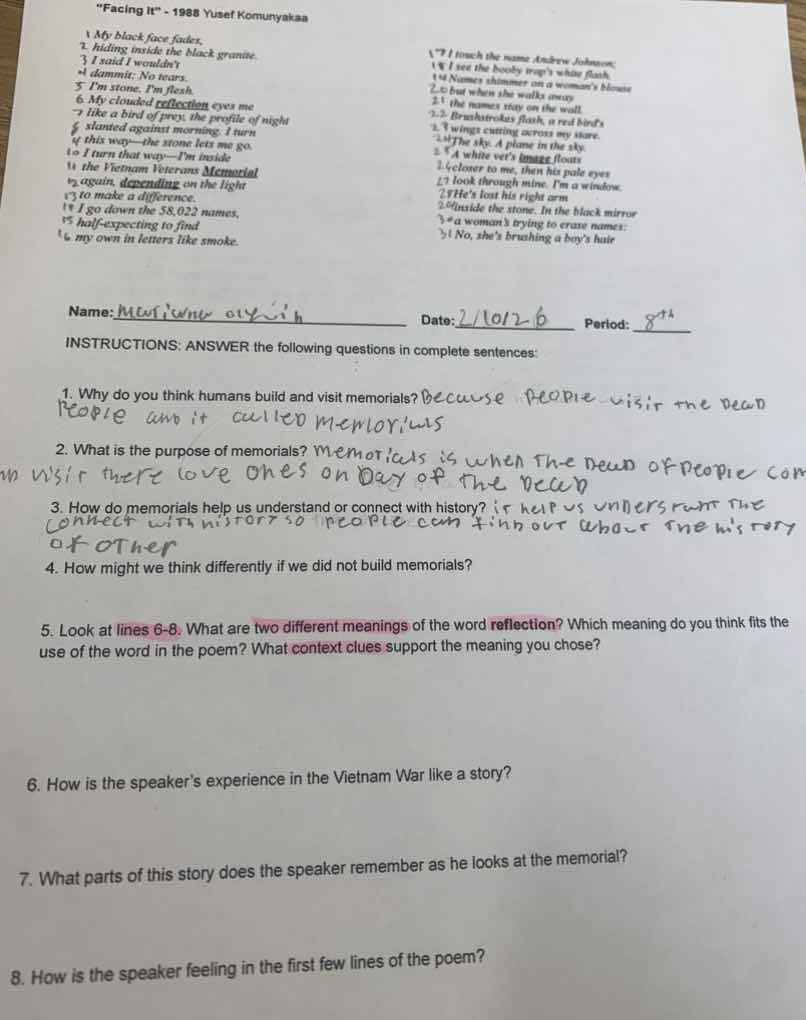
\facing it\ - 1988 yusef komunyakaa1 my black face fades,2. hiding inside the black granite.3 i said i wouldnt4 dammit: no tears.5 im stone. im flesh.6 my clouded reflection eyes me7 a bird of prey, the profile of night8 slanted against morning. i turn9 this way-the stone lets me go.10 i turn that way-im inside11 the vietnam veterans memorial12 again, depending on the light13 to make a difference.14 i go down the 58,022 names,15 half-expecting to find16 my own in letters like smoke.17 i touch the name andrew johnson;18 i see the booby traps white flash.19 names shimmer on a womans blouse20 but when she walks away21 the names stay on the wall.22 brushstrokes flash, a red birds23 wings cutting across my stare.24 sky. a plane in the sky.25 a white vets image floats26 close to me, then his pale eyes27 look through mine. im a window.28hes lost his right arm29inside the stone. in the black mirror30a womans trying to erase names:31 no, shes brushing a boys hairname:date: 2/10/26period:instructions: answer the following questions in complete sentences:1. why do you think humans build and visit memorials?2. what is the purpose of memorials?3. how do memorials help us understand or connect with history?4. how might we think differently if we did not build memorials?5. look at lines 6-8. what are two different meanings of the word reflection? which meaning do you think fits the use of the word in the poem? what context clues support the meaning you chose?6. how is the speakers experience in the vietnam war like a story?7. what parts of this story does the speaker remember as he looks at the memorial?8. how is the speaker feeling in the first few lines of the poem?
- Humans build and visit memorials to honor and remember people who have died, especially those lost in tragic events like wars, to preserve their legacies and process grief.
- The purpose of memorials is to commemorate the deceased, preserve collective memory of significant events, and provide a physical space for people to grieve, reflect, and connect with the human cost of history.
- Memorials help us understand and connect with history by making abstract historical losses tangible; they present specific names, stories, and contexts that ground large-scale historical events in individual human experiences, fostering empathy and a personal link to the past.
- Without memorials, we would be far more likely to forget the human stories behind historical tragedies, lose shared collective memory of sacrifice and loss, and struggle to pass down lessons from past conflicts or events to future generations.
- The two meanings of "reflection" are: 1) a mirror-like image, and 2) a thoughtful consideration of an idea or memory. In the poem, "clouded reflection" fits the mirror-like image meaning. Context clues include the speaker looking at their own face ("My black face fades") and being positioned at a memorial with a reflective surface, implying they are seeing their physical reflection, clouded by emotion or the memorial's setting.
- The speaker's Vietnam War experience is like a story because it has a narrative of personal trauma, specific vivid sensory details (like the "booby trap's white flash"), and a beginning, middle, and end tied to survival and lingering memory, just like a story with a plot and emotional arc.
- As he looks at the memorial, the speaker remembers the violent, sudden trauma of the war: the "booby trap's white flash," a comrade named Andrew Johnson who was lost, a helicopter ("chopper") in the sky, and a soldier who lost his right eye.
- In the first few lines, the speaker feels grief-stricken, tense, and emotionally closed off. Clues like "My black face fades," "Hiding inside the black granite," "I said I wouldn't / dammit: No tears," show he is struggling to hold back tears and is emotionally guarded while confronting the memorial.

Snap & solve any problem in the app
Get step-by-step solutions on Sovi AI
Photo-based solutions with guided steps
Explore more problems and detailed explanations
- Humans build and visit memorials to honor, remember, and grieve those who have died, particularly those lost in events like wars, and to preserve their legacies for future generations.
- The purpose of memorials is to commemorate deceased individuals, preserve collective memory of significant, often tragic historical events, and provide a physical space for reflection, grief, and education about the human cost of the past.
- Memorials help us connect with history by turning abstract historical losses into tangible, personal experiences; the names, stories, and physical space make large-scale events feel human, fostering empathy and a direct, personal link to the people and events of the past.
- If we did not build memorials, we would risk losing the collective memory of the human stories behind historical tragedies, struggle to pass down the lessons learned from past conflicts, and have no dedicated space to process grief or honor those who were lost, leading to a more disconnected understanding of history.
- The two meanings of "reflection" are: 1) a mirror-like visual image of something, and 2) careful, thoughtful consideration of an idea or memory. The mirror-like image meaning fits the poem. Context clues include the speaker referencing his own face fading and the physical setting of the memorial, which implies a reflective surface where he sees his clouded, emotionally affected physical reflection.
- The speaker's Vietnam War experience is like a story because it has a clear narrative of trauma and survival, with specific, vivid sensory details (such as the booby trap flash and comrade's name) that form a cohesive, emotionally charged plot of loss and lingering memory.
- As he looks at the memorial, the speaker remembers the sudden violence of a booby trap flash, the death of his comrade Andrew Johnson, a helicopter flying overhead, and a soldier who lost his right eye in the war.
- In the first few lines, the speaker feels emotionally guarded, grief-stricken, and tense. He is struggling to suppress tears, as shown by his statement "I said I wouldn't / dammit: No tears," and his description of hiding inside the memorial's granite reveals he is closed off while confronting his trauma.