QUESTION IMAGE
Question
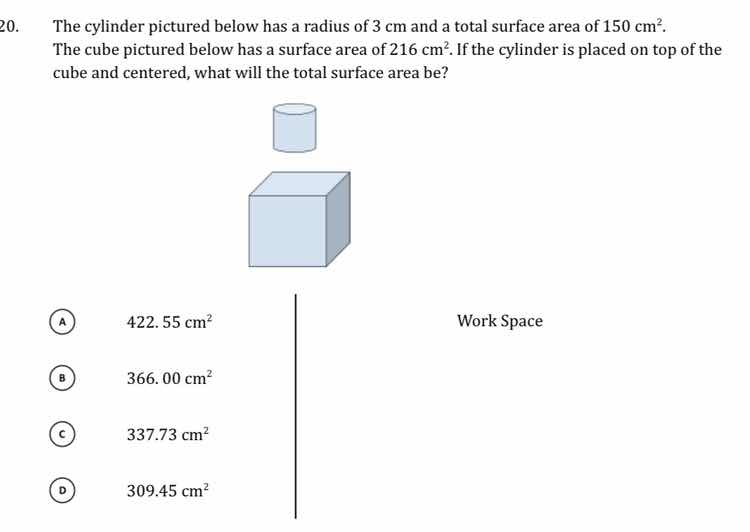
- the cylinder pictured below has a radius of 3 cm and a total surface area of 150 cm². the cube pictured below has a surface area of 216 cm². if the cylinder is placed on top of the cube and centered, what will the total surface area be? a 422.55 cm² b 366.00 cm² c 337.73 cm² d 309.45 cm² work space
Step1: Find the area of the circular base of the cylinder
The formula for the area of a circle is \( A = \pi r^2 \). Given \( r = 3 \) cm, we have \( A=\pi\times3^2 = 9\pi\) \( \text{cm}^2 \).
Step2: Analyze the total surface area of the combined figure
When the cylinder is placed on the cube, the overlapping area (the base of the cylinder and the corresponding area on the cube) is subtracted twice (once from the cylinder's surface area and once from the cube's, but actually we need to add the lateral surface area of the cylinder to the cube's surface area, and subtract the area of the two circular bases? Wait, no. Wait, the total surface area of the cylinder is \( 150 \) \( \text{cm}^2 \), which includes two circular bases and the lateral surface area. The cube's surface area is \( 216 \) \( \text{cm}^2 \). When we place the cylinder on the cube, we are covering one face of the cube with the base of the cylinder, so we need to subtract the area of one circular base from the cylinder's surface area (because that base is now attached to the cube and not exposed) and also subtract the area of one face of the cube (but wait, no: the cube's surface area is 6 faces. When we put the cylinder on top, we cover one face of the cube, so we need to subtract the area of that face? Wait, no, actually, the correct approach is: the combined surface area is (surface area of cylinder - area of one circular base) + (surface area of cube - area of one face of the cube) + area of the circular base? No, that's not right. Wait, let's think again. The cylinder has a total surface area of \( 2\pi r^2 + 2\pi r h=150 \) (where \( h \) is the height of the cylinder). The cube has a surface area of \( 6s^2 = 216 \), so \( s^2=36 \), so \( s = 6 \) cm (since side length \( s \) of cube is positive). Now, when we place the cylinder on the cube, the area where they are joined (the base of the cylinder and the top face of the cube) is no longer exposed. So for the cylinder, we now have the lateral surface area (total surface area of cylinder minus two circular bases) plus one circular base? Wait, no. Wait, the total surface area of the cylinder is \( 2\pi r^2 + 2\pi r h = 150 \). The lateral surface area is \( 2\pi r h=150 - 2\times9\pi=150 - 18\pi \). The cube's surface area is \( 216 \), which is \( 6\times6\times6 \) (since \( 6^3 \) is volume, wait no, surface area of cube is \( 6s^2 \), so \( 6s^2 = 216 \implies s^2 = 36 \implies s = 6 \) cm. So the top face of the cube has area \( 6\times6 = 36 \) \( \text{cm}^2 \). When we place the cylinder on the cube, we are covering the top face of the cube with the base of the cylinder. So the combined surface area is (surface area of cylinder - area of one circular base) + (surface area of cube - area of one face of the cube) + area of the circular base? No, that's confusing. Wait, actually, the correct way is: the combined surface area is (surface area of cylinder - area of one circular base) + surface area of cube. Because the cylinder's top base is still exposed, but the bottom base is attached to the cube, so we subtract one circular base from the cylinder's surface area (since that base is now internal), and the cube's surface area is reduced by the area of the face covered by the cylinder's base, but wait, no: the cube's surface area is 6 faces. When we put the cylinder on top, we cover one face, so we need to subtract the area of that face from the cube's surface area? Wait, no, the cube's surface area is 216, which is 6 faces each of area 36. If we cover one face with the cylinder's base (area \( 9\pi \ap…

Snap & solve any problem in the app
Get step-by-step solutions on Sovi AI
Photo-based solutions with guided steps
Explore more problems and detailed explanations
D. \( 309.45\ \text{cm}^2 \)