QUESTION IMAGE
Question
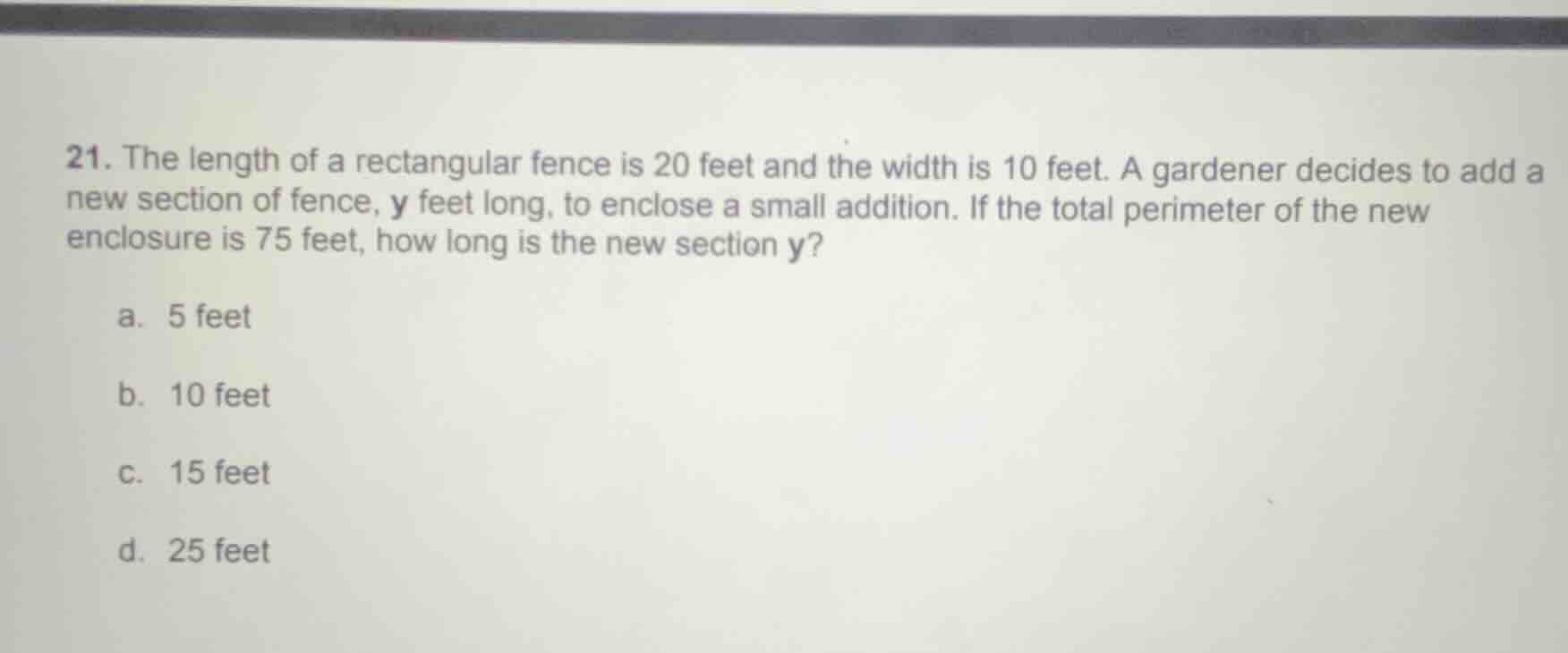
- the length of a rectangular fence is 20 feet and the width is 10 feet. a gardener decides to add a new section of fence, y feet long, to enclose a small addition. if the total perimeter of the new enclosure is 75 feet, how long is the new section y?
a. 5 feet
b. 10 feet
c. 15 feet
d. 25 feet
Step1: Recall the perimeter formula for a rectangle
The perimeter \( P \) of a rectangle is given by \( P = 2\times(\text{length} + \text{width}) \). Initially, the length is \( 20 \) feet and the width is \( 10 \) feet. When we add a new section \( y \) feet long, we are essentially adding \( y \) to the perimeter (since we are enclosing a new part, we can think of the new perimeter as the original perimeter plus \( y \), assuming the addition is such that we add one side; alternatively, we can set up the equation for the new perimeter).
First, calculate the original perimeter: \( P_{\text{original}} = 2\times(20 + 10) = 2\times30 = 60 \) feet.
Step2: Set up the equation for the new perimeter
The new perimeter \( P_{\text{new}} = 75 \) feet. We know that \( P_{\text{new}} = P_{\text{original}} + y \) (because we are adding a new section of length \( y \) to the fence, so the total perimeter increases by \( y \)). So we have the equation:
\( 60 + y = 75 \)
Step3: Solve for \( y \)
Subtract \( 60 \) from both sides of the equation:
\( y = 75 - 60 \)
\( y = 15 \)
Wait, no, wait. Wait, maybe my initial assumption about the perimeter change is wrong. Wait, maybe the new enclosure is a rectangle with length \( 20 \) and width \( 10 \), but we are adding a new section \( y \), so maybe the new shape is still a rectangle but with one side extended? Wait, no, the problem says "add a new section of fence, \( y \) feet long, to enclose a small addition". So maybe the new perimeter is calculated as follows: the original perimeter is \( 2(20 + 10) = 60 \). When we add a new section \( y \), we are adding \( y \) to the perimeter, but actually, maybe the new perimeter is \( 2(20 + 10) + y = 75 \)? Wait, no, that would be if we are adding a single side. Wait, let's re-examine.
Wait, the original rectangle has length \( 20 \) and width \( 10 \). The perimeter is \( 2(20 + 10) = 60 \). Now, when we add a new section \( y \) feet long to enclose a small addition, the new perimeter is \( 75 \). So the equation is \( 60 + y = 75 \)? Wait, but that would give \( y = 15 \), but let's check the answer options. Wait, but maybe the new enclosure is a rectangle with length \( 20 \) and width \( 10 + y \)? No, the problem says "add a new section of fence, \( y \) feet long, to enclose a small addition". Maybe the new perimeter is \( 2(20 + (10 + y)) \)? No, that doesn't make sense. Wait, maybe the original perimeter is \( 2*20 + 2*10 = 60 \). Then, when we add a new section \( y \), we are adding \( y \) to one of the lengths or widths. Wait, maybe the new perimeter is \( 220 + 2(10 + y) = 75 \)? Let's try that.
\( 40 + 20 + 2y = 75 \)
\( 60 + 2y = 75 \)
\( 2y = 15 \)
\( y = 7.5 \), which is not an option. So my initial approach must be wrong.
Wait, maybe the new enclosure is a rectangle where we are adding \( y \) to the length, so the new length is \( 20 + y \) and width is \( 10 \). Then the perimeter is \( 2*((20 + y) + 10) = 75 \).
So \( 2*(30 + y) = 75 \)
\( 60 + 2y = 75 \)
\( 2y = 15 \)
\( y = 7.5 \), still not an option.
Wait, maybe the new section is added to both length and width? No, the problem says "a new section of fence, \( y \) feet long", so it's a single section. Wait, maybe the original perimeter is \( 20 + 10 + 20 + 10 = 60 \). Then, when we add a new section \( y \), the new perimeter is \( 60 + y = 75 \), so \( y = 15 \). But the answer options have 15 as option c. Wait, but let's check again.
Wait, the original perimeter is \( 2*(20 + 10) = 60 \). The new perimeter is 75. So the difference is \( 75 - 60…

Snap & solve any problem in the app
Get step-by-step solutions on Sovi AI
Photo-based solutions with guided steps
Explore more problems and detailed explanations
c. 15 feet