QUESTION IMAGE
Question
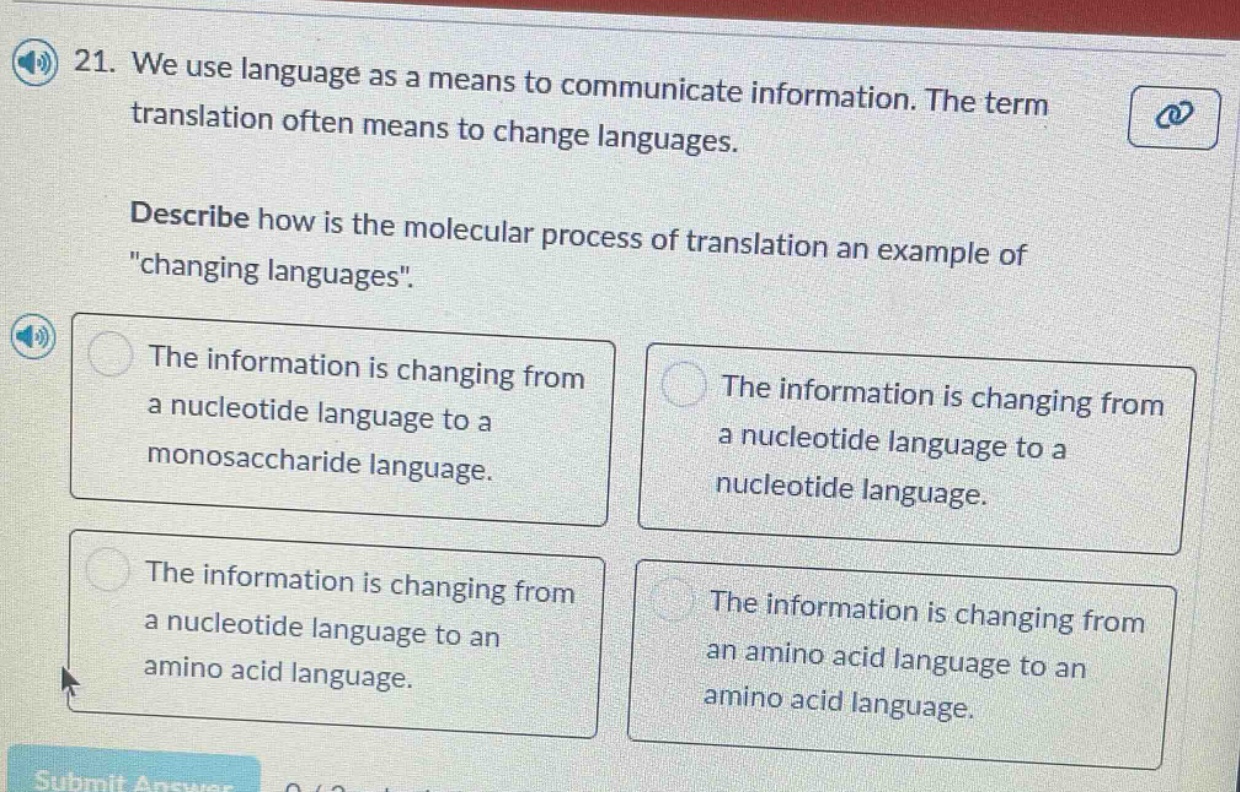
- we use language as a means to communicate information. the term translation often means to change languages.
describe how is the molecular process of translation an example of \changing languages\.
the information is changing from a nucleotide language to a monosaccharide language.
the information is changing from a nucleotide language to a nucleotide language.
the information is changing from a nucleotide language to an amino acid language.
the information is changing from an amino acid language to an amino acid language.
In molecular biology, the process of translation involves converting the genetic information encoded in mRNA (composed of nucleotides) into a protein. Proteins are made up of amino acids. So the "language" of nucleotides (in mRNA) is translated into the "language" of amino acids (in proteins). Let's analyze each option:
- Option 1: Monosaccharides are related to carbohydrates, not translation. Eliminate.
- Option 2: Changing from nucleotide to nucleotide language doesn't represent a change. Eliminate.
- Option 3: This matches the translation process (nucleotide - mRNA to amino acid - protein). Correct.
- Option 4: Changing from amino acid to amino acid language doesn't represent a change. Eliminate.

Snap & solve any problem in the app
Get step-by-step solutions on Sovi AI
Photo-based solutions with guided steps
Explore more problems and detailed explanations
C. The information is changing from a nucleotide language to an amino acid language. (Note: Assuming the third option (the one with "a nucleotide language to an amino acid language") is option C. If the original options had different labels, adjust the label but keep the text.)