QUESTION IMAGE
Question
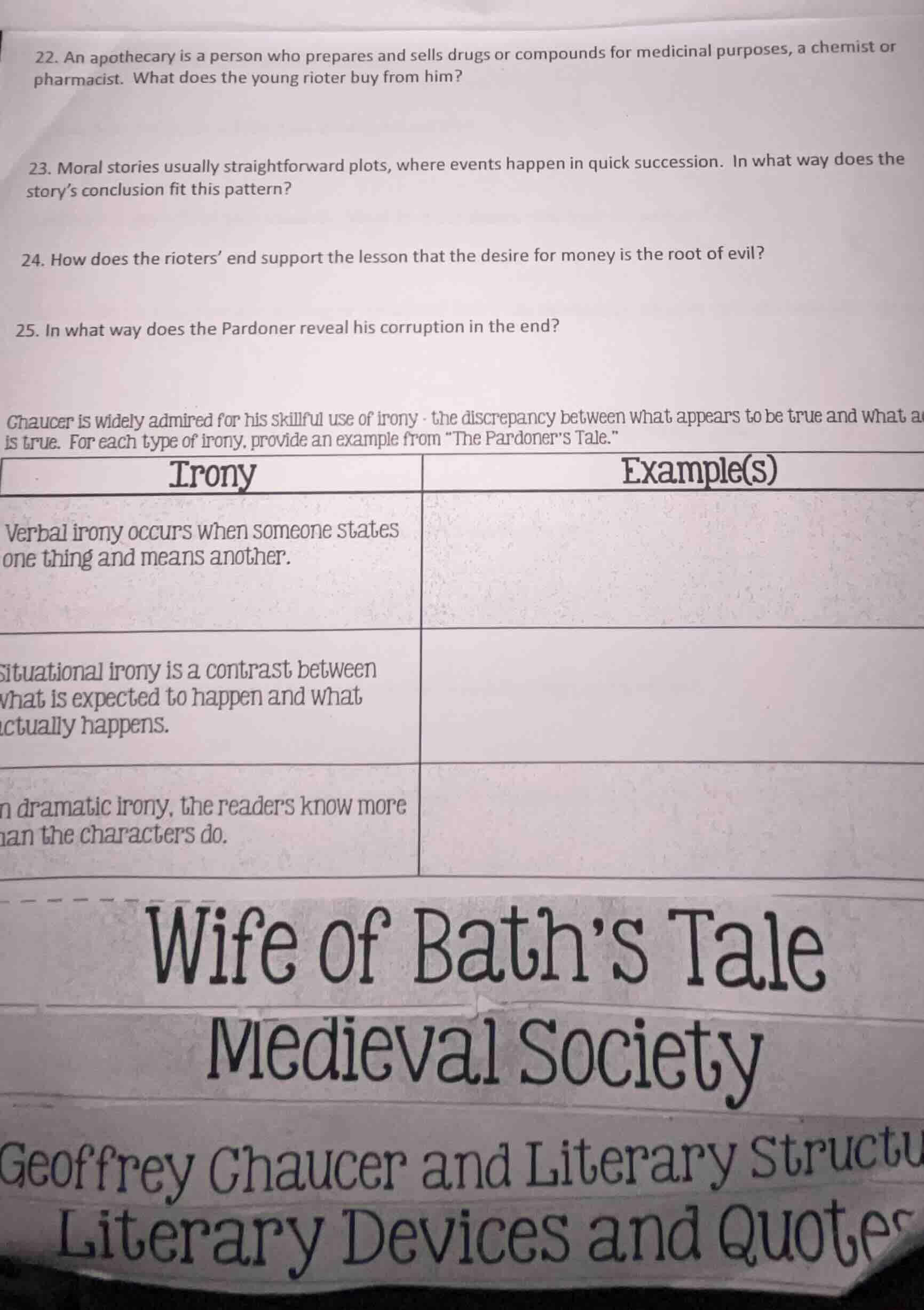
- an apothecary is a person who prepares and sells drugs or compounds for medicinal purposes, a chemist or pharmacist. what does the young rioter buy from him?
- moral stories usually straightforward plots, where events happen in quick succession. in what way does the story’s conclusion fit this pattern?
- how does the rioters’ end support the lesson that the desire for money is the root of evil?
- in what way does the pardoner reveal his corruption in the end?
chaucer is widely admired for his skillful use of irony - the discrepancy between what appears to be true and what a is true. for each type of irony, provide an example from \the pardoners tale.\
| irony | example(s) |
|---|---|
| situational irony is a contrast between what is expected to happen and what actually happens. | |
| in dramatic irony, the readers know more than the characters do. |
wife of bath’s tale
medieval society
geoffrey chaucer and literary structu
literary devices and quote

Snap & solve any problem in the app
Get step-by-step solutions on Sovi AI
Photo-based solutions with guided steps
Explore more problems and detailed explanations
- Poison.
- The conclusion occurs rapidly: the two rioters kill the third, and then immediately die from drinking the poisoned wine he brought.
- Their greed for the gold coins leads them to plot against and kill one another, resulting in the death of all three.
- After preaching against greed, he immediately attempts to sell fake relics and pardons to the pilgrims for money.
Verbal irony: The rioters swear to live and die for each other as "brothers" while actually planning to kill one another.
Situational irony: The rioters go on a quest to "kill Death" but instead find their own deaths through the gold.
Dramatic irony: The audience knows the wine is poisoned, but the two rioters drink it to celebrate after killing the third.