QUESTION IMAGE
Question
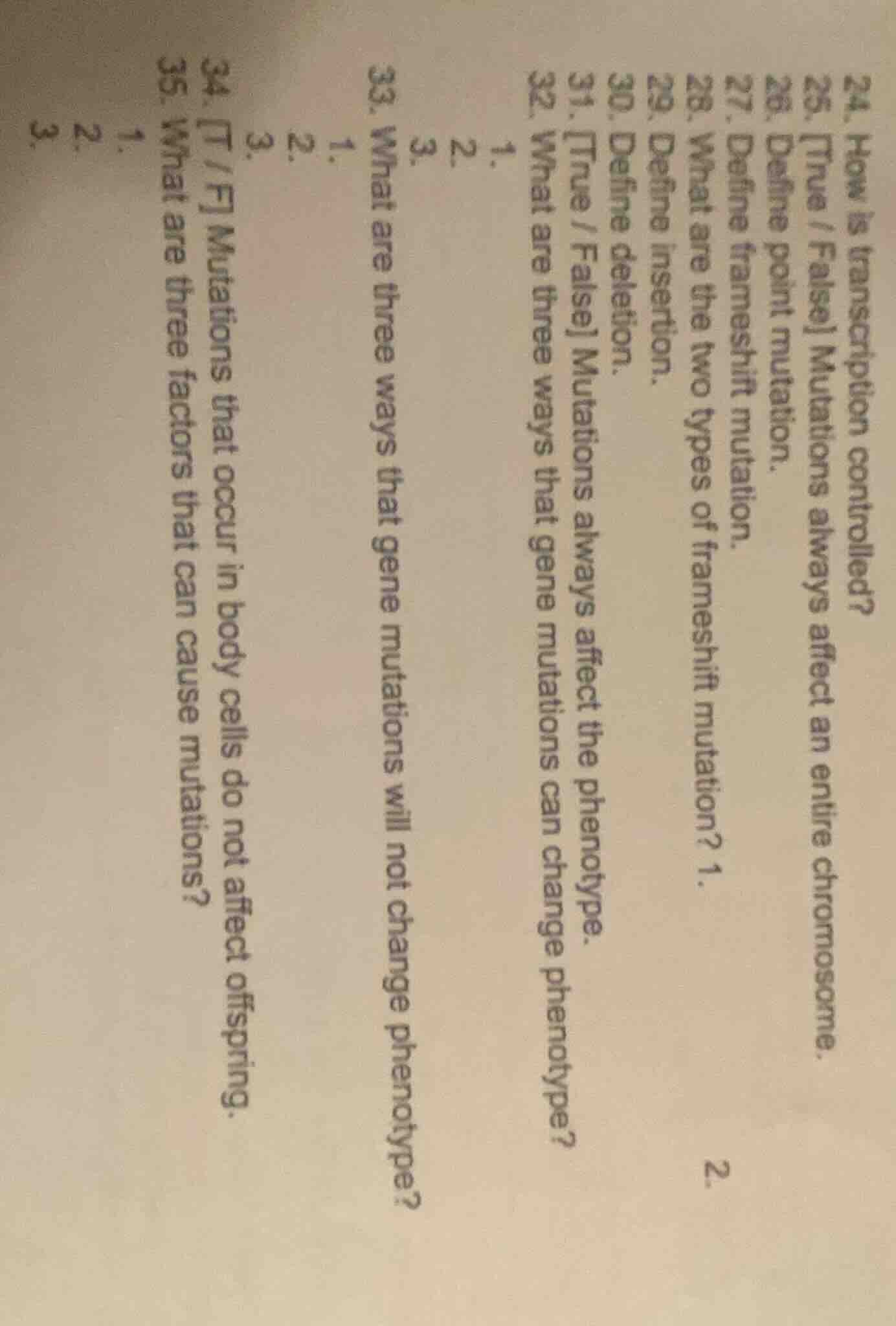
- how is transcription controlled?25. true / false mutations always affect an entire chromosome.26. define point mutation.27. define frameshift mutation.28. what are the two types of frameshift mutation? 1. 2.29. define insertion.30. define deletion.31. true / false mutations always affect the phenotype.32. what are three ways that gene mutations can change phenotype?1.2.3.33. what are three ways that gene mutations will not change phenotype?1.2.3.34. t / f mutations that occur in body cells do not affect offspring.35. what are three factors that can cause mutations?1.2.3.
Brief Explanations
- Transcription is controlled by regulatory proteins (like transcription factors) that bind to promoter/enhancer regions of DNA, as well as epigenetic modifications (e.g., DNA methylation) and RNA interference, which either promote or block RNA polymerase access to genes.
- Mutations can be small (e.g., point mutations) that only affect a single nucleotide, not an entire chromosome.
- A point mutation is a change in a single nucleotide base in DNA.
- A frameshift mutation is a genetic mutation caused by insertion or deletion of a number of nucleotides that shifts the reading frame of the genetic code.
- The two main types of frameshift mutations are insertions and deletions.
- Insertion is a type of mutation where one or more extra nucleotide bases are added to a DNA sequence.
- Deletion is a type of mutation where one or more nucleotide bases are removed from a DNA sequence.
- Some mutations are silent (change a nucleotide but not the encoded amino acid) and do not alter the phenotype.
32.
- A mutation can change the amino acid sequence of a protein, altering its function.
- A mutation can disrupt a regulatory region, changing gene expression levels.
- A mutation can create a premature stop codon, truncating a protein.
33.
- A silent mutation changes a nucleotide but not the encoded amino acid.
- A mutation occurs in a non-coding region of DNA with no functional role.
- A mutation results in an amino acid change that does not affect protein structure/function (a neutral mutation).
- Mutations in body (somatic) cells are not passed to gametes, so they cannot be inherited by offspring.
35.
- Exposure to mutagens like chemical toxins or radiation.
- Errors that occur during DNA replication.
- Spontaneous changes to DNA bases over time (e.g., depurination).

Snap & solve any problem in the app
Get step-by-step solutions on Sovi AI
Photo-based solutions with guided steps
Explore more problems and detailed explanations
- Transcription is controlled by transcription factors binding to regulatory DNA regions, epigenetic modifications (e.g., DNA methylation), and RNA-based mechanisms that regulate RNA polymerase activity and gene expression.
- False
- A point mutation is a change in a single nucleotide base within a DNA sequence.
- A frameshift mutation is a mutation that shifts the reading frame of the genetic code, caused by insertions or deletions of non-multiples of three nucleotides.
- 1. Insertion 2. Deletion
- Insertion is a mutation where one or more extra nucleotide bases are added to a DNA sequence, potentially causing a frameshift.
- Deletion is a mutation where one or more nucleotide bases are removed from a DNA sequence, potentially causing a frameshift.
- False
- 1. Alter protein amino acid sequence 2. Disrupt gene regulatory regions 3. Introduce premature stop codons
- 1. Silent mutation (no amino acid change) 2. Mutation in non-coding DNA 3. Neutral mutation (no protein function change)
- True
- 1. Exposure to mutagens (radiation/chemicals) 2. DNA replication errors 3. Spontaneous DNA base damage