QUESTION IMAGE
Question
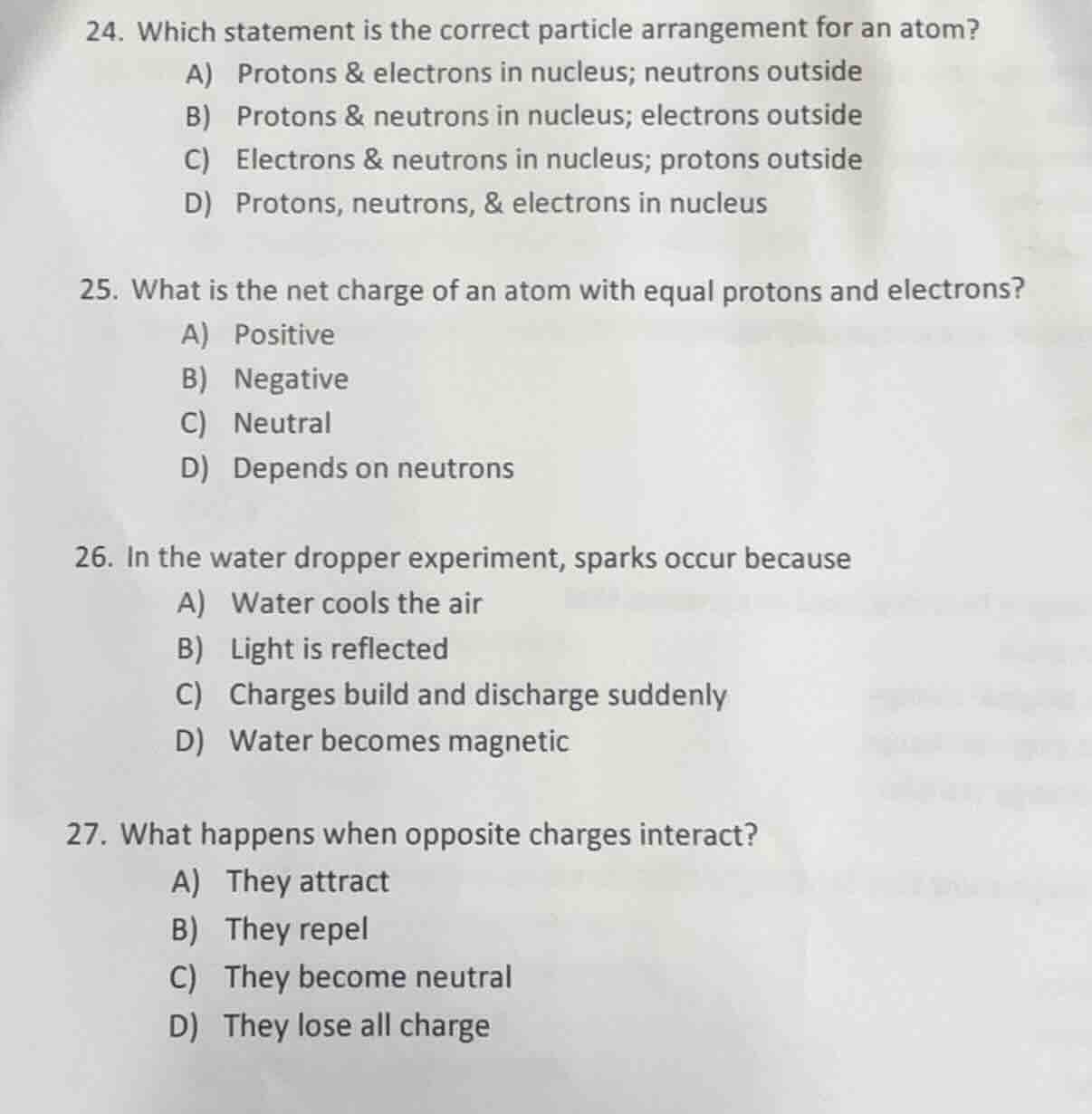
- which statement is the correct particle arrangement for an atom?
a) protons & electrons in nucleus; neutrons outside
b) protons & neutrons in nucleus; electrons outside
c) electrons & neutrons in nucleus; protons outside
d) protons, neutrons, & electrons in nucleus
- what is the net charge of an atom with equal protons and electrons?
a) positive
b) negative
c) neutral
d) depends on neutrons
- in the water dropper experiment, sparks occur because
a) water cools the air
b) light is reflected
c) charges build and discharge suddenly
d) water becomes magnetic
- what happens when opposite charges interact?
a) they attract
b) they repel
c) they become neutral
d) they lose all charge
Question 24
To determine the correct particle arrangement in an atom, we recall atomic structure: the nucleus contains protons (positive charge) and neutrons (neutral), while electrons (negative charge) orbit outside the nucleus. Option A is wrong (electrons not in nucleus, neutrons are in nucleus). Option C is wrong (protons are in nucleus, electrons outside). Option D is wrong (electrons are outside nucleus). Option B matches the correct structure.
Protons have a positive charge, electrons have a negative charge, and neutrons are neutral. If the number of protons (positive charges) equals the number of electrons (negative charges), their charges cancel out. So the net charge is neutral. Option A is incorrect (more protons would be positive), Option B is incorrect (more electrons would be negative), Option D is incorrect (neutrons don’t affect charge balance).
In the water dropper experiment (related to static electricity), sparks occur due to electrostatic discharge. When charges build up (e.g., due to friction or separation) and then discharge suddenly, it creates a spark. Option A is incorrect (cooling air doesn’t cause sparks). Option B is incorrect (light reflection isn’t related to spark formation). Option D is incorrect (water doesn’t become magnetic in this context).

Snap & solve any problem in the app
Get step-by-step solutions on Sovi AI
Photo-based solutions with guided steps
Explore more problems and detailed explanations
B) Protons & neutrons in nucleus; electrons outside