QUESTION IMAGE
Question
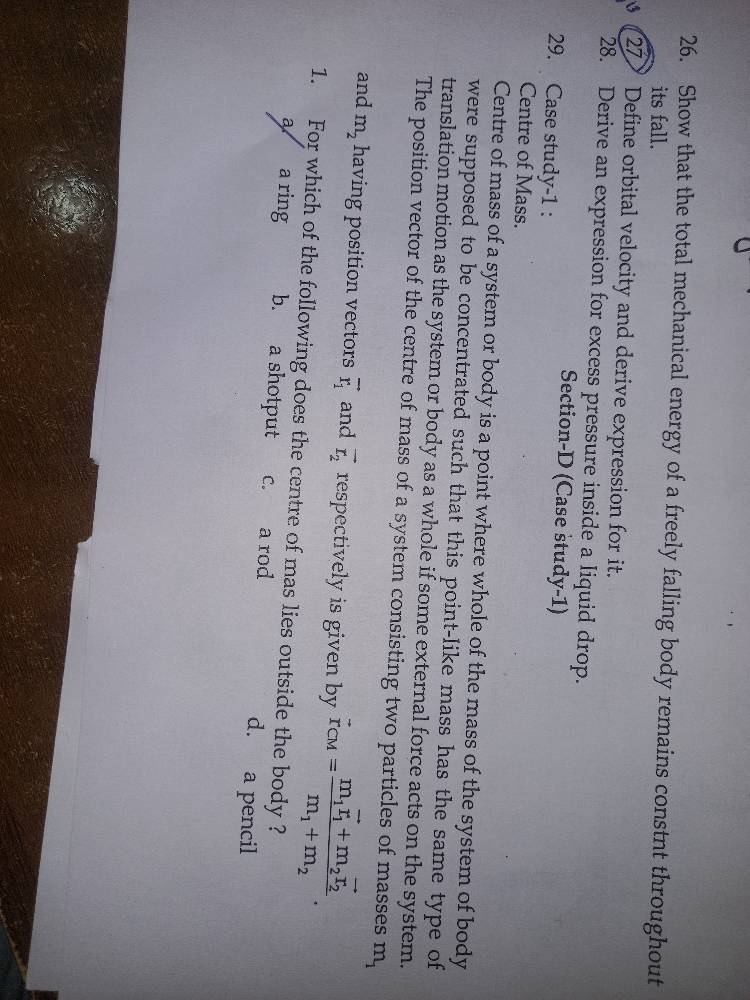
- show that the total mechanical energy of a freely falling body remains constant throughout its fall.
27.
- define orbital velocity and derive expression for it.
- derive an expression for excess pressure inside a liquid drop.
section-d (case study-1)
case study-1 :
centre of mass.
centre of mass of a system or body is a point where whole of the mass of the system of body were supposed to be concentrated such that this point-like mass has the same type of translation motion as the system or body as a whole if some external force acts on the system.
the position vector of the centre of mass of a system consisting two particles of masses m₁ and m₂ having position vectors $overrightarrow{r_1}$ and $overrightarrow{r_2}$ respectively is given by $overrightarrow{r_{cm}} = \frac{m_1overrightarrow{r_1}+m_2overrightarrow{r_2}}{m_1+m_2}$
- for which of the following does the centre of mas lies outside the body?
a. a ring
b. a shotput
c. a rod
d. a pencil
7 (Sub-question 1):
The center of mass (COM) is a point that represents the average position of the mass distribution of a body. For symmetric, hollow objects with mass distributed only on their boundary, the COM can lie outside the physical body. A ring is a hollow circular structure with all mass concentrated at its circumference; its COM is at the geometric center, which is not part of the ring's physical material. The other options (shotput, rod, pencil) are solid or have mass distributed such that their COM lies within their physical boundaries.
Step1: Define total mechanical energy
Total mechanical energy $E = K + U$, where $K$ is kinetic energy, $U$ is gravitational potential energy.
Step2: Energy at initial height $h$
Let initial velocity $v_0=0$. Initial kinetic energy $K_1 = 0$. Initial potential energy $U_1 = mgh$. So $E_1 = 0 + mgh = mgh$.
Step3: Energy after falling distance $y$
Velocity at this point: $v^2 = v_0^2 + 2gy = 2gy$. Kinetic energy $K_2 = \frac{1}{2}mv^2 = mgy$. Potential energy $U_2 = mg(h-y)$. Total energy $E_2 = mgy + mg(h-y) = mgh$.
Step4: Compare energies
$E_1 = E_2 = mgh$, so energy is constant.
Step1: Define orbital velocity
Orbital velocity $v_o$ is the speed of a satellite to orbit a planet. For a satellite of mass $m$ orbiting a planet of mass $M$, centripetal force = gravitational force:
$$\frac{mv_o^2}{r} = G\frac{Mm}{r^2}$$
where $r = R + h$ (R = planet radius, h = satellite height), $G$ = gravitational constant.
Step2: Derive orbital velocity
Cancel $m$ and rearrange: A liquid drop has surface tension $T$, which creates inward pressure. The excess pressure $\Delta P$ is the difference between internal and external pressure. Consider a spherical drop of radius $r$. Work done to increase radius by $dr$: $dW = T \times 2 \times 4\pi r dr$ (factor of 2 for liquid-air interface). This work equals pressure-volume work: $dW = \Delta P \times 4\pi r^2 dr$. Equate the two:
$$v_o = \sqrt{\frac{GM}{r}} = \sqrt{\frac{GM}{R+h}}$$
For near-earth orbit ($h<Step3: Define excess pressure in liquid drop
Step4: Derive excess pressure
$$\Delta P \times 4\pi r^2 dr = T \times 8\pi r dr$$
Cancel common terms:
$$\Delta P = \frac{2T}{r}$$

Snap & solve any problem in the app
Get step-by-step solutions on Sovi AI
Photo-based solutions with guided steps
Explore more problems and detailed explanations
a. a ring
---