QUESTION IMAGE
Question
y ≥ 2x - 1
x + y ≥ -3
o a)
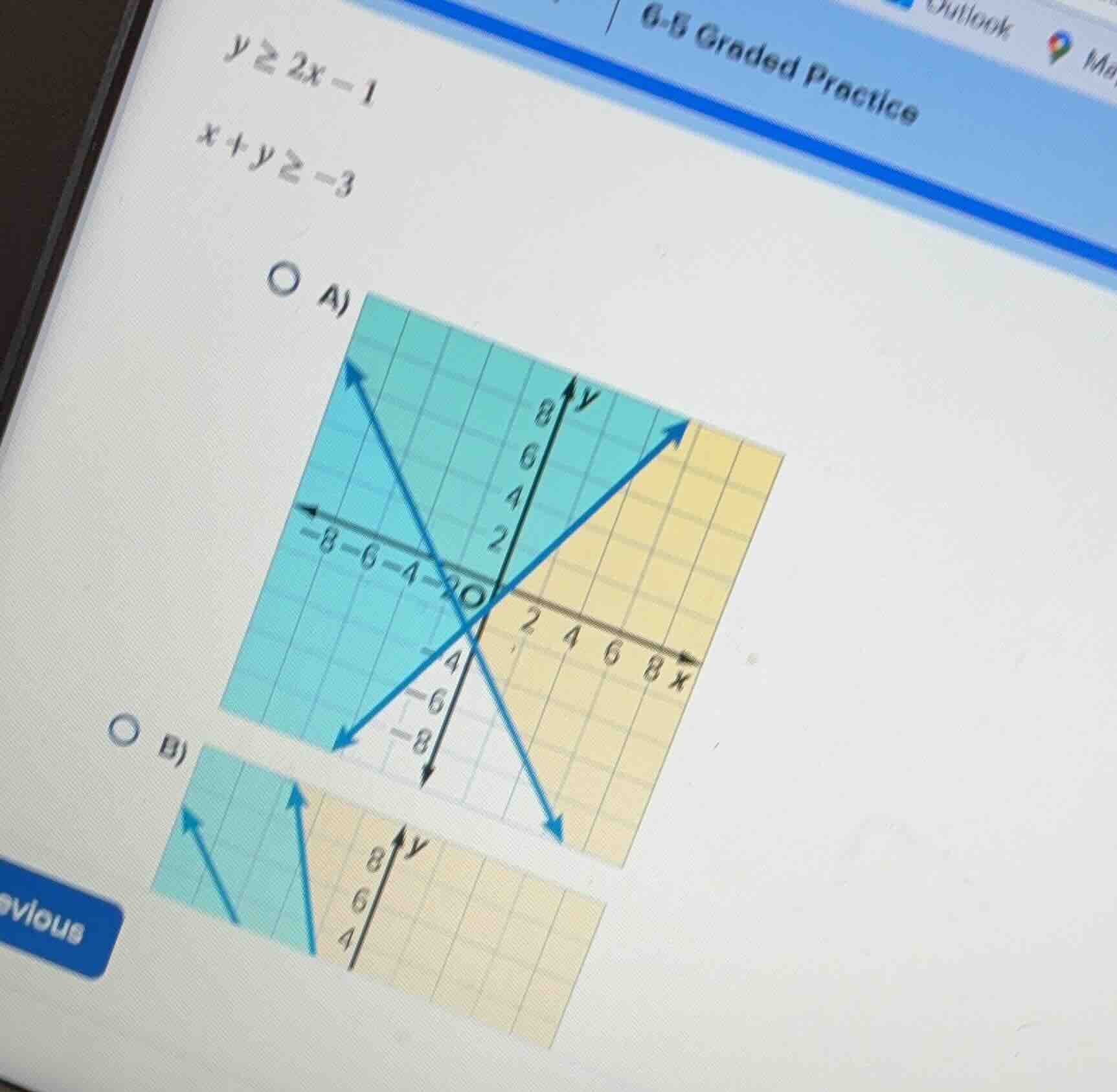
graph a
o b)
graph b
Step1: Analyze \( y \geq 2x - 1 \)
The line \( y = 2x - 1 \) has a slope of \( 2 \) and a \( y \)-intercept of \( -1 \). The inequality \( y \geq 2x - 1 \) means we shade above this line (since \( y \) is greater than or equal to the line's value). The line should be solid (because of the "or equal to" in the inequality).
Step2: Analyze \( x + y \geq -3 \)
Rewrite \( x + y \geq -3 \) as \( y \geq -x - 3 \). This line has a slope of \( -1 \) and a \( y \)-intercept of \( -3 \). We shade above this line (since \( y \geq -x - 3 \)) and the line is solid.
Step3: Compare with Graphs
- For the first inequality \( y \geq 2x - 1 \), the line with slope \( 2 \) (going up 2, right 1) should have shading above it.
- For the second inequality \( y \geq -x - 3 \), the line with slope \( -1 \) (going down 1, right 1) should have shading above it.
- Looking at option A, the blue regions (shaded) align with the regions above both lines \( y = 2x - 1 \) and \( y = -x - 3 \). The other option (B) does not match the shading for both inequalities.

Snap & solve any problem in the app
Get step-by-step solutions on Sovi AI
Photo-based solutions with guided steps
Explore more problems and detailed explanations
A) (the graph with the two lines \( y = 2x - 1 \) and \( y = -x - 3 \) and shading above both, forming a region that includes the area where both inequalities are satisfied)