QUESTION IMAGE
Question
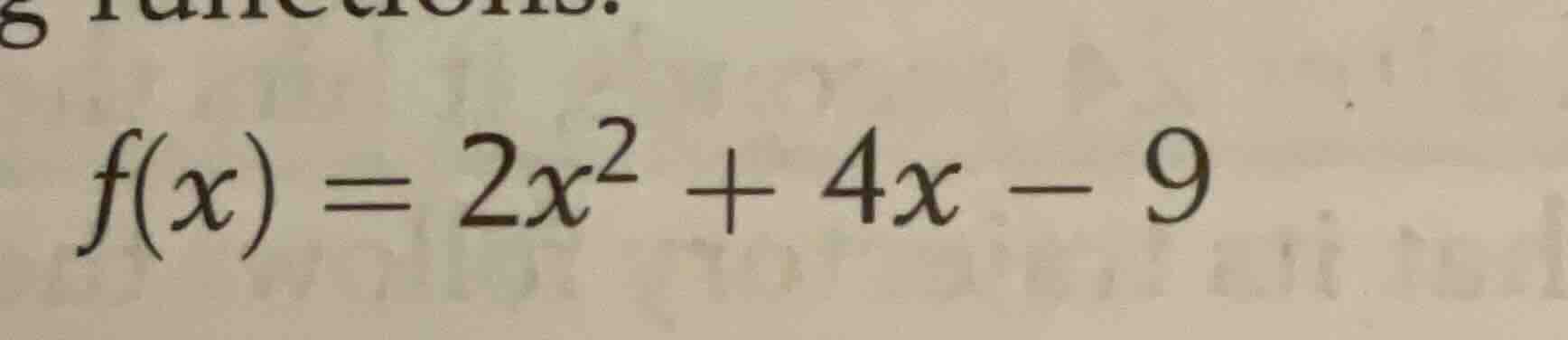
f(x) = 2x² + 4x - 9
Assuming the problem is to find the vertex form of the quadratic function \( f(x) = 2x^2 + 4x - 9 \) (a common task with quadratic functions), we can use the method of completing the square.
Step 1: Factor out the coefficient of \( x^2 \) from the first two terms
We factor out 2 from \( 2x^2 + 4x \):
\( f(x) = 2(x^2 + 2x) - 9 \)
Step 2: Complete the square inside the parentheses
To complete the square for \( x^2 + 2x \), we take half of the coefficient of \( x \) (which is \( \frac{2}{2}=1 \)), square it ( \( 1^2 = 1 \) ), and add and subtract it inside the parentheses. But since there is a factor of 2 outside, we need to be careful with the constant term:
\( f(x) = 2(x^2 + 2x + 1 - 1) - 9 \)
\( f(x) = 2((x + 1)^2 - 1) - 9 \)
Step 3: Distribute the 2 and simplify
We distribute the 2:
\( f(x) = 2(x + 1)^2 - 2 - 9 \)
Then combine the constant terms:
\( f(x) = 2(x + 1)^2 - 11 \)
If the problem was to find the vertex, the vertex of a quadratic function in the form \( f(x) = a(x - h)^2 + k \) is \( (h, k) \). From the vertex form we just found, \( h = - 1 \) and \( k = - 11 \), so the vertex is \( (-1, -11) \).
If the problem was to find the minimum (since \( a = 2>0 \), the parabola opens upwards) value of the function, the minimum value is \( k = - 11 \) (achieved at \( x = - 1 \)).
Since the original problem statement was cut off, but based on the function given (a quadratic function), these are common operations. If you had a different goal (like finding roots, domain, range, etc.), the steps would be adjusted accordingly.
For example, if we want to find the roots (solve \( 2x^2 + 4x - 9 = 0 \)) using the quadratic formula \( x=\frac{-b\pm\sqrt{b^2 - 4ac}}{2a} \) where \( a = 2 \), \( b = 4 \), and \( c=-9 \):
Step 1: Identify \( a \), \( b \), and \( c \)
\( a = 2 \), \( b = 4 \), \( c = - 9 \)
Step 2: Calculate the discriminant \( D = b^2 - 4ac \)
\( D=(4)^2-4\times2\times(-9)=16 + 72 = 88 \)
Step 3: Apply the quadratic formula
\( x=\frac{-4\pm\sqrt{88}}{2\times2}=\frac{-4\pm2\sqrt{22}}{4}=\frac{-2\pm\sqrt{22}}{2} \)
Please clarify the exact problem (e.g., find vertex, roots, minimum/maximum value, graph the function, etc.) so that a more specific solution can be provided.

Snap & solve any problem in the app
Get step-by-step solutions on Sovi AI
Photo-based solutions with guided steps
Explore more problems and detailed explanations
Step 1: Factor out the coefficient of \( x^2 \) from the first two terms
We factor out 2 from \( 2x^2 + 4x \):
\( f(x) = 2(x^2 + 2x) - 9 \)
Step 2: Complete the square inside the parentheses
To complete the square for \( x^2 + 2x \), we take half of the coefficient of \( x \) (which is \( \frac{2}{2}=1 \)), square it ( \( 1^2 = 1 \) ), and add and subtract it inside the parentheses. But since there is a factor of 2 outside, we need to be careful with the constant term:
\( f(x) = 2(x^2 + 2x + 1 - 1) - 9 \)
\( f(x) = 2((x + 1)^2 - 1) - 9 \)
Step 3: Distribute the 2 and simplify
We distribute the 2:
\( f(x) = 2(x + 1)^2 - 2 - 9 \)
Then combine the constant terms:
\( f(x) = 2(x + 1)^2 - 11 \)
If the problem was to find the vertex, the vertex of a quadratic function in the form \( f(x) = a(x - h)^2 + k \) is \( (h, k) \). From the vertex form we just found, \( h = - 1 \) and \( k = - 11 \), so the vertex is \( (-1, -11) \).
If the problem was to find the minimum (since \( a = 2>0 \), the parabola opens upwards) value of the function, the minimum value is \( k = - 11 \) (achieved at \( x = - 1 \)).
Since the original problem statement was cut off, but based on the function given (a quadratic function), these are common operations. If you had a different goal (like finding roots, domain, range, etc.), the steps would be adjusted accordingly.
For example, if we want to find the roots (solve \( 2x^2 + 4x - 9 = 0 \)) using the quadratic formula \( x=\frac{-b\pm\sqrt{b^2 - 4ac}}{2a} \) where \( a = 2 \), \( b = 4 \), and \( c=-9 \):
Step 1: Identify \( a \), \( b \), and \( c \)
\( a = 2 \), \( b = 4 \), \( c = - 9 \)
Step 2: Calculate the discriminant \( D = b^2 - 4ac \)
\( D=(4)^2-4\times2\times(-9)=16 + 72 = 88 \)
Step 3: Apply the quadratic formula
\( x=\frac{-4\pm\sqrt{88}}{2\times2}=\frac{-4\pm2\sqrt{22}}{4}=\frac{-2\pm\sqrt{22}}{2} \)
Please clarify the exact problem (e.g., find vertex, roots, minimum/maximum value, graph the function, etc.) so that a more specific solution can be provided.