QUESTION IMAGE
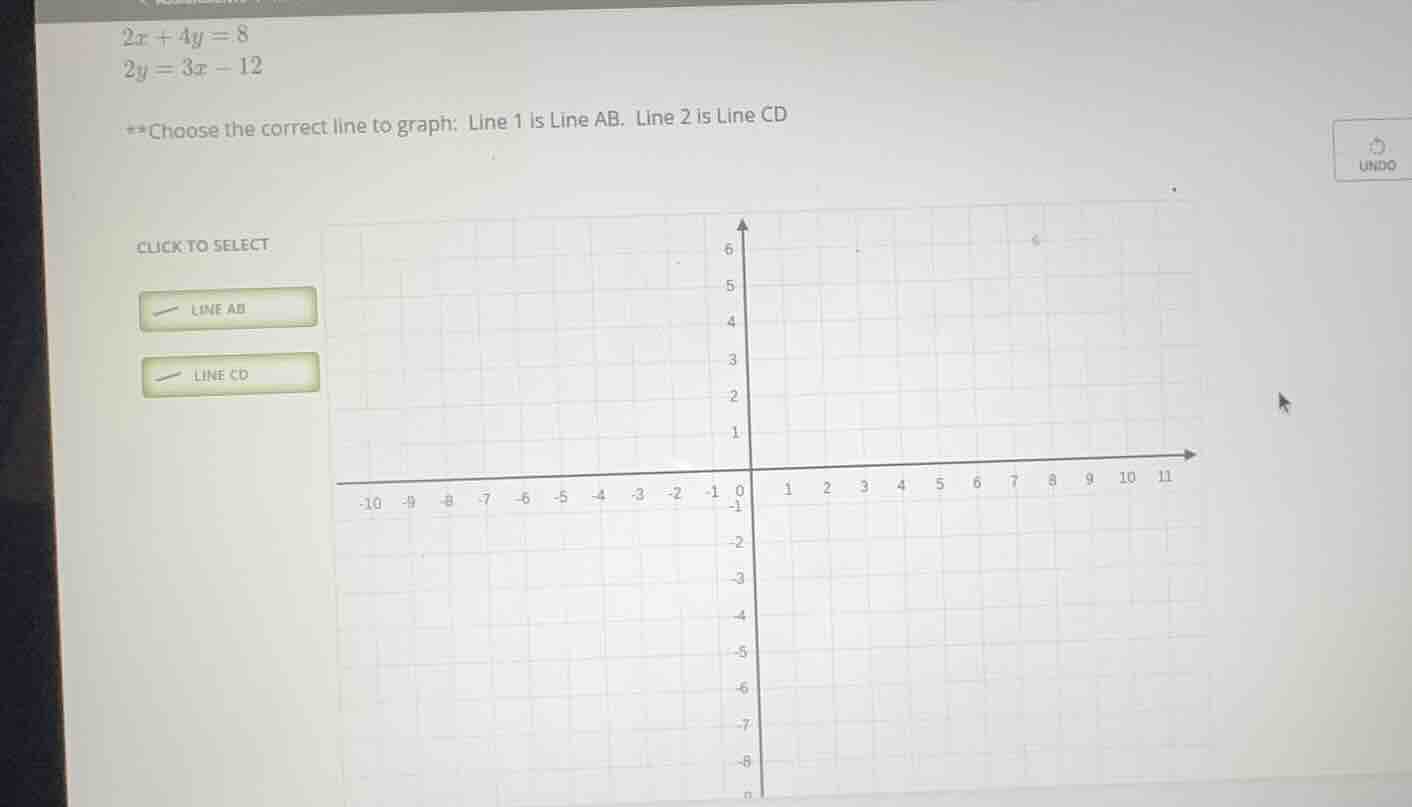
Question
2x + 4y = 8
2y = 3x - 12
choose the correct line to graph: line 1 is line ab. line 2 is line cd
click to select
line ab
line cd
Step1: Rewrite first equation in slope - intercept form
The first equation is \(2x + 4y=8\). We want to solve for \(y\).
Subtract \(2x\) from both sides: \(4y=- 2x + 8\).
Divide each term by 4: \(y =-\frac{2}{4}x+\frac{8}{4}\), which simplifies to \(y=-\frac{1}{2}x + 2\).
Step2: Rewrite second equation in slope - intercept form
The second equation is \(2y = 3x-12\).
Divide each term by 2: \(y=\frac{3}{2}x-6\).
Step3: Analyze the slopes and intercepts
For the first line \(y =-\frac{1}{2}x + 2\), the y - intercept is \(2\) (when \(x = 0\), \(y=2\)) and the slope is \(-\frac{1}{2}\) (negative, so the line is decreasing from left to right).
For the second line \(y=\frac{3}{2}x - 6\), the y - intercept is \(-6\) (when \(x = 0\), \(y=-6\)) and the slope is \(\frac{3}{2}\) (positive, so the line is increasing from left to right).
To graph these lines, we can also find x - intercepts.
For \(y =-\frac{1}{2}x + 2\), set \(y = 0\): \(0=-\frac{1}{2}x + 2\), \(\frac{1}{2}x=2\), \(x = 4\). So the line passes through \((4,0)\) and \((0,2)\).
For \(y=\frac{3}{2}x-6\), set \(y = 0\): \(0=\frac{3}{2}x-6\), \(\frac{3}{2}x=6\), \(x = 4\). Wait, no, \(\frac{3}{2}x=6\) gives \(x = 4\)? Wait, \(\frac{3}{2}x=6\) implies \(x=6\times\frac{2}{3}=4\)? Wait, no, let's recalculate: \(\frac{3}{2}x=6\), multiply both sides by \(\frac{2}{3}\), \(x = 6\times\frac{2}{3}=4\). Wait, but the y - intercept is \(-6\), so the line passes through \((4,0)\) and \((0, - 6)\).
Now, to determine which line is which (Line AB and Line CD), we can look at the slopes and intercepts. If we assume Line AB is one of them and Line CD is the other, we can plot the points.
For the line \(y=-\frac{1}{2}x + 2\), when \(x = 0\), \(y = 2\) (on the positive y - axis) and when \(x = 4\), \(y=0\). For the line \(y=\frac{3}{2}x-6\), when \(x = 0\), \(y=-6\) (on the negative y - axis) and when \(x = 4\), \(y = 0\).
If we consider the graph, the line with y - intercept \(2\) (and slope \(-\frac{1}{2}\)) and the line with y - intercept \(-6\) (and slope \(\frac{3}{2}\)) can be identified. But since the problem is about choosing the correct line to graph, we can see that we need to graph both lines, but if we are to match them to Line AB and Line CD, we can find two points for each line.
For \(2x + 4y=8\) (or \(y=-\frac{1}{2}x + 2\)):
When \(x = 0\), \(y = 2\); when \(y = 0\), \(x = 4\). So the line passes through \((0,2)\) and \((4,0)\).
For \(2y=3x - 12\) (or \(y=\frac{3}{2}x-6\)):
When \(x = 0\), \(y=-6\); when \(y = 0\), \(x = 4\). So the line passes through \((0,-6)\) and \((4,0)\).
Now, to graph these lines, we can use these points. If we are to choose the correct line for each equation, we can plot the points.
For example, if we want to graph \(2x + 4y = 8\), we can use the points \((0,2)\) and \((4,0)\) to draw the line (Line AB or Line CD). If we want to graph \(2y=3x - 12\), we use the points \((0,-6)\) and \((4,0)\).
Let's assume that we need to graph both lines. But the problem says "Choose the correct line to graph: Line 1 is Line AB. Line 2 is Line CD". So we need to match each equation to Line AB or Line CD.
Let's find the slope - intercept form of both lines:
- Line 1 (from \(2x + 4y=8\)): \(y=-\frac{1}{2}x + 2\) (slope \(-\frac{1}{2}\), y - intercept \(2\))
- Line 2 (from \(2y=3x - 12\)): \(y=\frac{3}{2}x-6\) (slope \(\frac{3}{2}\), y - intercept \(-6\))
To graph \(2x + 4y = 8\) (Line AB or Line CD), we can plot \((0,2)\) and \((4,0)\). To graph \(2y=3x - 12\), we can plot \((0,-6)\) and \((4,0)\).
If we are to choose the correct line for each equation, we can see that:
-…

Snap & solve any problem in the app
Get step-by-step solutions on Sovi AI
Photo-based solutions with guided steps
Explore more problems and detailed explanations
To graph \(2x + 4y = 8\) (rewritten as \(y=-\frac{1}{2}x + 2\)), use the line (e.g., Line AB) passing through \((0,2)\) and \((4,0)\). To graph \(2y = 3x-12\) (rewritten as \(y=\frac{3}{2}x - 6\)), use the line (e.g., Line CD) passing through \((0,-6)\) and \((4,0)\). If we assume we need to graph one of them, for example, if we take \(2x + 4y = 8\), the line is the one with y - intercept \(2\) and x - intercept \(4\), and for \(2y=3x - 12\), it's the one with y - intercept \(-6\) and x - intercept \(4\).