QUESTION IMAGE
Question
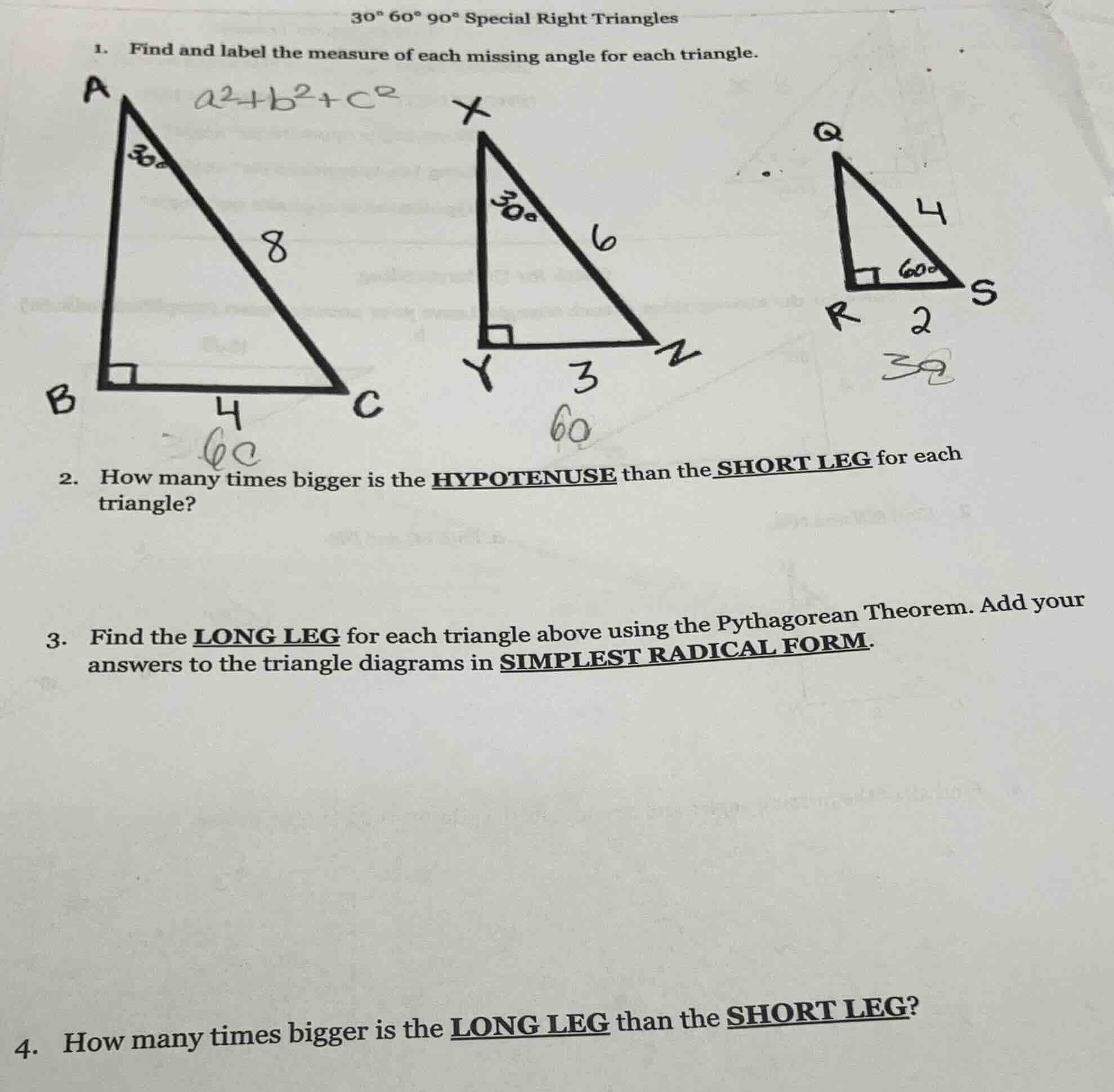
30° 60° 90° special right triangles
- find and label the measure of each missing angle for each triangle.
- how many times bigger is the hypotenuse than the short leg for each triangle?
- find the long leg for each triangle above using the pythagorean theorem. add your answers to the triangle diagrams in simplest radical form.
- how many times bigger is the long leg than the short leg?
---
Question 1: Find Missing Angles
Step1: Triangle ABC: Sum angles to 180°
$\angle C = 180^\circ - 90^\circ - 30^\circ = 60^\circ$
Step2: Triangle XYZ: Sum angles to 180°
$\angle Z = 180^\circ - 90^\circ - 30^\circ = 60^\circ$
Step3: Triangle QRS: Sum angles to 180°
$\angle Q = 180^\circ - 90^\circ - 60^\circ = 30^\circ$
---
Question 2: Hypotenuse vs Short Leg
Step1: Triangle ABC: Identify sides
Short leg $BC=4$, Hypotenuse $AC=8$
$\frac{8}{4}=2$
Step2: Triangle XYZ: Identify sides
Short leg $YZ=3$, Hypotenuse $XZ=6$
$\frac{6}{3}=2$
Step3: Triangle QRS: Identify sides
Short leg $RS=2$, Hypotenuse $QS=4$
$\frac{4}{2}=2$
---
Question 3: Find Long Leg (Pythagorean Theorem: $a^2 + b^2 = c^2$, rearranged to $b=\sqrt{c^2 - a^2}$)
Step1: Triangle ABC: Calculate long leg AB
$AB = \sqrt{8^2 - 4^2} = \sqrt{64-16} = \sqrt{48} = 4\sqrt{3}$
Step2: Triangle XYZ: Calculate long leg XY
$XY = \sqrt{6^2 - 3^2} = \sqrt{36-9} = \sqrt{27} = 3\sqrt{3}$
Step3: Triangle QRS: Calculate long leg QR
$QR = \sqrt{4^2 - 2^2} = \sqrt{16-4} = \sqrt{12} = 2\sqrt{3}$
---
Question 4: Long Leg vs Short Leg
Step1: Triangle ABC: Compare legs
$\frac{4\sqrt{3}}{4}=\sqrt{3}$
Step2: Triangle XYZ: Compare legs
$\frac{3\sqrt{3}}{3}=\sqrt{3}$
Step3: Triangle QRS: Compare legs
$\frac{2\sqrt{3}}{2}=\sqrt{3}$
---

Snap & solve any problem in the app
Get step-by-step solutions on Sovi AI
Photo-based solutions with guided steps
Explore more problems and detailed explanations
- Missing angles:
- Triangle ABC: $\angle C = 60^\circ$
- Triangle XYZ: $\angle Z = 60^\circ$
- Triangle QRS: $\angle Q = 30^\circ$
- For all triangles, the hypotenuse is 2 times bigger than the short leg.
- Long legs (simplest radical form):
- Triangle ABC: $AB = 4\sqrt{3}$
- Triangle XYZ: $XY = 3\sqrt{3}$
- Triangle QRS: $QR = 2\sqrt{3}$
- For all triangles, the long leg is $\boldsymbol{\sqrt{3}}$ times bigger than the short leg.