QUESTION IMAGE
Question
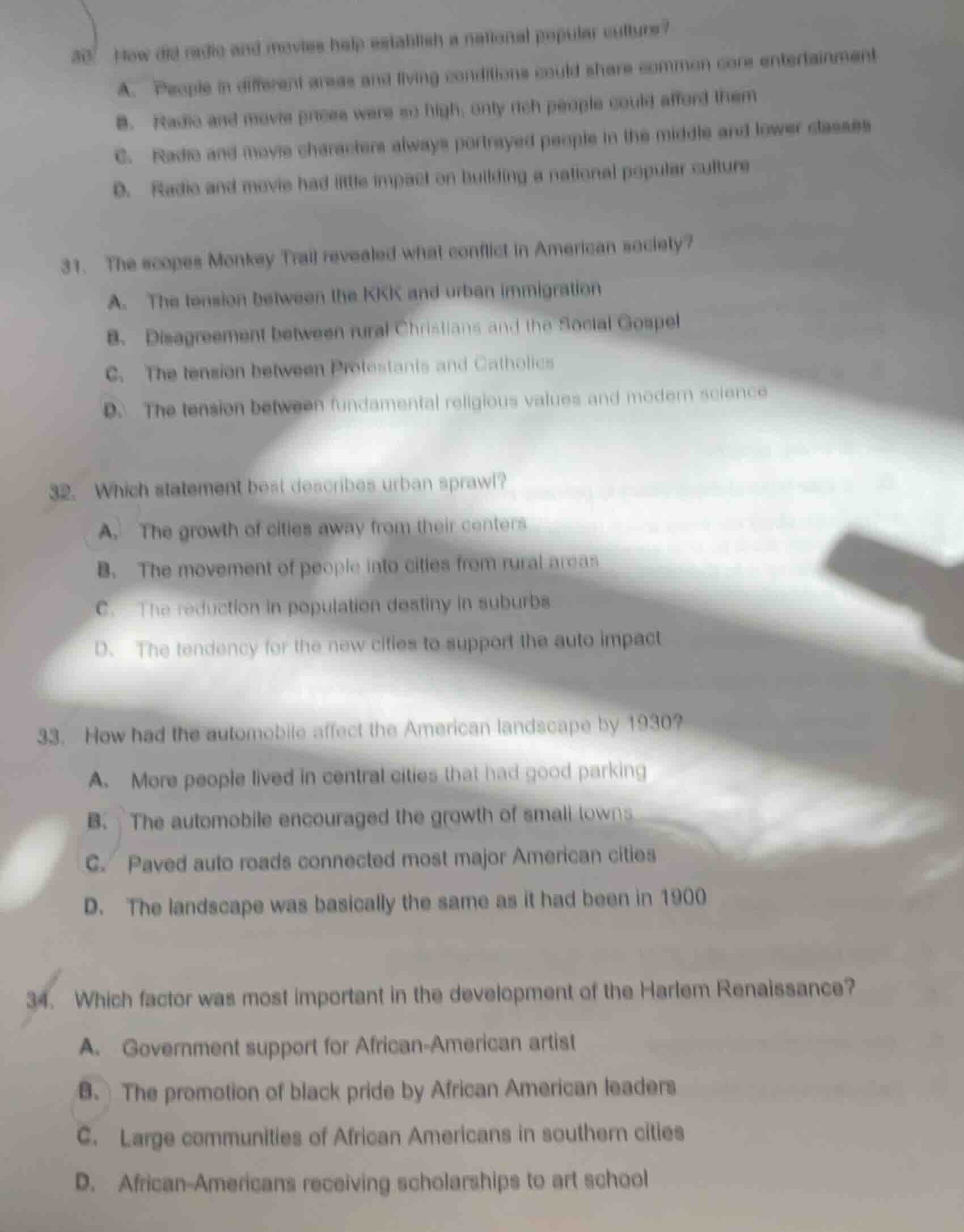
30 how did radio and movies help establish a national popular culture?
a. people in different areas and living conditions could share common core entertainment
b. radio and movie prices were so high, only rich people could afford them
c. radio and movie characters always portrayed people in the middle and lower classes
d. radio and movie had little impact on building a national popular culture
- the scopes monkey trail revealed what conflict in american society?
a. the tension between the kkk and urban immigration
b. disagreement between rural christians and the social gospel
c. the tension between protestants and catholics
d. the tension between fundamental religious values and modern science
- which statement best describes urban sprawl?
a. the growth of cities away from their centers
b. the movement of people into cities from rural areas
c. the reduction in population density in suburbs
d. the tendency for the new cities to support the auto impact
- how had the automobile affect the american landscape by 1930?
a. more people lived in central cities that had good parking
b. the automobile encouraged the growth of small towns
c. paved auto roads connected most major american cities
d. the landscape was basically the same as it had been in 1900
- which factor was most important in the development of the harlem renaissance?
a. government support for african - american artist
b. the promotion of black pride by african american leaders
c. large communities of african americans in southern cities
d. african - americans receiving scholarships to art school
Question 30
To determine how radio and movies helped establish a national popular culture, we analyze each option:
- Option A: Radio and movies allowed people across different regions and circumstances to access and share the same entertainment, which fostered a national popular culture. This makes sense as these media could reach a wide audience.
- Option B: If only rich people could afford radio and movies, they wouldn't help establish a national popular culture (since most people couldn't participate). So this is incorrect.
- Option C: Radio and movie characters didn't always portray middle and lower classes, and this isn't the main way they established national popular culture. So this is incorrect.
- Option D: Radio and movies had a significant impact on popular culture, so this is incorrect.
The Scopes Monkey Trial was about the teaching of evolution (modern science) versus creationism (based on fundamental religious values). Let's analyze the options:
- Option A: The KKK and urban immigration were not the focus of the Scopes Trial. So this is incorrect.
- Option B: The Social Gospel is about applying Christian principles to social problems, not related to the Scopes Trial's conflict. So this is incorrect.
- Option C: The trial wasn't about Protestant - Catholic tension. So this is incorrect.
- Option D: The trial revealed the tension between fundamental religious values (opposing evolution teaching) and modern science (supporting evolution as a scientific theory). This matches the nature of the Scopes Monkey Trial.
Urban sprawl is defined as the expansion of cities outward from their central areas. Let's analyze the options:
- Option A: This matches the definition of urban sprawl, as cities grow away from their centers into surrounding areas.
- Option B: The movement of people into cities from rural areas is urbanization, not urban sprawl. So this is incorrect.
- Option C: Urban sprawl is about city growth, not population density reduction in suburbs. So this is incorrect.
- Option D: Urban sprawl is about city growth, not related to new cities supporting auto impact. So this is incorrect.

Snap & solve any problem in the app
Get step-by-step solutions on Sovi AI
Photo-based solutions with guided steps
Explore more problems and detailed explanations
A. People in different areas and living conditions could share common core entertainment