QUESTION IMAGE
Question
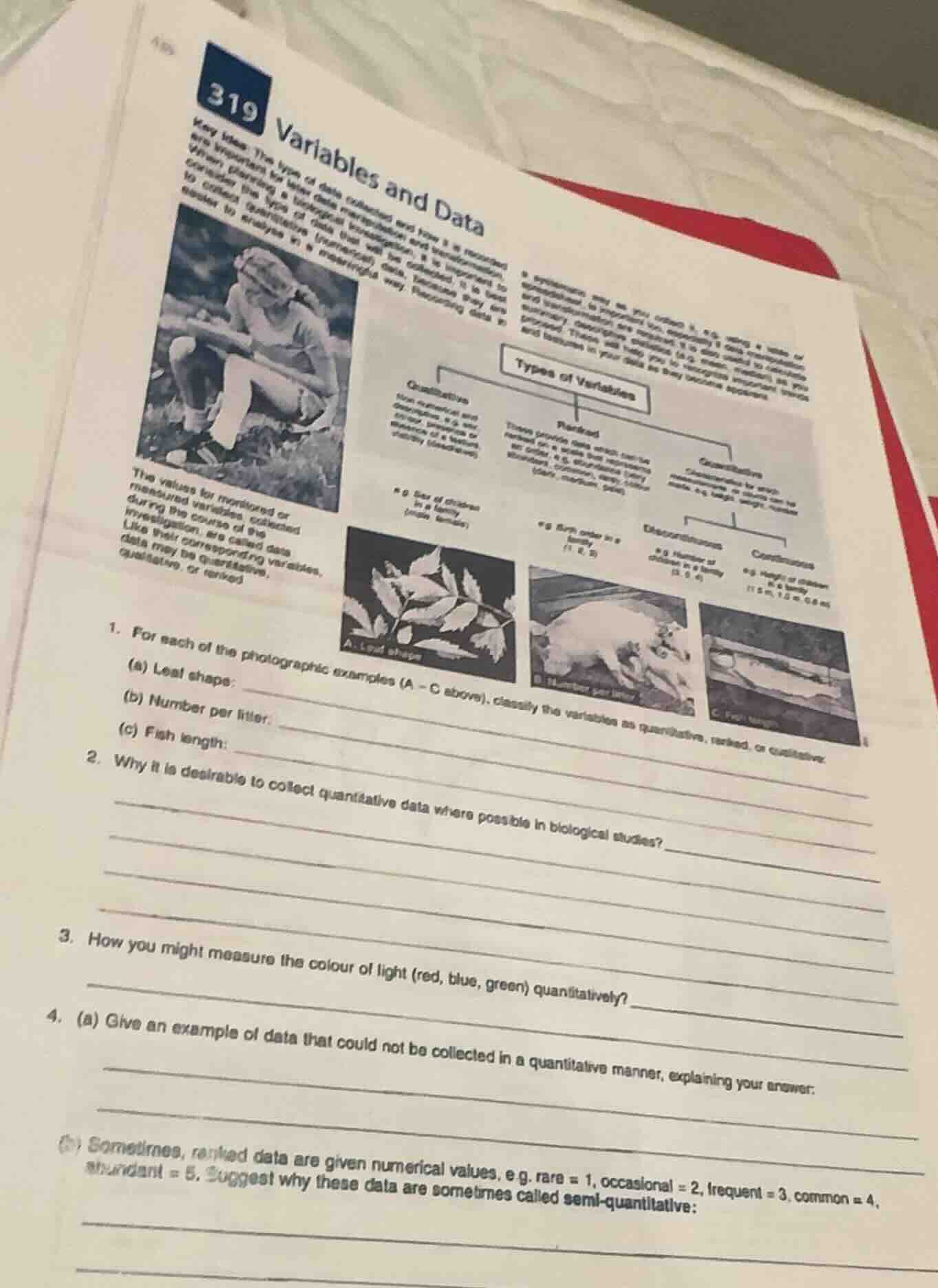
319 variables and data key idea: the type of data collected and how it is recorded are important for later interpretation and presentation. when planning a biological investigation, it is important to consider the type of data that will be collected. they are to collect the appropriate (quantitative, ranked, or qualitative) data. recording data in a manner to analyze it is a meaningful way. the values for monitored or measured variables, collected during the course of the investigation, are called data. like their corresponding variables, data may be quantitative, qualitative, or ranked. 1. for each of the photographic examples (a – c above), classify the variables as quantitative, ranked, or qualitative. (a) leaf shape: ______ (b) number per litter: ____ (c) fish length: ____ 2. why it is desirable to collect quantitative data where possible in biological studies? ____ 3. how you might measure the colour of light (red, blue, green) quantitatively? ____ 4. (a) give an example of data that could not be collected in a quantitative manner, explaining your answer: ____ (b) sometimes, ranked data are given numerical values, e.g. rare = 1, occasional = 2, frequent = 3, common = 4, abundant = 5. suggest why these data are sometimes called semi - quantitative: ______
Question 1 (a) - Leaf shape
Leaf shape is a non - numerical characteristic used to describe leaves. Qualitative variables are non - numerical and are used to categorize or describe attributes. So leaf shape falls under the qualitative variable type.
The number of offspring per litter is a countable quantity (e.g., 1, 2, 3 etc.). Discrete quantitative variables are numerical values that can be counted. So the number per litter is a discrete quantitative variable.
Fish length can take on any value within a certain range (e.g., 1.5 cm, 2.34 cm etc.). Continuous quantitative variables are numerical values that can take on any value in an interval. So fish length is a continuous quantitative variable.

Snap & solve any problem in the app
Get step-by-step solutions on Sovi AI
Photo-based solutions with guided steps
Explore more problems and detailed explanations
Qualitative