QUESTION IMAGE
Question
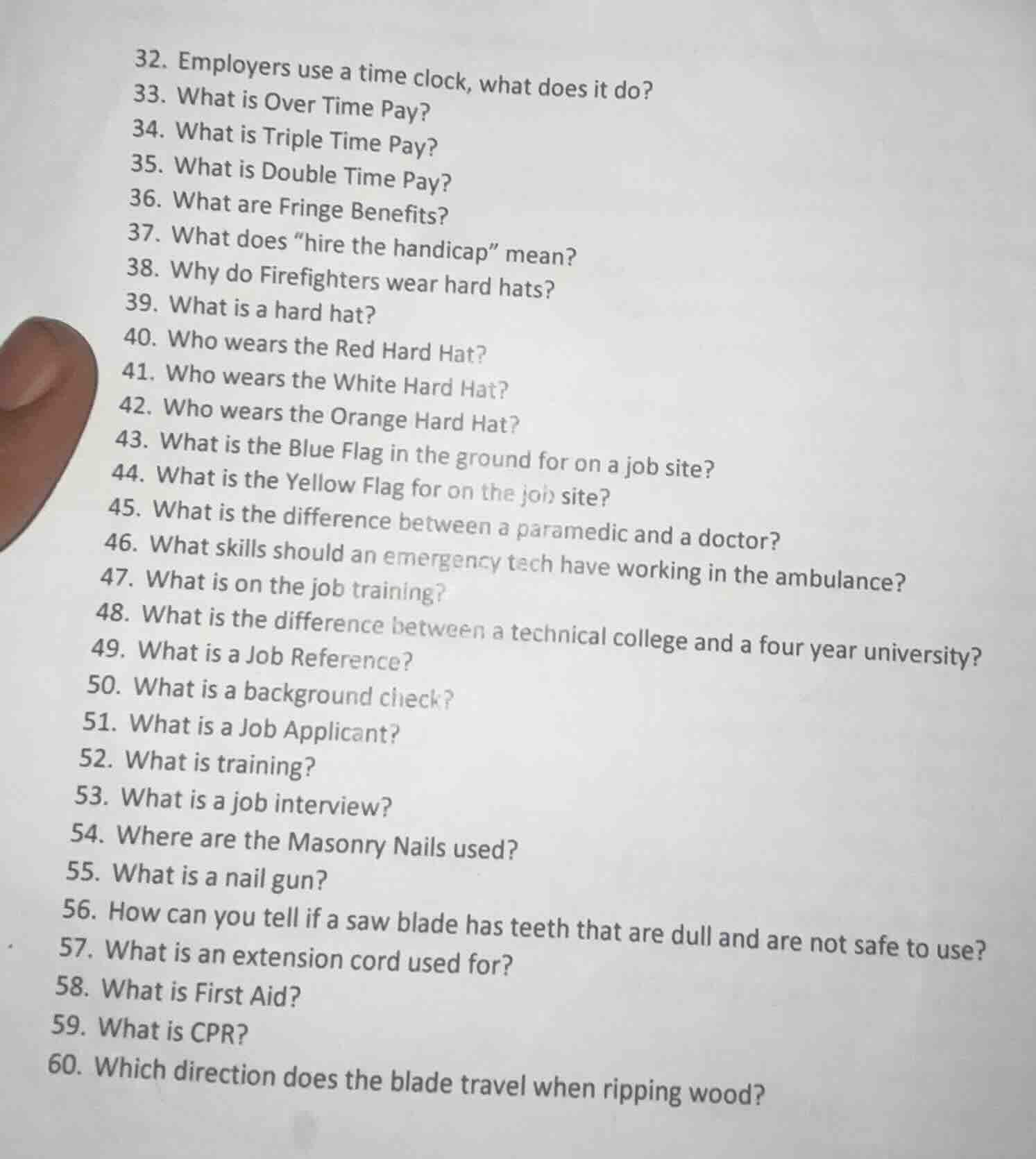
- employers use a time clock, what does it do?
- what is over time pay?
- what is triple time pay?
- what is double time pay?
- what are fringe benefits?
- what does \hire the handicap\ mean?
- why do firefighters wear hard hats?
- what is a hard hat?
- who wears the red hard hat?
- who wears the white hard hat?
- who wears the orange hard hat?
- what is the blue flag in the ground for on a job site?
- what is the yellow flag for on the job site?
- what is the difference between a paramedic and a doctor?
- what skills should an emergency tech have working in the ambulance?
- what is on the job training?
- what is the difference between a technical college and a four year university?
- what is a job reference?
- what is a background check?
- what is a job applicant?
- what is training?
- what is a job interview?
- where are the masonry nails used?
- what is a nail gun?
- how can you tell if a saw blade has teeth that are dull and are not safe to use?
- what is an extension cord used for?
- what is first aid?
- what is cpr?
- which direction does the blade travel when ripping wood?
Since there are multiple sub - questions here, we'll use the Business (subfields like Management, Human Resources related which can be under 'Others' or relevant subfields) and the Answer - Explanation Format for each sub - question:
Question 32: Employers use a time clock, what does it do?
A time clock is used by employers to record the time when employees start and end their work shifts. It helps in accurately tracking the number of hours an employee works, which is essential for calculating wages, overtime, and ensuring compliance with labor regulations.
Overtime pay is the additional compensation that an employer pays to an employee for the hours worked beyond the regular working hours (usually 40 hours in a workweek in many labor regulations). The rate of overtime pay is typically higher than the regular hourly rate, often 1.5 times the regular rate.
Triple time pay means that an employee is paid three times their regular hourly rate for the hours they work. This is a higher - than - usual pay rate, often applicable in special circumstances like working on holidays or in emergency situations as per company or labor agreements.

Snap & solve any problem in the app
Get step-by-step solutions on Sovi AI
Photo-based solutions with guided steps
Explore more problems and detailed explanations
A time clock records employees' work start and end times to track work hours for wage calculation and compliance.