QUESTION IMAGE
Question
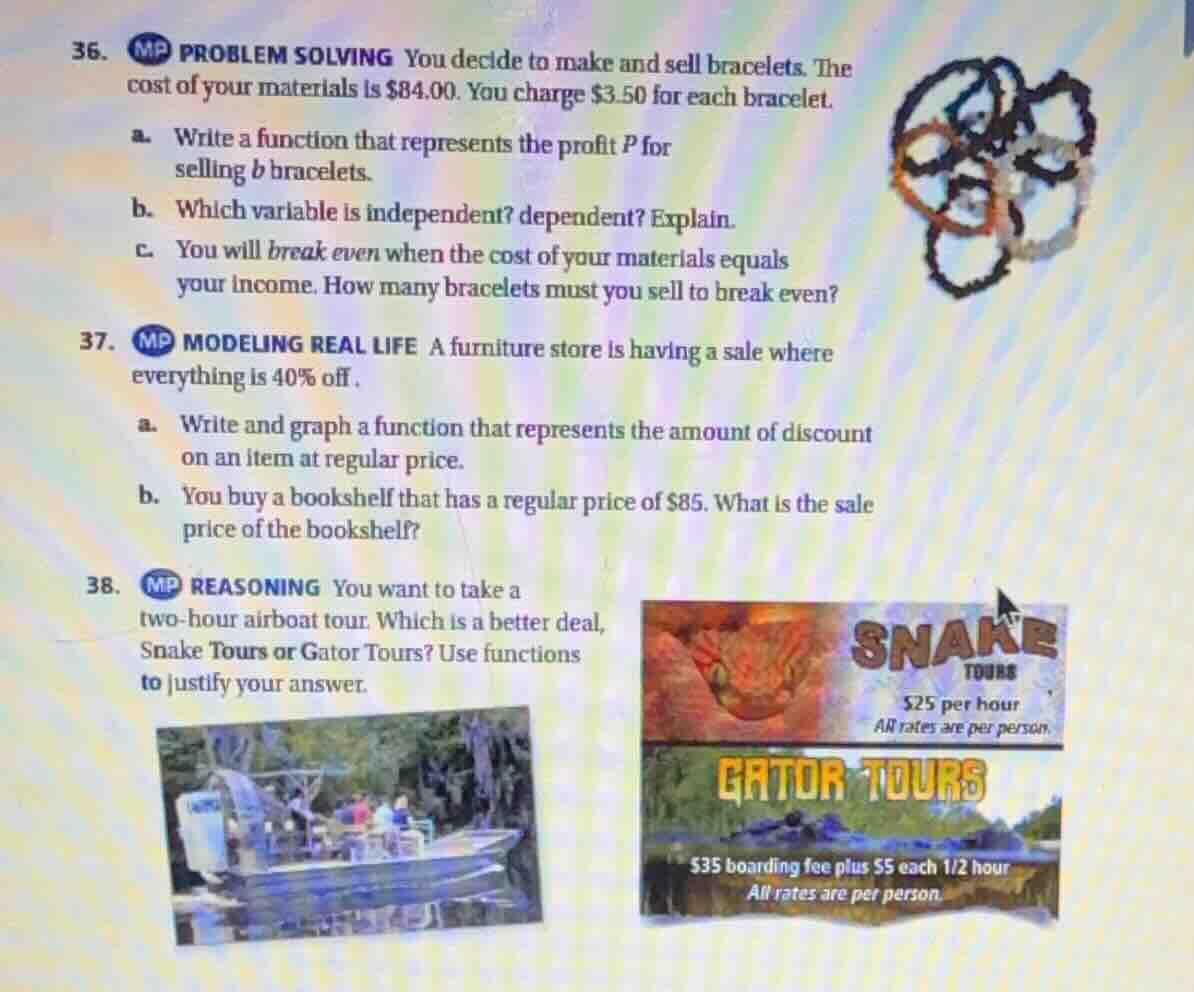
- mp problem solving you decide to make and sell bracelets. the cost of your materials is $84.00. you charge $3.50 for each bracelet.
a. write a function that represents the profit $p$ for selling $b$ bracelets.
b. which variable is independent? dependent? explain.
c. you will break even when the cost of your materials equals your income. how many bracelets must you sell to break even?
- mp modeling real life a furniture store is having a sale where everything is 40% off.
a. write and graph a function that represents the amount of discount on an item at regular price.
b. you buy a bookshelf that has a regular price of $85. what is the sale price of the bookshelf?
- mp reasoning you want to take a two-hour airboat tour. which is a better deal, snake tours or gator tours? use functions to justify your answer.
snake tours
$25 per hour
all rates are per person.
gator tours
$35 boarding fee plus $5 each 1/2 hour
all rates are per person.
Problem 36
Step1: Define profit formula
Profit = Total Income - Total Cost
Total income from selling \(b\) bracelets is \(3.50b\), fixed cost is \$84.00.
\(P = 3.50b - 84\)
Step2: Identify independent/dependent
Independent variable: \(b\) (number of bracelets sold, it is controlled freely). Dependent variable: \(P\) (profit depends on the number of bracelets sold).
Step3: Calculate break-even point
Set profit \(P=0\) (cost = income):
\(0 = 3.50b - 84\)
Solve for \(b\):
\(3.50b = 84\)
\(b = \frac{84}{3.50} = 24\)
Step1: Define discount function
Let regular price = \(p\), discount = \(d\). 40% off means discount is 40% of regular price.
\(d = 0.40p\)
(Graph: Linear line through origin, slope = 0.40, x-axis = regular price, y-axis = discount)
Step2: Calculate sale price
Sale price = Regular price - Discount
Discount = \(0.40 \times 85 = 34\)
Sale price = \(85 - 34 = 51\)
Step1: Define cost function for Snake Tours
Cost = Hourly rate × Hours
\(C_s = 25t\), where \(t=2\) hours
\(C_s = 25 \times 2 = 50\)
Step2: Define cost function for Gator Tours
1/2 hour rate = \$5, so hourly rate = \$10. Cost = Boarding fee + (Hourly rate × Hours)
\(C_g = 35 + 10t\), where \(t=2\) hours
\(C_g = 35 + 10 \times 2 = 55\)
Step3: Compare costs
\(50 < 55\), so Snake Tours is cheaper.

Snap & solve any problem in the app
Get step-by-step solutions on Sovi AI
Photo-based solutions with guided steps
Explore more problems and detailed explanations
a. \(P = 3.50b - 84\)
b. Independent: \(b\) (number of bracelets, set freely); Dependent: \(P\) (profit depends on \(b\))
c. 24 bracelets
---