QUESTION IMAGE
Question
- what is the difference between a foreshock, mainshock, and aftershock?
- what is an epicenter?
- what are seismic waves?
- which is faster — p waves or s waves?
- what method do scientists use to locate an earthquake?
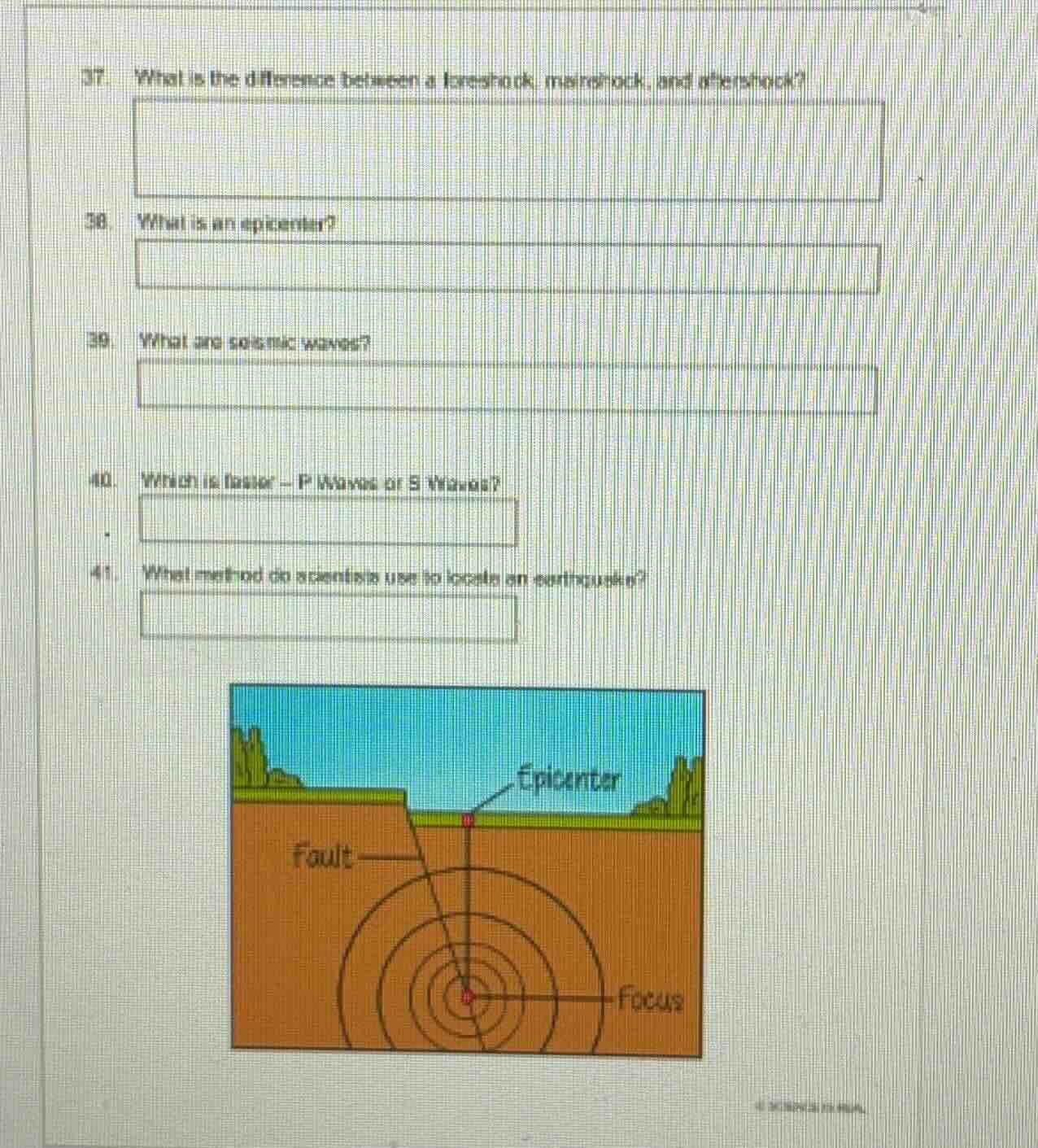
image of a cross - section of the earths crust showing fault, focus, and epicenter
Brief Explanations
- Defines each earthquake-related shock by timing and magnitude relative to each other.
- Identifies the surface point directly above an earthquake's origin.
- Describes the energy waves generated by seismic activity.
- Compares the speed of the two primary seismic wave types.
- Names the standard scientific method for pinpointing earthquake locations.

Snap & solve any problem in the app
Get step-by-step solutions on Sovi AI
Photo-based solutions with guided steps
Explore more problems and detailed explanations
- A foreshock is a smaller earthquake that occurs before the largest quake (mainshock) in the same area; the mainshock is the largest, most powerful earthquake in a sequence; an aftershock is a smaller earthquake that happens after the mainshock, near the same fault zone.
- The epicenter is the point on the Earth's surface that lies directly above the focus (the underground origin point) of an earthquake.
- Seismic waves are waves of energy that travel through the Earth's layers, generated by earthquakes, volcanic eruptions, or other seismic activity.
- P Waves (Primary Waves)
- Scientists use the triangulation method: they measure the difference in arrival times of P and S waves at three or more seismograph stations, then calculate the distance from each station to the earthquake, and plot these distances to find the common intersection point (the epicenter).