QUESTION IMAGE
Question
40 algebra, functions, and data analysis
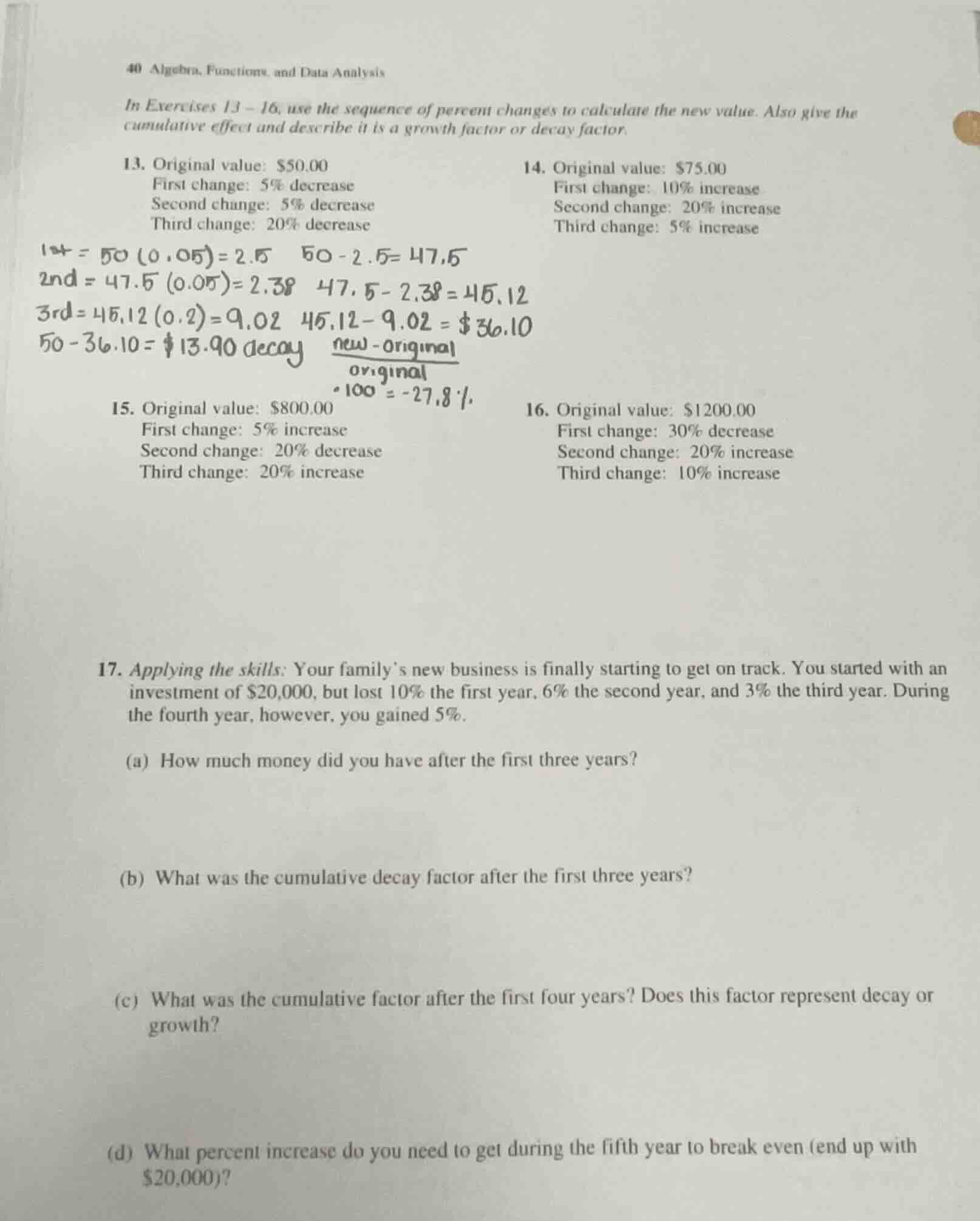
in exercises 13 - 16, use the sequence of percent changes to calculate the new value. also give the cumulative effect and describe it is a growth factor or decay factor.
- original value: $50.00
first change: 5% decrease
second change: 5% decrease
third change: 20% decrease
- original value: $75.00
first change: 10% increase
second change: 20% increase
third change: 5% increase
- original value: $800.00
first change: 5% increase
second change: 20% decrease
third change: 20% increase
- original value: $1200.00
first change: 30% decrease
second change: 20% increase
third change: 10% increase
- applying the skills: your family’s new business is finally starting to get on track. you started with an investment of $20,000, but lost 10% the first year, 6% the second year, and 3% the third year. during the fourth year, however, you gained 5%.
(a) how much money did you have after the first three years?
(b) what was the cumulative decay factor after the first three years?
(c) what was the cumulative factor after the first four years? does this factor represent decay or growth?
(d) what percent increase do you need to get during the fifth year to break even (end up with $20,000)?
For Exercises 14:
Step1: Apply 10% increase
$75.00 \times (1 + 0.10) = 75.00 \times 1.10 = 82.50$
Step2: Apply 20% increase
$82.50 \times (1 + 0.20) = 82.50 \times 1.20 = 99.00$
Step3: Apply 5% increase
$99.00 \times (1 + 0.05) = 99.00 \times 1.05 = 103.95$
Step4: Calculate cumulative effect
$\frac{103.95 - 75.00}{75.00} \times 100\% = \frac{28.95}{75.00} \times 100\% = 38.6\%$
Step1: Apply 5% increase
$800.00 \times (1 + 0.05) = 800.00 \times 1.05 = 840.00$
Step2: Apply 20% decrease
$840.00 \times (1 - 0.20) = 840.00 \times 0.80 = 672.00$
Step3: Apply 20% increase
$672.00 \times (1 + 0.20) = 672.00 \times 1.20 = 806.40$
Step4: Calculate cumulative effect
$\frac{806.40 - 800.00}{800.00} \times 100\% = \frac{6.40}{800.00} \times 100\% = 0.8\%$
Step1: Apply 30% decrease
$1200.00 \times (1 - 0.30) = 1200.00 \times 0.70 = 840.00$
Step2: Apply 20% increase
$840.00 \times (1 + 0.20) = 840.00 \times 1.20 = 1008.00$
Step3: Apply 10% increase
$1008.00 \times (1 + 0.10) = 1008.00 \times 1.10 = 1108.80$
Step4: Calculate cumulative effect
$\frac{1108.80 - 1200.00}{1200.00} \times 100\% = \frac{-91.20}{1200.00} \times 100\% = -7.6\%$

Snap & solve any problem in the app
Get step-by-step solutions on Sovi AI
Photo-based solutions with guided steps
Explore more problems and detailed explanations
New value: $\$103.95$
Cumulative effect: 38.6% growth (growth factor)
---